 |
|
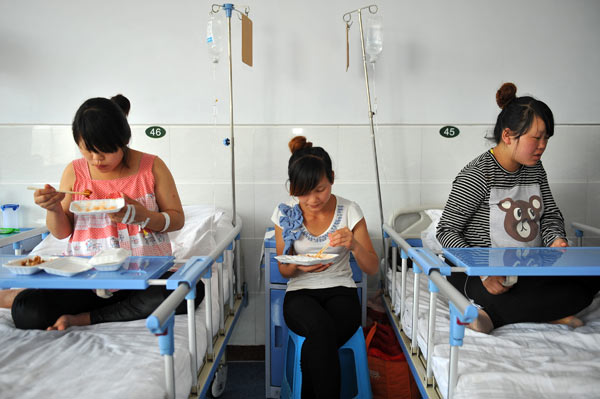
Pregnant women eat lunch at a county hospital in Fugu county, Shaanxi province. Basic medical insurance covered more than 95 percent of the Chinese population in 2011, forming the largest basic medical insurance network in the world. LIU XIAO / XINHUA |
Unified system urgently needed to protect migrants, report He Na in Beijing and Han Junhong in Jilin.
An inflamed pancreas was the jab in the side Zhao Zhiqiang needed to realize that health insurance was a good idea.
"It was like torture. It was really painful, and even though it was more than six months ago, I'm still afraid of hospital drips," said the 52-year-old farmer from Huangdi village in Jilin city.
"But the most painful experience was when the nurse told me there wasn't enough money in my hospital account to cover the cost of the medicine. That happened quite a few times," he recalled.
"I wanted to pull out all the drips and go home," Zhao said.
His 23 days of hospital treatment cost more than 22,000 yuan ($3,500), almost an entire year's income for a farmer.
However, thanks to the New Rural Cooperative Medical Care System, he only had to pay about one-third of that.
Because Zhao had always been reluctant to join the insurance system, the treasurer of the program was surprised when he was the first to pay up this year.
Now Zhao has been helping persuade hesitant or unwilling villagers to join the program.
"My son had just got married and we had borrowed a lot of money from relatives to build the new house, hold the wedding and pay a dowry. If the government hadn't reimbursed most of the health cover, I would definitely have been refused treatment. It saved my life," he said.
"Before the attack, I always thought I was in good health. I thought that joining the health insurance plan would be a waste of money. It wasn't until I benefited from it that I realized it was money well spent," he said.
Statistics from the National Health and Family Planning Commission show that between the first trials of the insurance program in 2003 and the end of June 2012, more than 812 million rural residents - around 95 percent of all rural residents - were listed under the system.
"A lot of people who've worked in the fields for a long time have chronic illnesses. Afraid of spending money, they would rather endure pain than visit the doctor. It's a vicious circle that can eventually lead to serious, or even fatal, illness. The increase in the level of reimbursement provided by the New Rural Cooperative Medical Care System, or NCMS, has greatly improved the health of rural residents and their standard of living," said Liu Minghui, vice-president of the school of public finance and taxation at Dongbei University of Finance and Economics, who has conducted research into medical insurance and urbanization for more than a decade.
| ?
 |
|
Medical experts provide checkups for residents of new rural communities in Xuchang county, Henan province, as one of the services organized by the local government to boost the urbanization process. NIU SHUPEI / FOR CHINA DAILY |
On the move
Hoping to earn a better living in the city, Li Zhiwei, another member of the Huangdi village medical insurance program, sold his house and moved his entire family to Beijing in 2002.
In the first few years, Li opened a small restaurant near a school in the capital's Changping district. Business was good, but the government demolished many of the buildings as part of a redevelopment plan. In addition, the rent began to soar so Li and his family had little option but to move further out to the northern suburbs. Failing to find a suitable room at a reasonable rent, they dropped the idea of reopening their restaurant and began doing odd jobs at nearby construction sites.
Because neither Li nor his wife had construction industry experience, their wages were quite low. After paying the rent and their daily expenses, plus providing funds for their student daughter, they were unable to put money aside in the form of savings.
In May last year, Li took a heavy fall down a set of stairs at a construction site, which resulted in a broken leg and two cracked ribs. His workmates sent him to a nearby hospital for treatment, but the 20,000 yuan medical fee meant he discharged himself just a week after undergoing surgery on his leg, even though the doctor urged him to stay.
Although Li had joined the health insurance program in his village, he didn't have a transfer agreement with the hospitals assigned by his health insurance. That meant he was unable to claim for reimbursement of his medical costs because he was treated at a hospital outside the district in which he held hukou, the Chinese system of home registration. To make matters worse, Li's boss didn't provide basic medical insurance for his employees, so Li was left to foot the bill himself.
"We've been living in Beijing for more than 10 years, but we still don't feel as though we belong here or are part of the city. We had planned to buy a house and stop moving from district to district, but the longer we stay, the more desperate we become. The only way we can hope to become Beijingers now is if my daughter can find a Beijing husband with property," he said with a bitter smile.
"I have often dreamed that one day I would take my wife and daughter back to our home village in glory. But now I think it may never happen," he said.
Two-tier system
|
What's in a name? There's a tradition in China, whereby children are often named after major events. For example, many women in their 50s who were born just after the Korean War (1950-53) have the name Kangmei, which means "Anti-United States", while many men bear the name Yuanchao, which means "Aiding the Democratic People's Republic of Korea". The tradition survives in many parts of China, especially in Sichuan province where a newborn girl brought a new dimension to the practice in 2006. She was named after the New Rural Cooperative Medical Care System, called Xin Nong He in pinyin - the system by which Chinese characters are rendered in the Roman alphabet. The girl's mother Wang Haifang attended Jiange county health center for a pre-natal examination on Jan 1, 2006. She had planned to give birth at home to save on medical bills, but the doctor told her she would be eligible to reimbursement of 100 yuan ($16) if she participated in the NCMS. Wang registered at once and her daughter was born the following morning. Because she was the first child born after the county joined the NCMS, her grandfather suggested calling her Wei Xinhe, or "New Cooperation". |
China had 262.61 million migrant workers in 2012, according to official data from the National Bureau of Statistics, but Dai Baozhen, vice-president of the school of management at Jiangsu University believes the real figure could be much higher.
The second generation of migrant workers is totally different from the first. People are heading to the cities not only to earn a living, but also to settle down and, unlike their parents, many choose to take their families with them.
"More farmers are now expected to pour into cities and towns to seek a new life after Premier Li Keqiang pledged that migrant workers would enjoy the same benefits as urban residents. However, there are many difficulties to overcome before that goal can be realized. One of them is the provision of effective medical insurance," said Dai.
Professor Liu Minghui attributed the differences between the treatment received by Zhao and Li to the nature of the urban-rural divide, which has resulted in a two-tier medical insurance system.
"Because of their special situation, migrant workers occupy a gray area between the Basic Medical Insurance System for Urban Employees and the NCMS," said Liu.
"The NCMS mainly provides health care for permanent rural residents but, in an ideal world, migrant workers would also be provided for under this system. However, although these people have spent a long time working and living in the cities and towns, if they want to benefit from the welfare system, they have to go back to the place where they have hukou. But that would be extremely expensive, of course, and if they have a serious illness, time is also a factor. Therefore, it's hard for them to gain any real benefits from the NCMS," he said.
Migrant workers are classified as urban residents when official statistics are collated, but compared with genuine urban residents, migrant workers rarely enjoy the same access to welfare, Liu said.
"Since China launched the reform and opening-up policy at the end of the 1970s, the national labor force has become much more mobile. The main flow trend is from undeveloped inland areas to developed coastal areas. The huge disparity in the levels of economic development from region to region has resulted in major differences in the levels of medical insurance cover and welfare," said Bai Chong'en, vice-president of Tsinghua University's school of economics and management, at the China Development Forum 2013 held in Beijing in March.
"At present, medical insurance falls within the scope of each city, but the situation differs from each province and region and that has limited the transfer of reimbursement for medical fees from place to place and hindered the flow of labor resources," said Bai.
Under the State Council's 12th Five-Year Plan for Social Security (2011-2015), the relevant government departments are obliged to formulate ways of ensuring that medical payments can be reimbursed no matter where a patient receives treatment, whether it's the place where they hold household registration or not.
"It's not the first time the central government has made this stipulation, but so far the effects have not been obvious," said Bai.
Reforming the hukou
Liu used Shenmu county in Shaanxi province as an example of forward thinking. Shenmu isn't the richest county in China, but it provides free medical treatment for its residents in an attempt to solve two major problems facing the health system; poor access and high fees.
"It will be a good test of whether the government is really service-oriented. The program is vital to ensure that people enjoy better and higher medical insurance," she said.
Speeding up reform of the house registration system and removing the limitations imposed by the relationship between hukou and welfare is vital to solving the challenges arising from the urbanization process, including medical insurance, said Dai.
However, reform of the household registration system will not be achieved over a short period and Liu Minghui called on the government to conduct a survey of migrant workers to ascertain ages, jobs and terms of employment. Those in stable work and who have lived in towns for many years should enjoy the same medical insurance benefits as urban workers. The others can be listed in the urban residents' medical insurance system.
Many migrant workers change their jobs and locations frequently and so it's essential that the authorities establish a sound and simple system of medical insurance transfer between their hometowns and villages and their places of work, she added.
Wu Ming, vice-president of Peking University's school of public health, said, "Although the country has enacted several laws and regulations relating to the medical security of migrant workers, they still need to be further improved and more detailed."
Research conducted by the school shows that migrant workers visit hospital far less frequently than urban residents; 11 percent of them don't bother with treatment if they fall sick, while 65 percent choose to treat themselves with oral medicines and eating foods they believe promote good health. Only 24 percent visit a doctor. That means the risk of disease has become a major factor in the falling living standards of migrant workers.
"The lack of medical security not only affects the physical and mental health of migrant workers, but hampers the pace of urbanization as well. It has also become an increasing cause of social unrest," said Wu Ming.
The aim of developing the medical security system for migrant workers is not only to solve the dilemma that many face, but to establish a system that will benefit everybody, no matter whether they are urban or rural residents, added Wu.
"We need to raise basic medical insurance as a whole, from the current city level to a national level. In the meantime, we have to accelerate the pace at which we merge the different types of medical insurance into a fully national system," said Wu.
Contact the writer at hena@chinadaily.com.cn.
Jiang Xueqing contributed to this story.
|
|
|
|
|
|
|
|

Copyright 1995 - . All rights reserved. The content (including but not limited to text, photo, multimedia information, etc) published in this site belongs to China Daily Information Co (CDIC). Without written authorization from CDIC, such content shall not be republished or used in any form. Note: Browsers with 1024*768 or higher resolution are suggested for this site.
License for publishing multimedia online 0108263 Registration Number: 20100000002731 












 Op Rana
 Berlin Fang
 Zhu Yuan
 Huang Xiangyang
 Chen Weihua
 Liu Shinan