|
|
 |
|
30th Anniversary Celebrations
Economic Development
New Rural Reform Efforts
Political System Reform
Changing Lifestyle
In Foreigners' Eyes
Commentary
Enterprise Stories
Newsmakers
Photo Gallery
Video and Audio
Wang Wenlan Gallery
Slideshow
Key Meetings
Key Reform Theories
Development Blueprint
Alexis Hooi:
Going green in tough times   Hong Liang:
Bold plan best option for economy   Raymond Zhou:
True story of police brutality  Message from the cradle of reform
By Fu Jing (China Daily)
Updated: 2008-10-22 11:51 Zhu Gang and his wife get up early. After helping get in the family's crops from the autumn harvest, the 29-year-old is ready to return to a home appliance assembly line in Suzhou, China's "Garden City" close to the east coast.
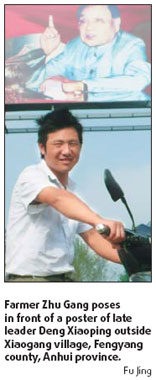
After packing a few clothes into Zhu's traveling bag, the couple ride their motorcycle out of Xiaogang village in Anhui province to catch a long distance bus. Reluctant to part again with her husband, his wife's eyes well up with tears as she watches him pose for a photograph in front of a poster of Deng Xiaoping, the late leader who started China's economic reform. She had been holding back her tears for the past few days because she knows the next time when she would see him again would be around the Chinese lunar new year in late January. The poster is of Zhu's own choosing, for he has picked up quite a few urban habits of posing against large billboards and posters. But true to her rural background, the wife remains camera-shy. "This coming-and-going has long been part of our life," says Zhu, who first left home for work when he was just 16. His first destination was the southern Chinese city of Shenzhen, the country's largest "special economic zone" that borders Hong Kong. Then he shifted to Shanghai, China's business hub and the best place for someone to get a job - a shift from the economic center of the Pearl River Delta to the Yangtze River Delta.
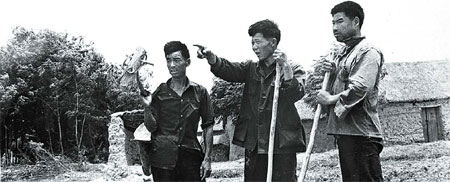
The "life" Zhu refers to is true of about 200 million other rural households. For almost three decades now, members of such rural families have been living a life interspaced by short, happy reunions and long, and at times painful, separation. The scene played out by Zhu just before he left his home in the Fengyang county village has become common in almost every Chinese village - with parents waving to their sons and daughters, wives kissing their husbands goodbye, and wives leaving behind husbands. Workers like Zhu have been the driving force behind China's rapid industrial growth. They send money back to their families and relatives, helping the rural economy to grow, too. In more recent years, with the gradual relaxation in the urban residential rules (which earlier was biased against rural people), some workers have stopped moving between villages and cities, for they have moved their families to urban settlements where they hold permanent jobs or business interests. But few people outside China know the entire process started from Zhu's village of Xiaogang. Back in 1978, Xiaogang was a poor village, struggling to recover from the long periods of chaotic political campaigns and rigid collective farming. Many children went to bed hungry, and as many as 80 percent of the villagers had resorted to begging in some other places at least once. The change came after a group meeting, called by Yan Hongchang and attended by 18 families in the village decided to divide the collective commune's land and hand it over individuals. Such practice used to be seen as promotion of capitalism, a label for the politically incorrect, and hence it was banned. So to seek a minimum level of self-protection, the 18 families signed a secret agreement to share the loss and gains from the land in future. The result surprised even Xiaogang villagers. Deng Xiaoping asked villages across the country to follow Xiaogang's example, citing it as China's first successful attempt to break away from the old, ineffective pattern of agricultural development. What followed after that is well known to the world, and is seen as the beginning of reforms in China. Yan is all of 60 years old now. But he is still busy on his family plot (where he grows rice and corn) and remains a staunch believer in the path he chose: "Tell me about another system in the world that can motivate farmers to get up at midnight to water their paddy fields," he says proudly.
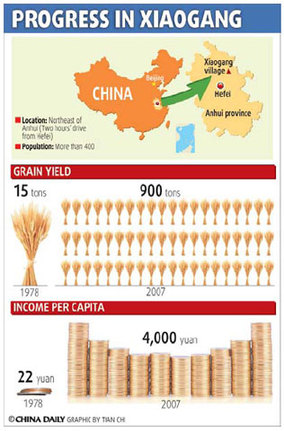
"Collective responsibility may sound good, but if it's not tied to individual behavior, it means no responsibility," he says, recalling his days 30 years ago. He maintains his habit of checking the water level and pest control at midnight in his family's 1.5-hectare plot. Yan lives comfortably in a three-story house with his five sons and daughters. Some of these had once followed their mother to seek alms 30 years ago. The system that Xiaogang village started for China is officially called the household-responsibility farming system. "It is indeed about responsibility," he says. "The entire process of reform in China is about that. Only with a growing sense of responsibility can a farmer grow more food." The stress on individual responsibility and its rewards raised China's grain output from 300 million tons in 1978 to 400 million tons in 1984, and then to 500 million tons last year. It is expected to cross the last figure this year. Even in the "beggars' village" of Xiaogang, the total grain yield has risen from 15 tons in 1978 to 900 tons in 2007, a 60-fold increase. Its per capita cash income has soared, too, from 22 yuan to about 4,000 yuan. Every family in the village has enough food today and good enough shelter. Most of the families own motorcycles and farm equipment. Some of them have even leased out part of their land (converted into a vineyard) to a Shanghai-based company and small local enterprises. All working age villagers not engaged in farming have jobs in other sectors. To reward the local farmers for their 1978 initiative, and to prepare for the celebration of China's economic reform, the Fengyang county government recently gave 10,000 yuan each to Xiaogang households to rebuild their homes. That came as a big relief to the families, most of which had been under some debt after borrowing money to build new homes that cost about 100,000 yuan each. Yan is still an "amateur thinker", wracking his brains on how to improve China's rural development policies. For him, land is still the basic guarantee of life for farmers. That is why he is still against returning to collective farming or administratively structured cooperative farming. Nor does he favor what he calls "image-building projects", started by some officials, because they expose farmers to greater risks. Instead, he says farmers should be encouraged to lease their farmland to industrial houses. Twenty-three Xiaogang farmers are earning above-average income by leasing their plots, he says. "Leasing is a risk-reducing mechanism." What about Zhu? Can't he be a role model for today's farmers? Yan says "no", because a person can "either be a farmer or a worker". Zhu's lifestyle is not the logical result of rural reforms, Yan says. Zhu cannot become a fulltime farmer and pay for all his expenses, especially the medical cost for his parents and the tuition fees for his two children. He is not a complete urban dweller either because not having a permanent job prevents him from moving his family to a city. This is where government help is important. It has to help farmers like Zhu to lead a better life, Yan says. And hopefully it will, he added.

|
       |
久久久无码人妻精品无码_6080YYY午夜理论片中无码_性无码专区_无码人妻品一区二区三区精99