


Historical starting point for new stage of development









 |
The context of the 19th CPC National Congress is the grand vision for China presented by CPC Central Committee General Secretary Xi Jinping, who is now the "core" of "the CPC Central Committee and of the whole Party". It is an epic narrative of what China has remarkably achieved, what China has yet to do, and what China envisages as necessary to become a great nation.
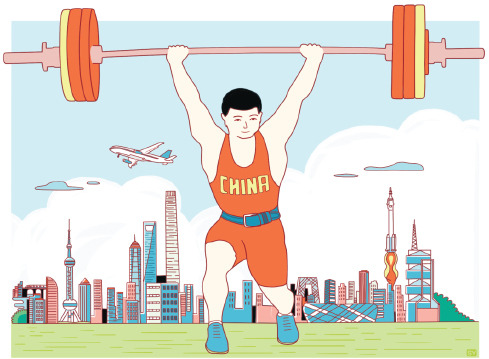
Xi's grand vision is famously expressed as "the Chinese Dream", described as "the great rejuvenation of the Chinese nation", which has personal and national implications. It is specified by two overarching goals: the two centenary goals of establishing a moderately prosperous society by 2020-the 100th anniversary of the CPC is 2021-and establishing China as a "fully modernized, socialist nation" by the 100th anniversary of the People's Republic of China in 2049.
The first goal, which includes the total elimination of extreme poverty in the country, will likely be achieved within the five-year term of the 19th CPC National Congress. It is the second goal that is of special interest at this time, because in drawing the roadmap and formulating the policies to achieve China's mid-century goal, this Congress may set the agenda for the next 30-plus years.
The CPC national congresses are the highest authority of CPC governance and decision-making. The CPC constitutional provision of holding congresses every five years was reaffirmed by Deng Xiaoping in the early days of reform (in part to establish order and collective responsibility after a period of chaos and political vicissitudes), and since 1982, Party congresses have been held scrupulously on schedule.
The congresses establish the senior leadership of the Party and hence the nation by electing the CPC Central Committee, which in turn elects all top Party positions, and also the Central Commission for Discipline Inspection; review and assess the achievements and challenges over the five years since the previous Party Congress; set the vision, goals and objectives, agenda and priorities for the subsequent five years; revise the Party constitution (to keep up with the times); and project an image of unified purpose and direction to engender national confidence and commitment.
The review and assessment of the previous five years and setting the agenda and priorities for the subsequent five years are formally presented in the Report, delivered by the general secretary representing the outgoing Central Committee and thus reflecting the consensus view of the Party leadership. Ratified by the congress (after minor modifications), it becomes the guiding document that drives policy for the incoming Central Committee.
On the day following a congress, the first plenum of the new 19th Central Committee is convened to elect the Party's new senior leadership, including the Political Bureau, the Standing Committee of the Political Bureau (to which, in essence, everything in China reports), and the general secretary of the Central Committee. Also approved are the Central Military Commission (which oversees the People's Liberation Army), the Secretariat (which runs Party daily operations), and the head of the Central Commission for Discipline Inspection.
The planning for the national Party Congress follows similar patterns. Beginning more than a year in advance, it involves both formal and informal processes. The formal process includes the election or appointment of about 2,300 delegates (2,280 delegates at the 19th National Congress) from among the Party's over 89 million members, at all levels and in all sectors, and the preparation of the Report via an elaborate system of extensive research in targeted areas (involving thousands of experts), solicitation of broad input, drafts (or sections) circulated to numerous Party experts and officials for comments, and iterative intense reviews by higher bodies and senior leaders. In addition, smaller groups are assigned the more sensitive tasks of amending the Party constitution and recommending candidates for the new Central Committee and senior leadership positions.
Final decisions for this year's congress, as well as final edits of the Report, were made at the Seventh Plenum of the 18th CPC Central Committee, held on Oct 11 to 14, days prior to the opening ceremony of the 19th CPC National Congress.
To understand the position and role of CPC Central Committee General Secretary Xi at the 19th Party National Congress, we should appreciate what it means for Xi to be the core. It was in October 2016, at the Sixth Plenum of the 18th CPC Central Committee, that Xi was designated the "core" of the CPC Central Committee and of the entire Party. The appellation was an unambiguous assertion that China requires strong leadership to maintain stability and ensure development given China's unprecedented, complex challenges: domestically, slower growth, industrial overcapacity, endemic pollution, unbalanced development, income disparity, social injustice, social service demands; and internationally, regional conflicts, sluggish economies, volatile markets, trade protectionism, ethnic clashes, terrorism, geopolitical rivalries, and territorial disputes.
Moreover, because China must deepen reform to achieve the goal of being a moderately prosperous society, the resistance of entrenched interest groups must be overcome. In fact, the necessity of having a leadership core to maintain stability and expedite reform was a primary factor relating to Xi's elevation to be the core.
In addition, not only does Xi have the responsibility for China's transformation; he is also accountable for it. He has shown courage in combating rampant practice of graft, bribery and illicit patronage. Xi's relentless anti-corruption campaign is altering how officials in government and managers in industry work, and even how they think. And let no one assume that Xi's battle against corruption has been risk-free.
Xi as the core does not change the Party's cardinal principle of "democratic centralism". The Party says it is encouraging the democratic solicitation of input and feedback from Party members, lower-ranked officials, and the general public; and strengthening centralism through Xi's core leadership.
In a complex world, given the diverse interests and forces in Chinese society, the Party asserts that the Chinese Dream cannot be realized without unity. Strong leadership is required to build and maintain unity for China to continue its development.
When Xi received the core appellation, he was already general secretary of the Party, chairman of the Central Military Commission, and president of the country-the three highest leadership positions in China-so how does being the "core" augment his perceived stature or actual power?
The 2016 Party plenum communique confirmed that "the collective leadership system … must always be adhered to". Nonetheless, there must have been shifts in terms of both the setting of the agenda and making final decisions-or else making Xi the core would have little meaning.
When foreigners dismiss the political aphorisms of China's leaders as simplistic sloganeering, they miss an opportunity to enrich their understanding. Chinese officials certainly hold Xi's frameworks in high esteem.
Xi's thought for the Party, the inner-Party directives, include the "eight regulations" (against waste and perks); "four self-confidences" (in the country's development path, theories, systems, culture of socialism with Chinese characteristics); opposing the "four evil winds" (formalism, bureaucracy, hedonism, decadence); the "four greats" (struggles, projects, enterprises, dreams).
The combined intent is to make Party members, especially Party and government officials, more dedicated, committed, competent and loyal, with exemplary moral standards of probity and rectitude. It is no small order.
The Party's unremitting anti-corruption campaign, unprecedented under Xi, has won strong public support and will certainly continue. But some foreign analysts mistakenly see Xi's anti-corruption campaign as largely a tool of political power, thus reflecting a superficial and one-dimensional understanding of China. Befitting the size and complexity of the country, for almost every decision of importance, China's leaders have multiple motivations.
For the anti-corruption campaign, these motivations include respect for the rule of law and judicial impartiality; effective functioning of the Party devoid of personal interests; public trust in the Party; efficient economic resource allocations (corruption distorts markets); expediting reform (by breaking up "interest groups" that resist reform); maintaining national unity (by removing officials with non-standard political ambitions); elevating morality of Chinese society; restoring ethical standards of Chinese civilization; and facilitating China's emergence as a world-business center and global role model.
Xi's thought for the country-his new ideas, new strategies, new initiatives set forth over the past five years-can be encapsulated as the overall vision of the "Five in One" construction (economic, political, cultural, social, ecological); governance of the country via his "Four Comprehensives" (a moderately prosperous society; deepening reform, strengthening the rule of law, strictly governing the Party); and renewed economic development via the Five Major Development Concepts (innovation, coordination, green, open, sharing), plus "supply-side structural reform".
Xi's thought for national rejuvenation includes a grand vision for global governance, consisting of eight big diplomatic concepts: a global community of shared destiny and future; win-win cooperation; economic globalization; fairer global governance; a new kind of major power relationship; expanding cooperation while managing differences; multilateralism; and people-to-people exchanges. Moreover, Xi's Belt and Road Initiative-facilitating economic development in developing countries, especially by building much-needed infrastructure-is China's "project of the century".
China recognizes it has international responsibilities and seeks to uphold a common, comprehensive, cooperative and sustainable security strategy. China's own requirement is to protect the country's three sacrosanct "core interests"-its political system, economic development, and national sovereignty (territorial integrity).
China appreciates that to be a major country, with its political influence reflecting its economic strength, and also to protect its own core interests, its diplomacy must be pro-active. China does not claim that its "China model" can be adopted by other countries, but the world should understand Xi's principles of governance as optimally suited for China's domestic conditions.
Party congresses have similar styles and to casual observers, they can all seem much the same. But they do have differences, which are usually subtle and often meaningful.
For the 19th National Congress, some of the things to look out for are:
Are political frameworks and policies stated in their expected forms? If so, confidence in political and economic stability is reinforced.
How is General Secretary Xi Jinping's status as "core" further stressed, as expected?
Who are the members of the new Standing Committee of the Political Bureau and what are their portfolios?
Assuming the Party Constitution is amended to include Xi's new ideas, new strategies, new initiatives, will they be given an overarching label?
What is the composition of the new Central Committee?
In listing the essential economic, political, cultural, social and ecological policies, are there shifts of emphasis that, however nuanced, suggest changing priorities?
For deepening reform, surely stressed, what targets are specified? For example, what will be stated explicitly about State-owned enterprise reform?
Environmental protection is a high priority, but what specific regulations and enhanced enforcements distinguish the fight against pollution under Xi from those of previous congresses?
Many social areas will be highlighted-for example, education, healthcare, rural land reform, migrant worker residencies-but do any stand out?
As already affirmed, the anti-corruption campaign will continue, but will its intensity or direction change in any manner, will it be institutionalized? How will the forthcoming National Supervisory Commission work?
What is the relative prominence of military reform and modernization?
What is the relative prominence of international affairs, given the high-profile Belt and Road Initiative and China's intense, pro-active diplomacy?
Forecasting the 19th CPC National Congress is not all guesswork and triangulating rumors. Following tradition, Xi offered to Party leaders a preview of his Report. Speaking on July 26, he outlined China's achievements since the previous national congress: new concepts of development, deepened reform, enhanced rule of law, strengthened environmental protection, and a more capable military.
China, Xi said, has, after suffering century-long hardships and tribulations, taken three historic leaps, from standing-up to becoming better-off to becoming stronger. Xi called for a comprehensive, strategic and forward-looking action program, highlighting the success and vitality of socialism with Chinese characteristics, the increasing strength of the Party, and China's expanding circle of friends in the international community. In China, he stressed, political legitimacy is founded on competence and accomplishment.
Significantly, Xi asserted that China's development stands at a new historic starting point and that socialism with Chinese characteristics is entering a new development stage. The CPC cannot rest on its laurels, he stressed. The country faces daunting challenges. He warned the Party against self-satisfaction and blind optimism.
Xi's comments resonated with his core values and bear witness to his consistency. In 2006, then Zhejiang Party Secretary Xi told me that China should be proud of its successes, but its "achievements should not engender complacency", adding "we need to assess ourselves objectively".
Preparing for the upcoming congress, Xi recognizes that the people's desire for a happier life is stronger than ever. They want better education, higher incomes, stable jobs, reliable social insurance, higher quality healthcare, more comfortable living conditions, a more beautiful environment and a richer cultural life.
And there has been an inflection point in China's international perspective, reflecting the nation's consequential global engagement. The China model, Xi said, successful at home, also broadens the way for developing countries to modernize, thus providing Chinese wisdom and Chinese solutions for problems facing mankind.
The influence of the 19th CPC National Congress and the impact of Xi Jinping's thought seem for decades to come.
The author is a public intellectual, international corporate strategist, and China expert/commentator. He is co-creator (with Adam Zhu) and host of CGTN's Closer to China with R.L. Kuhn.