


Are we heading for US-China trade war?









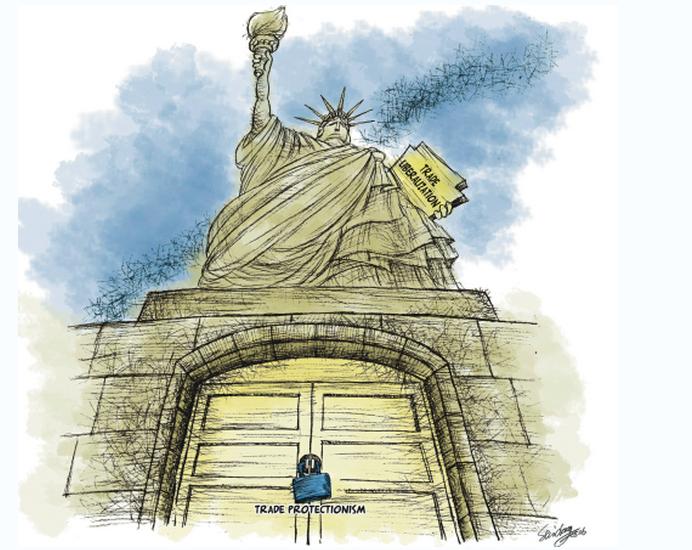
Trump administration's actions trigger concerns about business conflicts between world's two largest economies
After a warming up of relations with China in 2017, the Trump administration has again triggered concerns about a possible trade war between the world's two largest economies.
In his State of the Union address on Jan 30, US President Donald Trump declared that the era of "economic surrender" is over.
"From now on, we expect trading relationships to be fair and to be reciprocal," he told the joint session of the US Congress. "And we will protect American workers and American intellectual property, through strong enforcement of our trade rules."
Just a week earlier, Trump took action in two pending trade disputes, imposing tariffs on imported solar cells and modules and washing machines, affecting China and a number of Asian and European economies.
It followed the Commerce Department's announcement last June of its investigation of steel imports under Section 232 of the Trade Expansion Act of 1962 to determine the effects of imports on US national security.
In August, US Trade Representative Bob Lighthizer initiated an investigation of China's intellectual property policy and practice under the rarely used Section 301 of US Trade Act of 1974, long regarded as inconsistent with World Trade Organization principles.
For the first time in a quarter-century, the US Commerce Department self-initiated in November an anti-dumping and countervailing duty investigation on aluminum sheet from China.
China has protested each of the US actions. On Feb 4, China's Ministry of Commerce launched an anti-dumping and anti-subsidy probe into imports of sorghum from the US, a move seen by many as China's indication of its willingness to retaliate.
Two days later, WTO filings showed that China sent the US a request for talks on compensation for the US tariffs imposed on imported solar panels and washing machines.
The tit-for-tat actions have sparked renewed concern for a possible trade war that had haunted many when Trump took office a year ago.
On his presidential campaign trail, Trump had threatened to impose 45 percent tariffs on Chinese exports to the US and designate China a "currency manipulator".
As president, he hasn't done either one. The US Treasury, in its semi-annual reports last April and October, declined to name China a currency manipulator. China has been supporting its currency rather than depreciating it.
Trump met with President Xi Jinping three times in 2017, in Mar-a-Lago, Florida, in April; Hamburg, Germany, in July; and Beijing in November. Both sides have hailed their positive personal relationship.
Trade war
Nicholas Lardy, a senior fellow at the Washington-based Peterson Institute for International Economics and an expert on the Chinese economy, said after Xi's trip to Mara-Lago and Trump's trip to Beijing, many people in China thought that the danger has passed and that the two leaders have such a good personal relationship everything will be okay.
"I don't think that's going to be proven out. There is still some risk of escalation beyond what are just washing machines and solar panels," Lardy said.
David Dollar, a senior fellow at the John L. Thornton China Center of the Brookings Institution in Washington, said that after a lot of rhetoric, what the Trump administration has done so far is very small. He described the limited actions against specific products as following the Obama administration's playbook.
China only accounts for 2 percent of US steel imports. It is the fourth-largest exporter of solar cells and modules to the US, trailing Malaysia, South Korea and Vietnam.
Derek Scissors, a resident scholar at the American Enterprise Institute (AEI), said Trump's commitment on trade measures against China is weaker than he thought previously. He believes the weak stock market and Trump's infrastructure plan will push back the trade agenda.
The Dow Jones Industrial Average suffered a sharp fall lately. A trade war with China or major tit-for-tat actions will inject panic to the stock market. Trump has repeatedly talked and tweeted about a rallying stock market in 2017 as a success of his presidency.
The White House recently rolled out a $1.5 trillion infrastructure investment proposal, triggering controversy due to its relying heavily on local government and private funding.
Scissors suspects that Trump will still take actions from now until the midterm election in November. "The US will act and will sound like the US is doing a lot, but when you add up all the values, what the US is doing is not very much," he said.
"We should expect trade skirmishes, instead of a trade war," said Dollar, a US Treasury emissary in Beijing from 2009 to 2013.
Compared to several other US actions, Section 301 has been seen the most likely trigger for major Chinese retaliation if US imposes tariffs on Chinese production after the investigation.
Trump told Reuters on Jan 17 that "we have a very big intellectual property potential fine going, which is going to come out soon". The 1974 US Trade Act allows Trump to levy retaliatory tariffs on Chinese goods or other trade sanctions until China changes its policies.
"We're talking about big damages. We're talking about numbers that you haven't even thought about," Trump said, without elaborating.
Yukon Huang, a senior fellow at the Carnegie Endowment for International Peace and a former World Bank country director for China, said it really depends on what the US plans to do with Section 301.
He said the US has to be very careful if it decides to levy huge tariffs on Chinese exports of technologically sophisticated equipment because many of the products are made by US companies in China.
China's supply chain that is closely linked with other countries, including the US and many US allies in Asia and Europe, has complicated the situation for possible US actions. Most economists believe that China would win if a trade war breaks out between the world's two largest economies, although they admit that there is no real winner in a trade war.
"So if this really got serious and went on for a period of time, I think there will be a lot of pushback, not just from American exporters who will be losing part of that market, but from other countries in Asia which suffered," said Lardy of the Peterson Institute.
He believes China will win if a trade war escalates because China is able to impose a lot of cost on the US by targeting, for example, agricultural goods that are produced predominantly in those states that gave Trump the margin to win his election.
Many economist believe it's relatively easy for China to pick a US product, such as Boeing planes, cars and soybeans, to impose significant costs on the US but difficult for the US to pick a Chinese product to impose costs on China. "That's why if we do escalate, it will be the US side who finally backs down," Lardy said.
Fair, reciprocal
Dollar of Brookings described Trump's use of the phrase "fair trade" as confusing. "For a lot of economists, that suggests managed trade. And that's the opposite of free trade," said Dollar, who claims himself as a believer of free trade.
In terms of being reciprocal, Dollar believes it means that US firms should be able to sell and invest in China in terms very similar to Chinese firms operating in the US.
He noted that when the Trump administration talks about fair and reciprocal trade, it often focuses on balanced trade.
Most economists believe that US trade deficit has much to do with US domestic macroeconomic policy, the low saving rate and the role of US dollar as a global reserve currency, rather than the trade barriers of other countries.
Dollar said if the Trump administration wants to cut the trade deficit, it could do it easily. "They have to raise taxes, not cut taxes," he said of the US tax cut that began effective this year, a move that economists believe will make trade deficit worse by stimulating US imports.
The US trade deficit hit a nine-year high in 2017 to $566 billion. Its trade deficit with China expanded $28.2 billion to $375.2 billion, according to the US Commerce Department.
Scissors from the American Enterprise Institute agreed, saying that Trump's being reciprocal just means the "trade deficit isn't too large". In his views, the Trump administration has not made specific demands on China, but simply says the trade deficit is bad.
Trade and trade deficit have become toxic words to both major US political parties. Besides Trump, the other three candidates in the 2016 US presidential election, Hillary Clinton, Bernie Sanders and Ted Cruz, all opposed the Trans-Pacific Partnership for fear of upsetting the powerful trade unions.
Scissors noted that after the 2016 presidential election, both parties realized that they cannot afford to do anything to upset blue-collar workers.
Trump said recently that the US will soon unveil a "reciprocal tax" on goods imported to the US from other nations. He named China, Mexico, Japan and South Korea as taking advantage of the US.
The latest US tariffs on solar panels and washing machines have triggered an outcry from the solar energy industry and some lawmakers for potentially killing 23,000 US solar jobs this year for the sake of protecting fewer jobs in manufacturing. The prices of solar panel installation and washing machines have both jumped, imposing a tax on US consumers.
Tech transfer
China has denied the Trump administration's allegation of forced technology transfer. Chinese officials and experts have acknowledged that their country's protection of intellectual property is still far from adequate, but they emphasized that it has been making constant progress.
A 2015 White Paper by the US Chamber of Commerce in China showed that 22 percent of the members believed China's IP protection was satisfactory, but 82 percent of them praised China's progress in IP protection.
The sixth annual International IP Index released on Feb 8 by the US Chamber of Commerce Global Innovation Policy Center also showed the progress, by ranking China 25th of 50 economies, compared with 27th out of 45 economies the previous year.
Erin Ennis, senior vice-president of the US-China Business Council, said in a USTR hearing last October that USCBC surveys show that only about a third of companies report that they have actually been asked to transfer technology by various levels of government entities or business partners.
"Once you start drilling down… it appears to be that there is a minority of companies who are forced to transfer technology and who are not compensated," she said.
William Mansfield, director of intellectual property at ABRO Industries, noted that his company has successfully worked with Chinese authorities to protect its products. "They are a sovereign nation with a right to develop and adopt their own rules and systems, just as we are and just as we do," he said.
Scissors of AEI said he had heard complaints about forced technology transfer from foreign companies in China. He said that what China demanded in the past was low technology, so foreign companies did not worry. "The reason you (they) complain is that China has become more competitive in the high end," he said.
Size matters
Scissors agreed that Japan, India and many other countries also have problems such as in market access that the US does not like.
"But we forgive our allies more than we forgive China. We forgive our new friend India more than we forgive China. That may not be fair," he said.
Lardy said he has been writing for years that Japan is more closed than China, citing figures that foreign companies in Japan produced 1 percent of Japanese manufactured goods at the peak, while the rate in China is 25 percent for two to three decades.
India, another emerging economy, imposes higher tariffs than China and is far more restrictive in market access and foreign investment, such as in the retail sector.
Lardy said the attention on China reflects China's success. India's economy was about the same as China's four decades ago, but now only a fifth of China's size.
"This affects how people react. They think this is very big, rapidly growing market. We need to get better access," Lardy said.
Huang of CEIP agreed that size matters. China's current account surplus, a measurement of trade balance, was only 1.4 percent of its GDP in 2017, compared with 19 percent in Singapore, a relatively small economy. "If China is small, it will not matter, but China is very big," he said.
The IMF said in 2014 that China's economy overtook the US economy in purchasing power parity. A report in December by London-based Centre for Economics and Business Research (CEBR) in London claims that China will be the world's top economy by 2032.
In January, the Washington Post, citing figures from the Japanese bank Mizuho, said China's retail sales will for the first time surpass that of the US in 2018.
Talks
The Trump administration has shown a lack of interest in talks following the inaugural China-US Comprehensive Economic Dialogue in Washington last July.
The US National Security Strategy and National Defense Strategy have both singled out China as a major strategic competitor to the US. Dollar described the language as too harsh and hard to back it up. "Once you say those things, you basically are not telling your ministries to go out and negotiate close relations," he said of the Trump administration.
China has also expressed frustration with the US objection of granting China's market economy status and its failure to endorse China's important development programs, the Belt and Road Initiative and the Asian Infrastructure Investment Bank.
Chinese State Councilor Yang Jiechi visited Washington recently to ease the tensions between the two countries. After his meeting with US Secretary of State Rex Tillerson, the Chinese Foreign Ministry said the two nations agreed to hold a comprehensive economic dialogue as early as possible this year and a security dialogue within the first half of 2018.
Dollar said the dialogue has played a useful role for the two sides, particularly on macroeconomic policy and also as an opportunity to make some small advances in the trade relationship.
Scissors explained that part of the reason the Trump administration is not engaging with China on trade talks is that many staff positions are still not filled. Also, past talks under Presidents George W. Bush and Barack Obama did not help reduce the trade deficit, and it just went up.
"Why I should talk? The trade deficit is the most important in the relationship," Scissors said of Trump.
Lardy of the Peterson Institute expressed the view that the whole stance of the Trump administration is wrong. "If you want to reduce barriers, you have to negotiate. You don't negotiate, I think your chances of success are smaller," he said.
Lardy believes the people in the White House don't have a good idea of the Chinese economy, and they think the Chinese economy is weak and vulnerable, and China would just give in to whatever US demands in the threat of a trade war.
"I think that's completely misunderstanding. I don't think the Chinese economy is fragile," he said.
Noting that there are always plenty of problems people can point to in China, Lardy said the basic economy is doing pretty well. "It's going very strongly. It's likely to continue to grow strongly. It's not going to be a financial crisis. There is not going to be a debt crisis, a banking crisis."