


Lessons for life









When some Chinese schools first began to introduce the concept of positive education, many parents feared that the programs would sacrifice academic rigor. However, research from China and around the world shows that programs to teach productive character traits and virtues — including curiosity, optimism, leadership, gratitude, teamwork, grit, resilience and longterm planning — raise not only life satisfaction, but also the test scores of students.
"Some people misunderstand the concept of positive education," says Zhao Yukun, administrative director of the Positive Psychology Research Center at Tsinghua University. "They think it aims to make the kids as happy as possible. This is wrong. The only way you could do that is to indulge them, to let them follow their own wills. But this will not give them sustainable happiness. We are trying to develop character skills that improve long-term well-being."
Zhao says positive psychology, upon which positive education is based, "aims for something beyond your subjective feelings. You still feel good, but you also do something. You achieve something. You succeed and, more important, you have a moral compass. You pursue the meaning of your life. You are trying to make a contribution to the world."
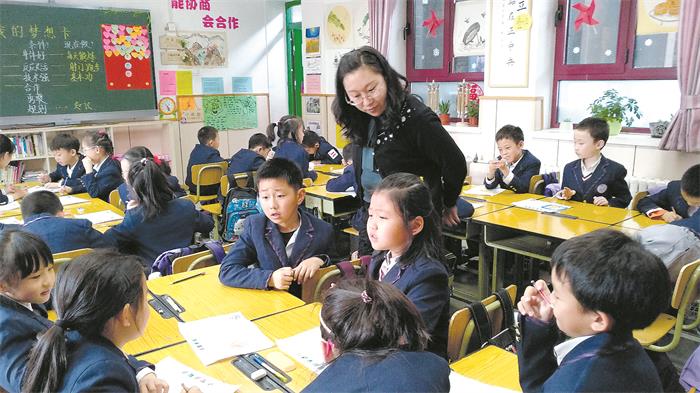
A positive education curriculum that is being tested at the elementary school affiliated with Tsinghua University in Beijing integrates key character-building goals through classes and activities.
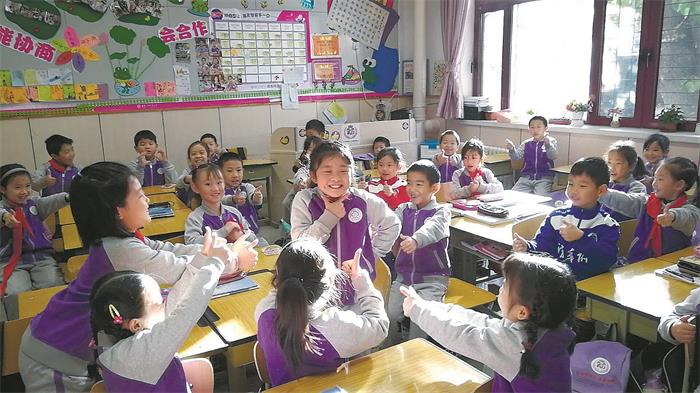
Zhang Huayu, vice-principal of the school, says: "In the first grade, we try to improve social behavior. For example, when they are playing soccer, we are primarily asking them to be a good audience or a good participant in the game.
"In the second grade, the character strength we are trying to develop is called negotiation and collaboration. We are trying, for example, to ask kids to resolve conflicts on a team."
Zhang says that in the third grade, "emphasis is on self-discipline and improvement. We ask the kids to actively prepare for a soccer game. Children should force themselves to do something they think they cannot do — like run every morning.
"In the fourth grade, we talk about honesty and integrity. Fifth grade focuses on responsibility. Sixth grade concentrates on respect and gratitude," she says.
Liu Lipin, secretary of the Party committee of the education bureau of Qingyang district of Chengdu, the capital of Southwest China's Sichuan province, has concluded that positive education is needed in China's schools.
"The schools where we tried positive education are the best schools in Chengdu. They performed pretty well in the college entrance exam, but there are also serious problems. Teachers are exhausted, and students feel tired or don't like to study," Liu says.
"The parents worry about academic performance. Not at just one period of time — it's all the time. The parents of elementary school children worry about whether they can go to a good junior high school. Junior high school parents worry about high school. And high school parents worry about whether their kids can go to a good college."
Liu says that "because academic performance is pretty much the only indicator of success, every parent disregards what the real strengths of their kids are. They just look at the test scores. They actually discourage the development of kids in any other direction other than the tests."
She says changes in the schools lead to better relationships among students, teachers and parents. "One of the segments in the positive education curriculum is to ask the kids to go home to talk to the parents about three good things that happened each day. And we ask the parents to list three good things that happened to them."
"It turned out that this intervention improved, first, the kids' confidence and, second, how the parents look at their kids," Liu says.
In China, "if a child has good academic performance, then of course the parents love you," she says. "Otherwise, they will blame you or scold you, say you are stupid. This even affects the relationship between the father and mother. So after this intervention was done for one semester, they found the children became more confident and the relationships between the students and the parents, and between the parents and the school, were much better."
"Interestingly," Liu adds, "the relationship between mother and father became much better, too."
Scientific studies of schools that implemented positive education in China and elsewhere found that a curriculum that builds the well-being of the students improves academic performance.
For example, the Zengcheng section of Guangzhou, which launched a large positive education program in 2014, found that the percentage of graduating students admitted to key universities rose from 28 percent to 41 percent by 2017. At the same time, suicides were reduced from seven to one. Similarly, the 19th Middle School in Beijing (which teaches grades 7 to 12) saw its percentage of graduates admitted to first-class universities rise from 70 percent to 75 percent in three years after implementing a positive education program.
The Himalayan country of Bhutan conducted an experiment in which some schools implemented a positive education curriculum focusing on building life skills. Other schools were a control group that retained the old curriculum. The conclusion was that students who received the positive education saw their standardized test performance increase by roughly the equivalent of a full academic year, compared with the control group. In addition, an analysis by a Loyola University of Chicago psychology professor and colleagues of 213 experimental studies concluded that students who receive positive education training see an average increase of 11 percent in their test scores.
Peng Kaiping, professor of psychology and dean of the School of Social Sciences at Tsinghua University, emphasizes that positive psychology is based on testable conclusions, not vague feelings. Psychological research found that individuals can use technology and training to improve their positive emotions and their feelings of living meaningfully, Peng says.
Zhang, of the Tsinghua elementary school, says: "It has been more than two years that we have been doing positive education. This is actually new to us, too. We knew that we needed to make the students more positive. But we did not actually know how to do it. It was interesting to learn the science of well-being and the scientific way to make students more positive. It is kind of shocking to us that there are actually scientifically validated ways to do that."
Martin Seligman, a professor of psychology at the University of Pennsylvania, is often known as the father of positive psychology. About 20 years ago, he became frustrated with his profession because psychologists had long studied psychological illnesses but had never addressed how to make people in general achieve a better level of well-being. Drawing on Aristotle's book Nicomachean Ethics, he says humans need to aim for "flourishing", not just simply short-term happiness.
His conclusions about what leads to a good life are summarized in the acronym PERMA, which stands for positive emotions, engagement, good relationships, meaning and achievement. For the past two decades, an increasing number of psychologists have developed tests to measure a person's level of these aspects of wellbeing, and they've developed training techniques and exercises designed to help raise each of the aspects.
Another key part of the positive psychology literature is called "grit", which means the ability to do the work needed to reach a goal, to stick with it, to not give up. Angela Lee Duckworth, a Chinese-American psychology professor, also at the University of Pennsylvania, developed a test for grit. She found a technique called "growth mindset", which shows struggling students that they can build their mental capacities by focusing on special areas where they are having difficulties. Just letting students know that they can improve makes a big difference in their attitudes, Duckworth says.
A study published last month in the online psychology journal Psy-ArXiv by independent researchers tested the effects of less than one hour of grit and growth mindset training provided to more than 12,000 ninth-grade students in 65 randomly chosen schools in the United States. It concluded that even such a small intervention led to significant improvements in test scores, especially among previously underperforming students.
Zeng Guang, currently a PhD candidate in psychology at Tsinghua who developed much of the positive education curriculum used in Guangzhou, says: "The growth mindset class was liked most by the students. After taking this class, they were able to keep working longer on math problems. Before, they would give up after 15 minutes. Now they think that if they work for some minutes, they will be a little bit smarter."
A 2016 paper published in the journal Frontiers of Psychology by Zeng, Peng and Hou Hanchao, also at Tsinghua, found that growth mindset training increased the students' resilience (their ability to adapt to setbacks) which, in turn, improved overall well-being as well as the students' level of engagement with their schoolwork.
Zhang, the vice-principal of Tsinghua elementary school, says: "Grit or willpower is something this school emphasizes a lot. They receive growth mindset training.
"One factor is that they are more optimistic, they can persist longer because they believe they can achieve their goals. Actually, it is typical for students to give up and not persist. But the students in the positive education experiment classes believe they have more self-efficacy in performing this goal. The second difference is that they have more peer support. They encourage and kind of supervise each other. So, as a group, they can achieve better."
In addition, Zhang says: "Growth mindset is an important character that this school tries to develop. We want to get them out of their comfort zone and grow."
She says a growth mindset "tells them that they can do it as long as it is not stretched too far. ... They think, 'I can always become better'."
Zhang says a growth mindset is also developed through purposeful practice. "We ask them to intentionally practice something and then they can see their growth."
Wang Jing, who teaches English to second-graders at the Tsinghua-affiliated elementary school, says she has seen improvement in the relationship aspect of the PERMA approach in her 7-and 8-year-old students.
"In the first grade, some of them didn't behave very well, but they gradually change. They become kinder to their friends. Most of the students listen to other students talking. I think this is quite a big change. They know how to respect other students. They know the rules and they know how to create a harmonious atmosphere for others. ... There are very healthy friendships now."
Wang says that although conflict among students cannot be avoided, "the students can use the positive way to see the things and, especially after the teachers give instruction and explanation, they can apologize to each other, and also the parents understand each other better than before.
"At this age, we concentrate on the relationship module," Wang adds. "I think kids can influence their parents, and parents give us positive feedback, (which creates) this kind of positive circle — teachers influence the students, students influence the parents, parents give us positive feedback."
Furthermore, the teachers need to adapt all aspects of the school's teaching to incorporate ideas from positive psychology. For example, history teachers might discuss the character strengths of historical figures, and math teachers might incorporate the practice techniques of growth mindset training.
Zhang, from the Tsinghua-affiliated elementary school, says: "The teachers who participate now, at the experimental testing stage, are all volunteers who are enthusiastic about psychology. But if we do it on the scale of the whole school, some teachers who are not interested in psychology will see it as an extra burden."
In addition, implementing positive education throughout a school system is not easy. Teachers have to be trained in the principles of positive psychology, and detailed curriculums need to be developed and adapted for local conditions. However, Shao Kaize, from the personnel office of the Qingyang district's bureau of education in Chengdu, says teachers in the area are paid less than the median wage.
Peng Kaiping, the dean at Tsinghua University, points out that the win-win synergy between well-being and academic success sounds counterintuitive. "Many people don't believe it," he says. "A ridiculous article circulating on WeChat even claims that it is a foreign conspiracy to make China lower its standards. You see that kind of mentality is still strong."
Supporters of the program argue that positive education can be an important support for the ongoing reforms in the Chinese economy and society.
Zeng Guang says positive education is consistent with Chinese culture. "There is a huge overlap between Confucianism and positive psychology. For example, important research by Chris Peterson and Seligman divided the character strengths into six categories — wisdom and knowledge, courage, humanity, justice, temperance and transcendence. Confucius emphasized all of them except transcendence."
Edmund Phelps, a professor of economics at Columbia University and winner of the 2006 Nobel Prize in Economic Sciences, says a flourishing spirit is essential to the "mass innovation and entrepreneurship". His 2014 book, Mass Flourishing, says the innovative technologies that changed the world in the 19th and 20th centuries were not driven by changes in institutions, but by changes in average people's philosophy of what makes a good life.
Contact the writer at davidblair@chinadaily.com.cn






- Sustainable agriculture in focus at Hainan forum
- Road accident in East China kills 4
- Health Bureau: Free Chinese medicine services for Tai Po fire victims
- Satellite launch marks a new milestone in UAE-China cooperation
- HK fire: 4,510 residents in shelters as support fund reaches HK$3.6b
- Scholars, industry insiders call for a responsible, scientific, credible think tank research system