


Anyone for a White Rabbit? China's massive snacks industry goes ballistic









Increasing affluence of people has seen nation's diet change radically, with implications for long-term health
"Snacks? I don't think we had the concept in my childhood," recalls Gao Cuiling, now 54 years old, and reminiscing about being a girl back in the 1960s.
That may well be, but nowadays she's busy taking care of her one-year-old granddaughter and fretting about how to prevent the baby from gobbling snacks that might taste good but aren't suitable for her.
Gao's early memories are shared by many of her generation. During the 1960s, China's total grain output had increased, but by today's standards it was meager. And the production record set in the 1960s was still only 210 million tons, equivalent to 280 kilos per person for the whole year. That's enough to fill peoples' bellies, but not enough to support any vibrant national snacks-producing industry.
The snacks made at the time were more like luxuries, too, beyond the reach of ordinary folk. Back in 1959, ABC Mickey Mouse Sweets-which later morphed to become the famous White Rabbit Creamy Candy and whose history can be traced back to Shanghai in the 1940s-accounted for so high percent of the monthly salary of an average worker during that period that it was considered luxurious.
Things fared a little better in the late 1970s. "During festivals we got some additional food such as sweet rice dumplings for the Lantern Festival, or rice cakes for the Dragon Boat Festival," Gao said.
"They're probably the earliest snacks in my memory, if you insist on calling them that," she adds.
It was after the Reform and Opening-up in 1978 that China's economy really took off, which in turn caused a food boom. In the 1980s, China's food production kept growing and finally reached 400 million tons in 1989, double the record set in the 1960s.
That also marked the start of the massive consumption of snacks in the country.

The 1980s: Time for a snack
According to the theory of human needs propounded by eminent US psychologist Abraham Maslow in the 1940s-a list of 'must haves' depicted in a pyramid with the most basic needs like safety at the bottom, ranging to self-actualization at the top-food is a dominant, core imperative. A look at history also shows that when a nation steps out of poverty, the first thing people do is to move their palates and stomachs onto the finer stuff.
Back in the 1980s, Chinese people, who were just getting a taste for the good life, were very creative in sniffing out the snacks they liked, which in turn created enormous business opportunities.
The above-mentioned ABC Mickey Mouse Sweets, which had already changed its name to White Rabbit Creamy Candy, seized the opportunity and forged its prime place in the pantheon of the national snacks industry.
A previous luxury, it repositioned itself successfully, leaving consumers nationwide with the idea "You can now enjoy luxury, too", winning it the warm affection with consumers it enjoys to this day.
In the hall of fame for drinks, the most successful brand has to be Jianlibao. At the 1984 Los Angeles Olympic Games China's women volleyball team scored gold, overnight inspiring and fueling both sports mania and national pride.
Jianlibao capitalized on that, popularizing the concept of "sport drinks" with China's consumers, with such success that at one point it had an extraordinary market share as high as 70 percent of the country's soda drinks sector.
For some born in the 1980s, Jianlibao was pretty much the only soft drink they would think of drinking during the summer.
There are a raft of other examples from the period. Fudges in orange, apple, pineapple and other flavors gained popularity, too, while canned fruits, mostly brewed in sweet drinkable water, became the preferred gift for those visiting patients in hospitals.
Nowadays nostalgic Chinese, whose childhood was in the 1980s, are very fond of recapturing the sweet moments of the time. Just do an online search on "snacks in the 1980s" and you get 930,000 results on search engine baidu.com. On micro blog Weibo Sina-China's equivalent to Twitter-there is the longstanding topic #Snacks in the 1980s#, which has recorded more than 100 million hits.
Even today, people surfing e-commerce platforms can easily buy snacks with packages and flavors exactly the same as those of the 1980s. "I buy this only to wake up the taste inside my heart," is a typical comment about one of the products.
Yet the snacks industry in this period was not without its problems. A lack of proper laws and regulation saw a fairly high percentage of snacks produced in illegal underground workshops. Some of the backshop boys even produced pirate products carrying fake trademarks of famous brands, or registered trademarks designed to be easily confused with the leading ones.
For example, when White Rabbit Creamy Candy really took off, some businesses registered Grey Rabbit or Small White Rabbit for their rival milk candy products. White Rabbit bared its teeth in response, registering some similar trademarks first to avoid them being registered by others, among them Black Rabbit candy. That trademark has been held by White Rabbit ever since, just to head off imitators.
The 1990s: Rise of brands
After a decade of development and competition, China's snack market had two major characteristics in the 1990s: Stricter regulation and internationalization.
In 1995, the Standing Committee of the National People's Congress, the nation's top legislature, passed China's Food Hygenie Law, which clearly required law enforcers at all levels to strike down the underground illegal workshops that produced low-quality foods or foods under false brands. Until then, quite a high percentage of these kinds of foods were actually sold in school tuckshops and targeted at pupils.
These illegal products finally disappeared from the market through stricter enforcement. They might still exist here and there, far from the main urban areas, but the total amount has decreased hugely.
Global brands also jumped on the bandwagon, rushing into China. Spanish brand Cola Gao made its first appearance in 1990 and ruled the roost for quite a few years. A nutritious product made of cocoa powder, it gives out smell of chocolate when brewed in hot milk, making it a popular drink with kids.
Yao Wenjun, born in 1991 and now working in Shenzhen in southern Guangdong province, witnessed the changes as a girl. "During my six years at primary school, the number of foreign snacks brands near my school grew from none to three, or one every two years", she said with a smile. "Every snack shop gave us a feeling of happiness."
US food giants KFC and McDonald's were among the international brands that moved into China during the period, along with rivals such as Subway and PizzaHut. Interestingly, the difference in the meaning of the word "lunch" for Chinese people and Westerners made their roles different in China, too. For many in the West, lunch is often a sandwich or roll, ordered to go and eaten on the run within half an hour.
In China, however, lunch is a substantial meal-no less important than breakfast or supper. As a result, the fried chicken and sandwiches sold by KFC and McDonald's were seen more as leisure snacks when they first came out in China and their bestsellers were fried chips.
New century: Health worries
An inevitable result of people eating more and more fried chips and other high-caloried snacks, both domestic and global brands, is obesity. According to the international Danone Institute, which specializes in nutritional research, the obesity rate for Chinese 7-18 years old had risen eight times in 2000 compared with 1985; for the subgroup aged 17-18 years, the rate was up 21.5 times.
That's why, since the beginning of the new century, "control" has become a key word in the lexicon of parents, reflecting their new attitude towards snacks for their family. Some parents have cut back on their kids' weekly allowance or pocket money, while others have imposed strict discipline at home and set limits on the amount of snacks their children can consume.
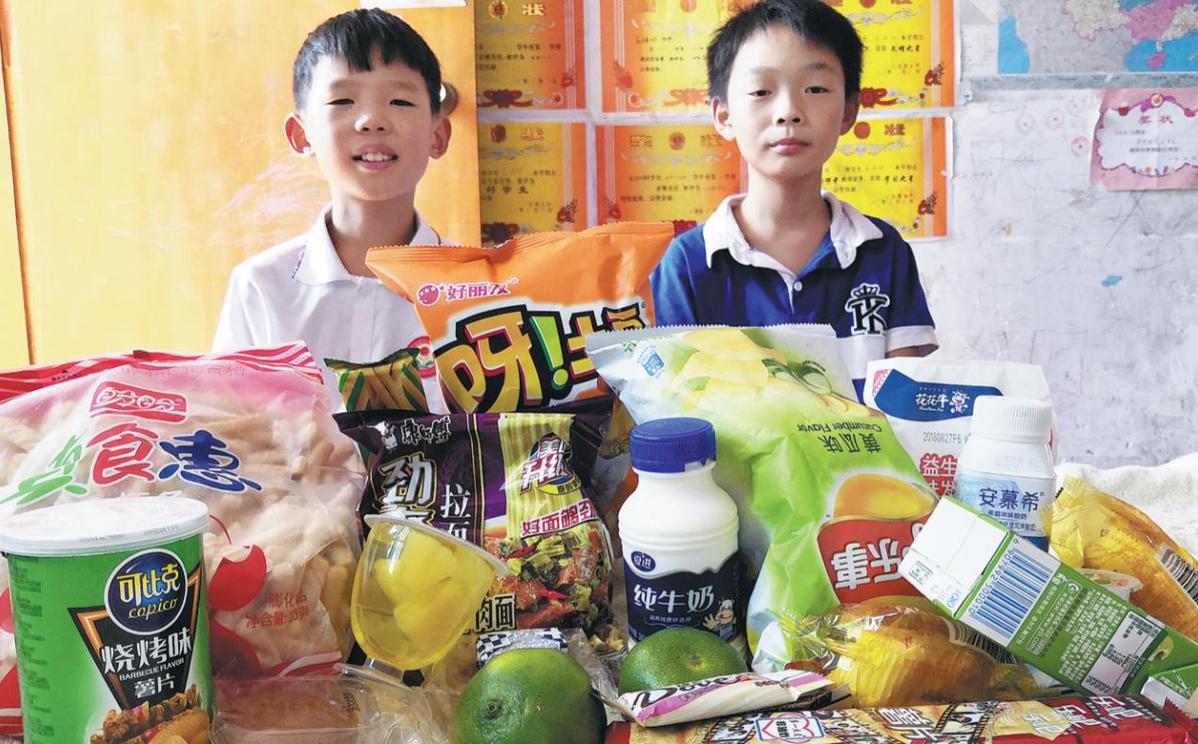
Yuan Jinghao and Zhu Xinyu, two cousins born in 2008 and 2009, have experienced both measures. Yuan is allowed to spend only 20 yuan a week on snacks, while Zhu is allowed to have only one small bag of snacks each day, with a weight not exceeding 150 grams.
Back at the Gao residence, baby granddaughter Zhang Junyao might still be wearing diapers, but she's already following rules, because of her obvious taste for snacks.
For her health, she is only allowed to take fruits, a small cup of yogurt, and two kinds of children's biscuit besides her meals.
"It seems a natural desire for children to want snacks", Goa said.
"But the health for my granddaughter is the most important thing and I must be strict in implementing the rules."