



Twin Beidou satellites launched









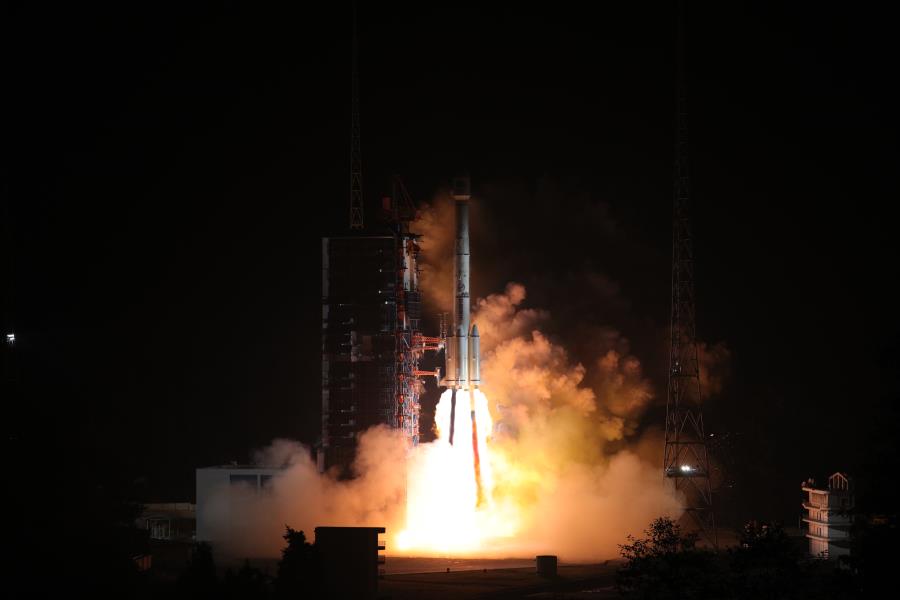
China launched twin Beidou-3 satellites successfully at 02:07am on Monday, enabling the domestically developed satellite system to expand its coverage to countries involved in the Belt and Road initiative by year's end.
The satellites were sent on a Long March-3B carrier rocket in Southwest China's Xichang Satellite Launch Center and are the 46th and 47th of the Beidou Navigation Satellite System.
"The two satellites are also the 18th and 19th of the Beidou-3 series, third generation of Beidou," said Yang Changfeng, chief designer of the Beidou satellite system.
"Working with 17 other Beidou-3 satellites already in orbit, the basic satellite constellation of Beidou-3 will finish its establishment by year's end," he said. "By then, the network will provide basic navigation service for countries or regions participating in the Belt and Road initiative."
The Beidou network, mainly constructed by China Aerospace Science and Technology Corp, is one of the four global space-based navigation networks along with the United States' GPS, Russia's GLONASS and European Union's Galileo.
Since 2000, when the first Beidou satellite was placed in the space, a total of 47 satellites, including four experiment satellites, have been launched for the system and several of them have been retired. Beidou began providing positioning, navigation, timing and message services to civilian users in China and parts of the Asia-Pacific region in December 2012.
According to government plans, the network will have global coverage before the end of 2020.






- Experts: Lai not freedom fighter, but a pawn of the West
- China planning to raise age limit for blood donors, shorten the minimum interval
- Breakthrough in BMI tech aids patients
- Chinese technique for making ultrathin metal films named top 10 scientific breakthroughs
- Former senior political advisor of Sichuan sentenced to 14 years
- Beijing has undergone dramatic improvements since 2017's revamped development plans