


The art of Chinese garden and traditional Chinese culture









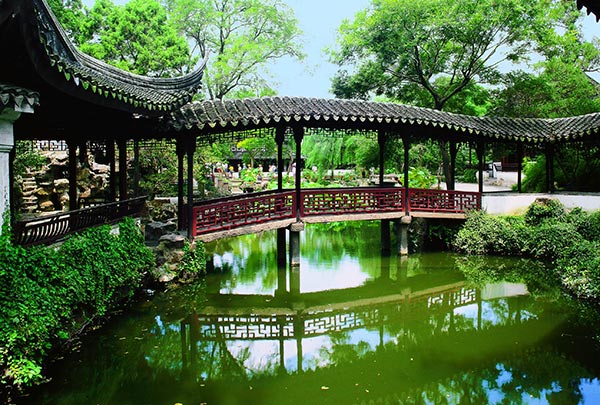
The art of Chinese garden has a rich theme of ideas and a subtle imaginary, because of the rich aesthetic ideas associated with Chinese gardens and the profound Chinese traditional culture.
What is a good garden landscape? The answer is: a good garden is somewhere between the knowing and the not-knowing. The one who knows understands why it is good and what they like or dislike. The one who does not know never understands the reason behind the landscape. This answer points out the essence of Chinese garden art. The biggest difference between Chinese gardens and other garden systems in the world is that the former will not take the actual landscape we can see as the ultimate design goal. It is all about the image behind the landscape and meanings beyond what is expressed, and that is the so-called "imaginary". Imaginary actually represents to the greatest extent the designer’s personal emotion, philosophical experience and image association. It also reflects the re-creational process of the viewer through their own association and imagination. Like Yan Yu said in Canglang’s Notes on Poets and Poetry: "It would be like the sound in the air, the color in the image, the moon in the water, and the image in the mirror, which all tell much more than they reveal." Therefore, a garden should collect natural mountain, water and rocks in its landscape design, and let visitors feel that they "understand the best part of the garden but do not know how to describe it". The origin of "imaginary" in the art creation of Chinese garden is closely connected to Chinese philosophical ideas.
These ideas influence the design of gardens by shaping the personality and aesthetic sense of Chinese scholars, which can be reflected on the style of the garden and the aesthetic standards of imaginary. Therefore, from the physical content to the spiritual function, from the disposition of elements to the allocation of themes, from meaningful content of the scenery to the symbolic connection between sceneries, a garden contains rich aesthetic ideas and profound traditional Chinese culture. In the cultural history of China, Confucianism, Taoism and Buddhism are the three important parts of traditional Chinese culture. Each of them has influenced the Chinese culture with their own characteristics. At the same time, they merge and collectively shape the course of development of Chinese culture, which is an epitome of the complementary feature of Chinese culture. This article explains the ideas of Confucianism, Taoism and Buddhism and how they influence Chinese gardens to offer a glimpse of the development of Chinese gardens.
1.Confucianism and Chinese Gardens
In the history of cultural development of China, Confucianism was the mainstream of traditional culture. In the Pre-Qin Period, Chinese culture was in a varying form of "a contention of 100 schools", and Confucianism was only one of the schools, but after Emperor Wu of Han adopted Dong Zhongshu’s suggestion to "outcast 100 schools and focus only on Confucianism", Confucianism has become the orthodox representation of Chinese culture, having deep influence on the development of culture in China. During its origin and development, Confucianism has developed its own set of theories: ideas like "benevolence and righteousness" and "rite and music" developed by Confucius advocate justice and the doctrine of the mean. In terms of politics, there are ideas like "rule of virtue" and "policy of benevolence". For education, there are ideas like "make no social distinctions in teaching" that focus on education of the public and the cultivation and practice of morality. The importance of the people, the three cardinal guides and the five constant virtues, Confucian orthodoxy and other ideas and the value of righteousness over benefits are also involved. Although these ideas played a positive role in the development of Chinese culture to some extent, they also suppressed or limited such development. The claiming of Confucianism that honors disposition over emotion, theory over literature, and reason over desire was criticized by past men of letters who valued nature. Therefore, Confucianism borrowed and absorbed content from Taoism, combining the two without compromising the core content, and developed Confucianism one step further. Confucius scholars completed the ideological system of Confucianism by absorbing Taoism’s ideas of the universe as ontology and that "everything comes from Tao".
The Book of Changes stressed that the three elements of heaven, earth, and man are based on man, and the harmony and unity between man and nature and between people is important. Although man seems more important than nature, Confucianism does not consider nature as heterodoxy. Rather, it promotes harmonious co-existence between man and nature with the belief that they are essentially connected, hence theories such as "man is an integral part of nature" and "man and everything are one". Therefore, ideas and theories shape Chinese people’s standards of art, which is being part of nature. "Honoring and following nature" has become an unshakable principle of building Chinese gardens. With this principle, designers are integrating building, mountain, river and plants as one, and imitating natural landscape in a limited space by introducing natural elements. After processing and refinement, natural and artificial beauties are united to create an art piece featuring man-nature coexistence and harmony. The couplet in Canglang Pavilion in Suzhou writes: "The wind and the moon are priceless; the near-by water and the remote mountain are emotional." It expresses the owner’s idea of being part of nature and the easy mood in nature. In addition, the "comparison of virtue" in Confucianism also has some influence on the theme of Chinese gardens. China’s classical gardens value much transferring emotion to the scenery, emotion interacting with the scenery, giving meanings to objects, and using objects to express virtues. People would regard such aesthetic object as a symbol of beauty in virtue, in spirit and in personality.
Since ancient times, bamboos have been a symbol of beautiful things and noble characters. People would associate bamboos with humility, honor, ambition, resisting frost and cold, and reconciling itself to the situation, among other characters and spirits. Many poets and writers in the past wrote poems and essays about bamboos. The great poet Bai Juyi from Tang Dynasty said: "The bamboo has an empty heart, and it shall be my teacher for modesty." Liu Yanfu, a literate from Tang Dynasty, compared the character of bamboos to those of a gentleman in Bamboo Planting Record. From this personalization of bamboo, we can see that various properties and forms of beauty of nature themselves are not the most important things in aesthetic appreciation. On the contrary, through the symbolic meaning of natural scenery, people focus more on the harmony of people and objects, oneself and others, the internal and the external, and man and nature. Besides bamboo, people would regard pine, plum tree, orchid, lotus and the distinctive and strange rocks as symbols of noble characters.
2.Taoism and Chinese Gardens
Taoism is originated in China. Along with Confucianism and Buddhism, it is one of the important pillars of Chinese culture. Laozi is the spiritual leader for Taoists. In terms of philosophy, Laozi believed that "Tao" is the highest domain, and that Tao is the origin of the universe that creates everything. It is also the basis of existence for everything. He pointed out: "Tao creates one, and one becomes two, two become three and then everything emerges." At the same time, he claimed that "the earth moves according to nature, the saints act upon nature, and nature is Tao." Later, Zhuangzi inherited and developed Laozi’s idea of "Tao rules the nature" and began to worship nature with the focus on inaction.
He believed that nature itself is the most beautiful, or "heaven and earth are beautiful but they say nothing". In the eyes of Laozi and Zhuangzi, nature is beautiful not because of its existence, but because of its ability to demonstrate that Tao "does everything by not acting". Nature does not intentionally pursue anything, but it makes things happen in a way that no one else can. Chinese gardens honor and pursue nature, but they are not copying the form of nature’s beauty. Rather, they are exploring Tao and the reason hidden in nature. This is why the Taoist perspective on nature is extremely important to the development of ancient literature and the formation of ancient art and national characteristics. The spiritual expressions of such perspective include not acting, honoring nature, following the natural course, being easy, quiet, simple, light, indifferent, romantic and free. As a result of the immortal Taoist influence, gardens with the theme of nature and fairyland emerge.
One example would be Shanglin Imperial Garden to the south of Wei River built by the First Emperor of Qin. According to the Record of Guanzhong, Shanglin Imperial Garden sets the Cowherd and the Weaving Maid as symbols of the Milky Way, and a water-shooting stone whale and Three Islets of Fairyland as symbols of Fusang in the East Sea. In addition, there is also a large Jianzhang Palace in Shanglin Imperial Garden. North of the palace is Taiye Pond, which is a wide artificial lake, famous for the three sacred mountains in the pond. "Record of Emperor Wu" in Records of the Historian writes: "The north of it is a huge pond, with a platform over 20 zhang (66 meters) high. The name is Taiye Pond. In the pond are the five sacred mountains of Penglai, Fangzhang, Yingzhou, Huliang and Xianghai. And there are turtles and fish swimming in the water." This kind of "one pond and three mountains" layout has profound influence on the design of the following gardens, and has become a model of creating pond and mountains, promoting the development of garden art.



- Defense Ministry denies naval task force directed at Australia
- China's flu cases projected to peak soon
- New CAS academicians vow to leverage research to drive economic development
- China again urges Japan to destroy the abandoned chemical weapons
- Japan will face neighbors' anger, consequences if it continues to make trouble, China warns
- HK continues safety checks on buildings under maintenance