


Mount Qingcheng and the Dujiangyan irrigation system










Category of site: Cultural Site
Brief introduction
Located on the northwest edge of Chengdu Plain, Dujiangyan was built in the 3rd century BC and is a world famous irrigation system, controlling the waters of the Minjiang River and distributing it to the fertile farmland of the Chengdu Plain. Qingcheng Mountain, famous for many ancient temples, can claim to have some strong roots for China's Taoism.
The Dujiangyan Irrigation System, a major landmark in the development of water management and technology that is still discharging its functions perfectly, was first built in 256 BC (during the Warring States Period) by magistrate Li Bing and modified and enlarged during the Tang, Song, Yuan and Ming dynasties. It is an ecological engineering feat, located in the western portion of the Chengdu flatlands at the junction between the Sichuan basin and the Qinghai-Tibet Plateau. Comprising two parts today - the Weir Works, located at an altitude of 726 meters, the highest point of the Chengdu plain 1 km from Dujiangyan city, and the irrigated area, it uses natural topographic and hydrological features to solve problems of diverting water for irrigation, draining sediment, flood control, and flow control without the use of dams. The water from the upper valley of the Minjiang River is controlled by three key components of the Weir Works: the Yuzui Bypass Dike, the Feishayan Floodgate, and the Baopingkou Diversion Passage. These structures, with ancillary embankments and watercourses including the Baizhang Dike, the Erwang Temple Watercourse and the V-Shaped Dike, ensure a regular supply of water to the Chengdu Plain. The system has played vital role in flood control, irrigation, water transport and general water consumption. One of the earliest irrigation systems of China and still in use today, it serves to divert waters from the Minjiang River to the West Sichuan Plain. There are many cultural relics in the neighborhood, including the Temple of the Two Kings, the Temple of the Hidden Dragon, the Bridge of Peaceful Waves and the Li Mounds.
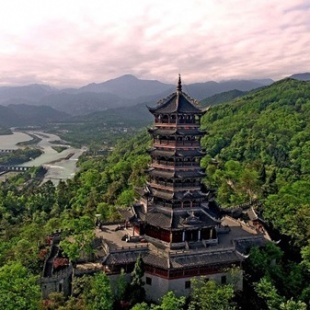
Qingcheng Mountain, dominating the Chengdu Plain to the south of the Dujiangyan Irrigation System, was the birthplace of Taoism in China. With over 20 temples and religious sites for Taoism, it exudes a strong flavor of Taoist culture and the buildings demonstrate the Sichuan style of architecture. It is famous as the place where in 142 the philosopher Zhang Ling founded the doctrine of Chinese Taoism. Built on the mountain during the Jin and Tang dynasties are many temples expressing Taoism culture. The mountain was regarded again as intellectual and spiritual centre of Taoism in the 17th century. The 11 important Taoist temples like Two Kings and the Temple of the Hidden Dragon, where Zhang Ling preached his doctrines, display the traditional architecture of western Sichuan.
It was added to the list in November 2000.
Cultural heritage
Large stone inscriptions by Huang Yunhu of the Qing Dynasty are prominent on the mountain, reading the fifth most famous mountain under Heaven and Top of Qingcheng Mountain. A 2.9 meters high and 4.5 ton statue of Li Bing, made 1,800 years ago, the first altorilievo stone sculpture in Chinese history, is now on display in a hall on the mountain after its excavation from a riverbed in 1974. Inscriptions recording water management methods, maps of Dujiangyan made in the Qing Dynasty and testimonials to Li Bing and his son are also on display, side by side with precious art works by several famous modern painters such as Xu Beihong, Zhang Daqian and Guan Shanyue.
Taoist culture
Qingcheng Mountain is one of the birthplaces of Taoism. In the Eastern Han Dynasty (25-220 AD), the founder of Taoism, Celestial Master Zhang Daoling once set up his pulpit there to deliver lectures. During the Tang Dynasty, advocates of the newly introduced Buddhism vied with the Taoists for this base, until Emperor Xuanzong allocated the mountain to the latter.
As an indigenous religion of China, the Taoist religion was initiated in the Eastern Han Dynasty by Zhang Daoling and developed ever since. It is part of Taoism in the larger sense, which is deeply inspired by the theory of Laozi in the Spring and Autumn Period (770-476 BC) and features the harmony of human and nature, the virtue of leisure and tranquility, and a positive attitude toward the occult and the metaphysical. The Taoist religion, which is concerned with the ritual worship of the Tao, has a profound influence upon Chinese life.
Qingcheng Mountain is a representative site of Taoist culture. Major religious sites here include the Natural Picture (a building complex immersed in nature), the Celestial Master's Cave, the Hall of the Ancestral Masters, Cave Facing the Sun and the Palace of Celestial Freshness.
All structures are shaded by dense woods and embraced by nature. The Celestial Master's Cave, perched on a cliff with only a small path leading to its entrance, houses statues of Fuxi, Shennong and Xuanyuan (three legendary primeval kings of the Han people) on its main altar.
The Natural Picture is a building complex made of wood. Lying in the arms of high mountains and steep cliffs, it presents a lush and primitive view of forests and pure sky. The neighboring Crane-dwelling Village adds even more colors to the picture when the white cranes cruise gracefully among the mountain peaks.
History
During the Warring States period, people living along the banks of the Minjiang River were plagued by annual flooding. Qin governor Li Bing investigated the problem and found that the river was swelled by fast flowing spring melt-water from the local mountains that burst the banks when it reached the slow moving and heavily silted stretch below. One solution was to build a dam but Li Bing had also been charged with keeping the waterway open for military vessels to supply troops on the frontier, so he proposed to build an artificial levee to redirect a portion of the river's flow and then to cut a channel through Yulei Mountain to discharge the excess water upon the dry Chengdu Plain beyond.
Receiving 100,000 taels of silver for the project from King Zhao of Qin, Li Bing set to work with a team said to number tens of thousands. The levee was built from long sausage-shaped baskets of woven bamboo filled with stones held in place by wooden tripods. The construction of a water-diversion levee looking like a fish's mouth took four years to finish.
Cutting the channel proved to be a much more difficult problem, as the tools available to Li Bing at the time could not penetrate the hard rock of the mountain. Therefore, he used a combination of fire and water to heat and cool the rocks until they cracked and could be removed. Having worked for 8 years, a 20-metre-wide (66 ft) channel had been gouged through the mountain.
After the system was completed, no more floods occurred. The irrigation turned Sichuan into the most productive agricultural place in China. On the east side of Dujiangyan, people built a shrine in memory of Li Bing.