


Preparations underway for the Second Belt and Road Forum for International Cooperation









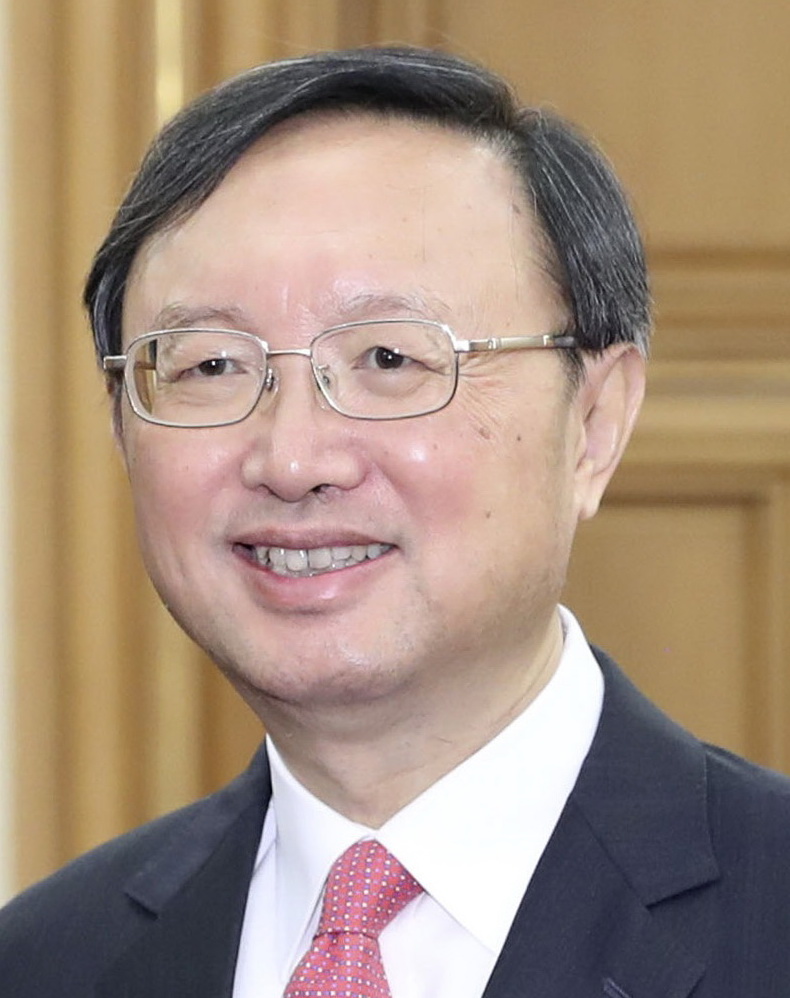
Editor's note: On November 17, 2018, President Xi Jinping announced that the second Belt and Road Forum for International Cooperation (BRF) would be held in Beijing in April 2019. The announcement drew the keen interest of both Chinese and foreign media. On March 29, Mr. Yang Jiechi, Member of the Political Bureau of the Central Committee of the Communist Party of China and Director of the Office of the Central Commission for Foreign Affairs, who has overseen the preparations for the Forum, gave an interview to People's Daily and China Daily. He talked about the progress in pursuing Belt and Road cooperation and preparations for the Forum.
Q: Close to six years since it was put forth by President Xi Jinping, the Belt and Road Initiative (BRI) has become a widely welcomed international public good with a far-reaching and profound impact on the world. What role has the BRI played in deepening international cooperation, promoting closer ties between countries, and boosting global growth? Is there any underlying link between the BRI and the vision of building a new type of international relations and a community with a shared future for mankind?
A: The BRI is an important initiative for international cooperation proposed by President Xi to enhance both China's development and its cooperation with global partners. The BRI represents a major breakthrough in both theory and practice, and it carries far-reaching significance.
Since its inception, the BRI has received strong endorsement and warm support from the international community. So far, a total of 124 countries and 29 international organizations have signed BRI cooperation documents with China. Most recently, during President Xi's visit to Italy, the two countries signed an MOU on promoting BRI cooperation, giving a new impetus to this process. Meanwhile, the BRI vision has been included in documents of major international institutions including the United Nations, the G20, the Asia-Pacific Economic Cooperation and the Shanghai Cooperation Organization. Indeed, the BRI has proved a popular and worthy cause that goes along with the trend of our times and responds to the shared aspiration of countries for development through mutually beneficial cooperation. Looking back at this pursuit over the last few years, I would draw your attention to the positive role the BRI has played in the following three ways:
First, the BRI has opened a new area for international cooperation and boosted confidence in it.
The world today is experiencing profound changes unseen in a century. Protectionism and unilateralism are rising, so are uncertainties and destabilizing factors. As stressed by President Xi, the BRI is a significant move China has taken to fully open itself under the new conditions, and it embodies China's commitment to sharing development opportunities and outcomes with more countries in the world. This important statement charts the course for Belt and Road cooperation.
The BRI is guided by the principle of consultation and cooperation for shared benefits. It represents an approach to international cooperation featuring mutual respect, justice, equity and cooperation for win-win outcomes. And it is a commitment to multilateralism and an open global economy. As such, the BRI will help move economic globalization toward greater openness, inclusiveness, balance and win-win outcomes.
Second, the BRI has created new impetus and opportunities for global growth.
Since the outbreak of the international financial crisis in 2008, to create both new growth drivers and a new cycle of global growth has become a common task for the international community. The BRI aims to address the fundamental issue of promoting development by enhancing all-round connectivity. It has helped countries involved to remove development bottlenecks and implement the UN 2030 Agenda for Sustainable Development. This initiative has thus become an important way to boost global growth.
The latest studies by the World Bank and other international institutions suggest that the BRI cooperation will cut the costs of global trade by 1.1 to 2.2 percent and those of trade along the China-Central Asia-West Asia Economic Corridor by 10.2 percent. What is more, it will contribute at least 0.1 percent of global growth in 2019.
Third, the BRI provides a new platform and new opportunities for fostering closer ties between countries.
By improving connectivity between countries, BRI cooperation has strengthened economic ties and people-to-people exchanges between them, thus binding them closer together with shared interests. This will naturally build extensive consensus, enhance cooperation, and ultimately promote development for all.
As President Xi Jinping pointed out, the BRI aims to replace estrangement with exchanges between different civilizations, replace clashes with mutual learning and replace a sense of superiority with coexistence; and it aims to boost mutual understanding, mutual respect and mutual trust among different countries. So the BRI is a sure path toward peace and cooperation for win-win outcomes.
The vision of building a new type of international relations and a community with a shared future for mankind is an important component of Xi Jinping Thought on Diplomacy. The BRI champions mutual respect, consultation on an equal footing, openness and inclusiveness, and mutual benefit. It is an approach to global governance featuring consultation and cooperation for shared benefits. And it aims to promote connectivity the world over. These are all important dimensions of the vision of a community with a shared future for mankind and a new type of international relations.
The BRI is a new path of state-to-state relations based on dialogue rather than confrontation, partnership rather than alliance and on mutual learning and enrichment. It supports the multilateral trading system and embraces an economic globalization that is more open, inclusive and balanced so that its benefits can be shared by all. The BRI is therefore an important platform for building a community with a shared future for mankind and a new type of international relations.
Q: President Xi has emphasized on various occasions that while the BRI initiative has been launched by China, its benefits should be shared by the world. The BRI aims to enhance connectivity in policy, infrastructure, trade, finance and people-to-people ties, and good progress has been made in all these areas over the last six years. Against the backdrop of China's foreign relations, how do you assess the progress made in pursuing Belt and Road cooperation? What benefits has the BRI brought to participating countries?
A: Since the BRI was first proposed close to six years ago, cooperation under this Initiative has seen major progress and proved more fruitful than planned.
First, there is growing complementarity between the BRI and development plans and policies of various parties.
At the global level, the BRI is well aligned with the UN 2030 Agenda for Sustainable Development, thus forming a synergy of policies to promote global development.
At the regional level, the BRI connects regional development plans and cooperation initiatives such as the Master Plan on ASEAN Connectivity, Agenda 2063 of the African Union, the Eurasian Economic Union and the Europe-Asia Connectivity Strategy of the European Union, thus creating a synergy for improving connectivity and supporting economic integration among regions in the world. During President Xi's recent visit to France, the two countries agreed to jointly promote Belt and Road cooperation in the form of cooperation in third markets, and a list was signed on the third batch of demonstration projects on third-market cooperation.
Second, the BRI has boosted global connectivity.
Guided by the principle of consultation and cooperation for shared benefits and by enhancing connectivity in the five priority areas of policy, infrastructure, trade, finance and people-to-people ties, the BRI has given a strong boost to international cooperation on connectivity.
To be more specific, the joint endeavor to promote the BRI has deepened international cooperation on physical connectivity within the basic framework of "six economic corridors, six connectivity networks, and multiple countries and ports in different parts of the world". It has also strengthened cooperation on institutional connectivity including policies, rules and standards.
Development of major transport links such as the China-Europe railway express and the new land-sea corridor is making a big difference; cooperation on transnational economic corridors is being intensified; construction of infrastructure projects on railway, port, motorway and pipeline construction as well as economic and trade cooperation parks is proceeding smoothly.
Third, the international platform for Belt and Road cooperation has been steadily strengthened.
The BRF is the highest-level platform for Belt and Road cooperation where all parties concerned meet to build consensus and adopt plans for future cooperation. We have set up a BRF Advisory Council consisting of leading international figures to provide advice on the growth of the Forum. In addition, China and other participating countries have in recent years set up platforms for multilateral cooperation on port, shipping, finance, taxation, energy, culture, think tank, the media and other areas and launched initiatives on a green Silk Road and a clean Silk Road.
Fourth, the BRI has delivered fruitful outcomes in boosting economic growth and improving people's lives in participating countries.
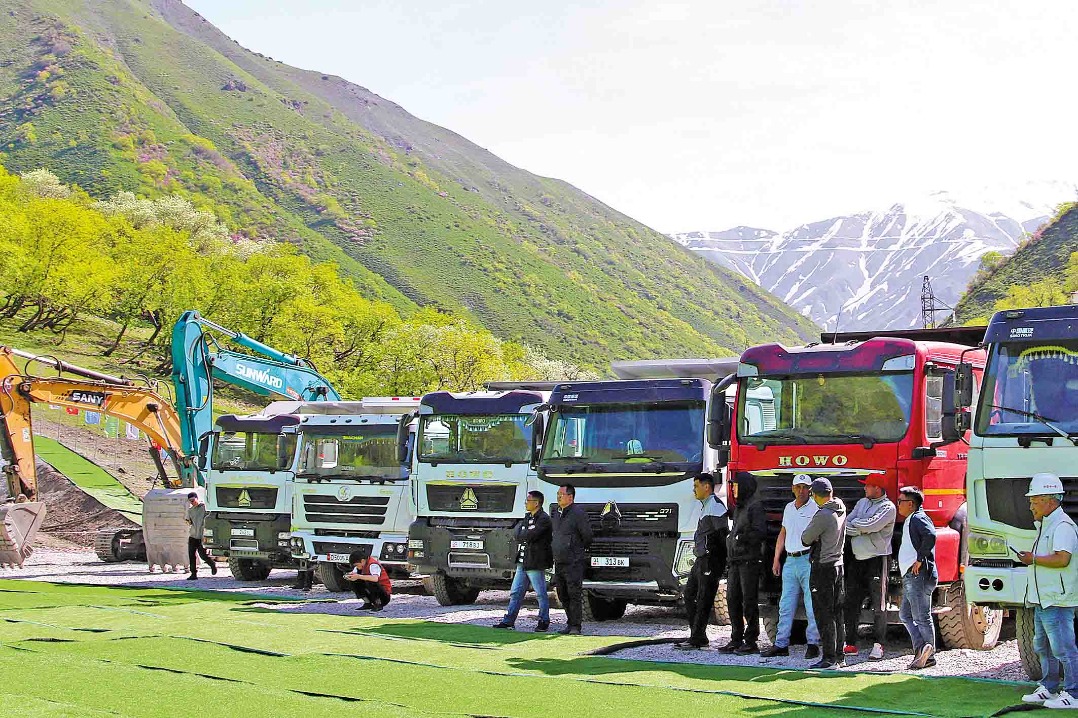
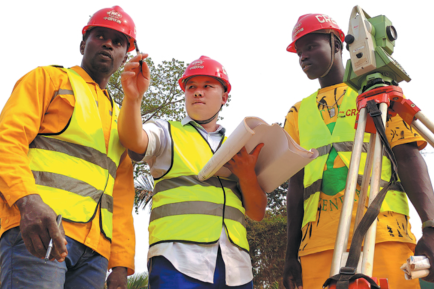
Through Belt and Road cooperation, some countries now have their first motorways or modern railways, some has developed its own car industry, and some have seen an end to their longstanding power shortages.
Thanks to Belt and Road cooperation, Kazakhstan, the world's largest landlocked country, has gained access to the Pacific Ocean through the Lianyungang port in China; and the China-Kazakhstan logistics terminal has become an international economic platform of cross-border transportation, warehousing, logistics and trade for many other Central Asian countries.
Thanks to regular China-Europe Railway Express freight services, the number of Chinese companies operating in Duisburg of Germany has grown from 40 in 2014 to more than 100. Statistics from the Duisburg City Council show that, in the city's logistics sector alone, such freight services have created more than 6,000 jobs.
Since it was leased to a Chinese company, the Piraeus port in Greece has become one of the fastest growing container ports in the world, soaring to the 36th place in global container traffic ranking from the 93rd in 2010. The port has about 10 Chinese staff but employs 3,000 Greeks, and it has also created more than 10,000 indirect local jobs.
Chinese investment in Egypt has made the country the world's third largest producer of fiberglass, and a large number of technical and managerial professionals have been trained. The 82 cooperation parks jointly built by China and other participating countries have created more than US$2 billion in tax revenue and about 300,000 jobs for host countries. The list of BRI success stories can go on and on.
All these success stories fully demonstrate that the BRI has provided good opportunities for all parties involved to jointly address global challenges, promote global growth, and achieve common prosperity through greater connectivity. But this is only the beginning, and there is a lot more we can accomplish by pursuing this cooperation initiative. China will continue to work with all other parties to create even more opportunities and deliver even more fruitful outcomes.
Q: Efforts made over the past six years have laid a solid foundation for BRI cooperation. What are the new opportunities for BRI cooperation under the new conditions? How will such cooperation be deepened and substantiated? The BRI is generally applauded and supported by the international community, but we have also heard some different views or even doubts expressed against this initiative. What is your response to it?
A: Through six years of hard work, the BRI has laid its groundwork and entered the stage of all-round growth; it is bearing fruit and will create more opportunities for cooperation.
The opportunities come with the BRI's growing international influence, moral appeal and cooperation potential. Against the backdrop of mounting protectionism and unilateralism in the world, the BRI principle of consultation and cooperation for shared benefits has gained wide recognition. Support for the BRI is the mainstream view of the international community, and the opportunities created by BRI cooperation are widely appreciated in the global community.
The opportunities come with the growing complementarity among the development strategies and plans of all BRI partners, from the solid gains achieved in BRI cooperation across the board, and from progress of bilateral, trilateral and multilateral cooperation. As such, a strong foundation has been laid for quality BRI cooperation.
The opportunities come with the accelerated industrialization of a vast number of developing countries, a process which generates new demands in infrastructure connectivity and industrial investment, and promises huge potential for international cooperation.
The opportunities also come with the transition of the Chinese economy toward quality development. As China opens its door wider to the world, more opportunities are being created for other countries to participate in BRI cooperation and enter the huge Chinese market.
At the seminar marking the BRI's fifth anniversary last August, President Xi Jinping highlighted the need to move BRI cooperation toward quality development. This is the goal we are striving to achieve. To this end, we will work vigorously to harness development opportunities, further enhance the complementarity of the development strategies of various parties, ensure that projects launched meet high quality standards, and further promote international cooperation.
We have noticed that some people have expressed different views about the BRI, claiming that the Initiative is China's geopolitical tool and could cause some countries to fall into a debt trap. Such views are less than objective or balanced. They are simply a misunderstanding, misrepresentation and even biased view of the BRI.
We have stressed on many occasions that the BRI is an initiative for economic cooperation that supports common development. All parties involved are equal participants, they have all contributed to the Initiative and benefited from it. The BRI is open, inclusive and transparent. It does not harbor any hidden geopolitical agenda, nor is it designed to form an exclusive circle or impose discriminatory trade terms on others.
No one is in a better position to repudiate the so-called debt trap allegation than the BRI participants themselves. As a matter of fact, the governments, business communities and the general public of many countries that have participated in and benefited from the BRI have spoken up and debunked such groundless assertions with facts and figures.
Decisions made under the BRI framework, whether project selection or investment and financing cooperation, are all based on full consultation among the parties and on the basis of conducting due risk assessment and investment feasibility study.
China and another 27 countries have jointly adopted the Guiding Principles on Financing the Development of the Belt and Road, which highlights the need to ensure debt sustainability in project financing. In case our cooperation partners face difficulties in servicing debts, China will properly address this issue through friendly consultation, and will never press them for debt payment. As a matter of fact, no country has got trapped in a debt crisis since its participation in the BRI. On the contrary, it is through participating in BRI cooperation that many countries have got out of the trap of "no development".
Q: The first BRF hosted by China in May 2017 was a complete success. President Xi Jinping announced that China will hold the second BRF in April 2019. What is the theme of this Forum? What activities will be held? What outcomes does China expect from this year's Forum?
A: The BRF is the top-level platform for international cooperation under the BRI framework. In May 2017, the first BRF was successfully held in Beijing, which produced positive consensus on BRI cooperation and delivered fruitful outcomes. In response to the wishes of the participating parties, President Xi announced at the first Forum that China will hold the second BRF in 2019.
Through consultation with all other parties, we have decided to hold the second BRF in Beijing in late April this year. President Xi has sent invitations to the leaders of relevant countries for participation in the second BRF. The theme of this year's BRF is: Belt and Road Cooperation: Shaping a Brighter Shared Future, and the Forum events include the opening ceremony, a leaders' roundtable, a high-level meeting, thematic forums, a CEO conference and other side events.
Representatives from over 100 countries, including about 40 leaders of foreign governments, have confirmed their attendance. As the host country, we will, together with other Forum parties, take stock of what has been achieved and draw a blueprint for future cooperation to further enrich BRI cooperation.
We hope that the participating parties will further enrich the vision of advancing quality BRI cooperation.
We hope the participating parties will continue to follow the principle of consultation and cooperation for shared benefits, stick to people-centered development philosophy, forge extensive partnerships, jointly promote all-round connectivity, and implement the UN 2030 Agenda for Sustainable Development. We hope the Forum will send a positive message of strengthening international economic cooperation, promoting global growth, and building an open global economy.
We hope that the participating parties will set clear priorities for cooperation and make concrete progress toward quality cooperation.
BRI cooperation is not a talk shop, but an action-oriented initiative that delivers real outcomes. The second BRF is expected to produce a full range of outcomes, including both governmental cooperation agreements and initiatives, and concrete cooperation projects involving participation of the business sector. All these will be included in a list of deliverables and be released in due course. We are confident that the second BRF will produce even greater numbers of cooperation outcomes that are of still higher quality.
We hope that the participating parties will strengthen cooperation mechanisms for quality BRI cooperation.
The parties concerned are currently involved in BRI cooperation in various forms. We hope that the participating parties attending the Forum will build on successful practices and jointly develop a multi-tiered cooperation framework.
First, we will improve bilateral cooperation mechanisms to strengthen the complementarity between the BRI and the development policies, plans and initiatives of all participating parties.
Second, we will enhance trilateral cooperation and encourage cooperation among participating countries in third markets.
Third, we will expand multilateral cooperation, with focus on ensuring the sound development of the BRF; and we will enhance cooperation with multilateral economic and financial institutions to explore multi-party cooperation in specific areas.
We are convinced that with the concerted efforts of all the participating parties, the second BRF will deliver fruitful outcomes, create more driving forces for the economic growth of both participating countries and other countries concerned, provide more opportunities for international economic cooperation, and contribute more to the vision of a community with a shared future for mankind and a new type of international relations.