


Reaching for the STARS










China's rapidly developing space program sets sights on Mars, Jupiter
The founders of China's space program could not have imagined one day sending a spacecraft to Mars when, back in the 1950s and '60s, they struggled with great difficulty to establish the country's space industry.
Ordinary Chinese, who in those days mostly dreamed of having a small television set or a bicycle, had not thought about possibly seeing some of their compatriots eventually traveling in space.
Today, Mars is one of the destinations on China's agenda. The space authorities have even worked with the local government in Gansu province to construct a Mars simulation base in the barren, wind-swept hills of the province. The base was opened to the public in April.
Researchers are racing against time to prepare for the country's first exploration mission to Mars, scheduled for 2020.
According to the China National Space Administration, China's first Martian probe will conduct scientific investigation of the Martian soil, geological structure, environment, atmosphere and water.
Zhang Rongqiao, chief scientist of the Mars exploration program, said the farthest distance between Earth and Mars is about 400 million kilometers, so a probe must travel about seven months before reaching the Martian atmosphere in 2021.
Sun Zezhou, the spacecraft's chief designer at the China Academy of Space Technology, said the robotic probe will consist of three parts - the orbiter, the lander and the rover. The rover, with six wheels and four solar panels, will carry 13 scientific instruments, weigh more than 200 kilograms and work for about three months on the planet, he said.
In the second step in China's Mars exploration program, a larger probe will set off for Mars around 2030 to take samples and then return to Earth, according to Wu Yanhua, deputy director of the space administration. He also has said Jupiter and its moons will be visited by at least one unmanned Chinese probe before 2030.
Lunar aspirations|China has launched four lunar probes since 2007, with the third being the first Chinese spacecraft to land on the moon's surface.
The latest and most remarkable, the ongoing Chang'e 4 mission, is the first endeavor by any nation to conduct surface observation of the moon's far side, which never faces Earth, thereby accomplishing a goal sought by scientists for decades.
The Chang'e 4 robotic probe was lifted atop a Long March 3B rocket in early December at the Xichang Satellite Launch Center in southwestern China's Sichuan province.
The probe made a soft landing on the far side on Jan 3 and then released the Yutu 2 - the world's seventh rover on the moon and the first to reach the far side - to roam and survey the landing site in the South Pole-Aitken basin, the largest known crater in the solar system.
Tidal forces on Earth slow the moon's rotation to the point where the same side always faces Earth. The other side, most of which is never visible from Earth, is known as the far side of the moon.
The Chang'e 4 mission has generated a great number of images and data about the far side. It is helping scientists around the world to discover what they haven't known about the moon and take advantage of the far side's shield against Earth's interference to make clearer observations into deep space.
The next step in China's lunar exploration agenda, the Chang'e 5 mission, is set to take place in the coming months, with the aim of deploying a rover to take samples and bring them back. If the mission is successful, it will make China the third nation to bring back lunar samples, after the United States and Russia.
Manned expeditions|China tried to run a manned space program in the late 1960s and mid-1970s, but later dropped the attempt due to financing and technological obstacles.
In the early 1990s, the call for sending Chinese into space was raised again and was supported by the country's top leadership. This led to an enormous project involving hundreds of thousands of researchers, engineers and technicians.
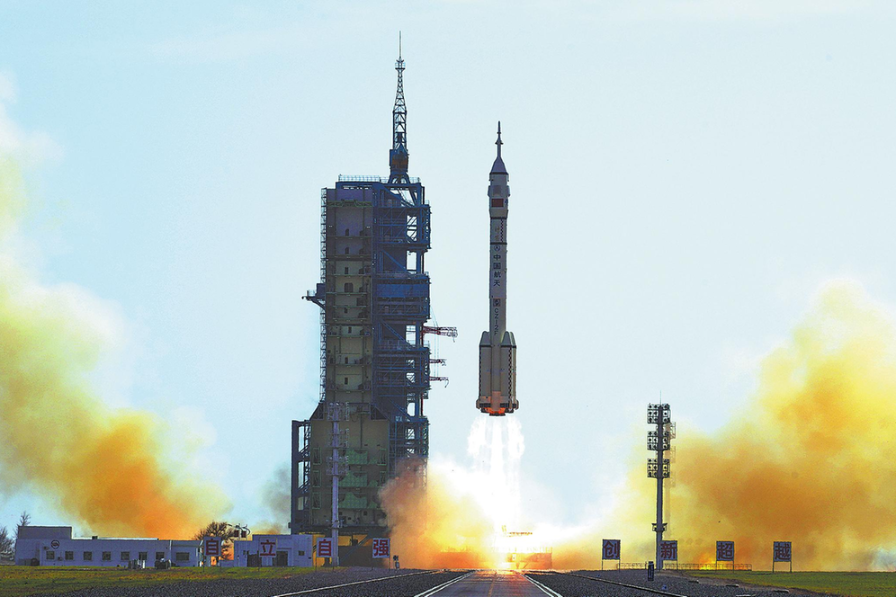
On Oct 15, 2003, the nation carried out its first manned space mission, sending Yang Liwei on a 21-hour journey around Earth in the Shenzhou V spacecraft.
Since then, China has conducted six manned spaceflights, which totaled 68 days and orbited Earth 1,089 times, while the nation's astronauts have traveled more than 46 million km in space and conducted more than 100 experiments.
Chinese astronauts have also undertaken extravehicular activity, conducted several extended missions inside the Tiangong I and Tiangong II space labs, and delivered a 40-minute lecture from space that was watched by more than 60 million students at about 80,000 schools.
China is now selecting the third group of astronauts and will train them for its coming space station mission.
According to government plans, the nation will start putting together its first manned space station around 2020. In the first step, a Long March 5B rocket will put the station's core module into orbit. Then other components and astronauts will be ferried to the core module to assemble the station.
The multimodule station, named Tiangong, or Heavenly Palace, will have three main components - a core module attached to two space labs - with a combined weight of more than 90 metric tons, according to the China Academy of Space Technology.
The space station is expected to be built and become fully operational around 2022, and is set to operate for about 15 years, the academy said.
Space-based compass | At the end of last year, China's Beidou Navigation Satellite System started to provide global services.
Currently, there are 41 Beidou satellites in active service in space. The China Satellite Navigation Office intends to launch up to five more Beidou satellites before the end of the year.
Beidou is one of four space-based navigation networks, along with the United States' GPS, Russia's GLONASS and the European Union's Galileo.
Since 2000, when the first Beidou satellite entered orbit, 52 satellites - including four experimental ones - have been launched, and some have been retired. Beidou began providing positioning, navigation, timing and messaging services to civilian users in China and other parts of the Asia-Pacific region in December 2012.
In addition to Beidou, China has made significant progress in developing other space-based assets for public or commercial purposes.
In December, China Aerospace Science and Industry Corp deployed the first satellite in its Hongyun project, the country's first low-orbit broadband communications satellite network.
The company intends to place more than 150 Hongyun satellites into orbit around 2023, and the number is likely to rise in response to market demand, according to Xiang Kaiheng, Hongyun's chief designer. After the network becomes fully operational, users will be able to pay to make calls and use high-speed internet services globally, he said.
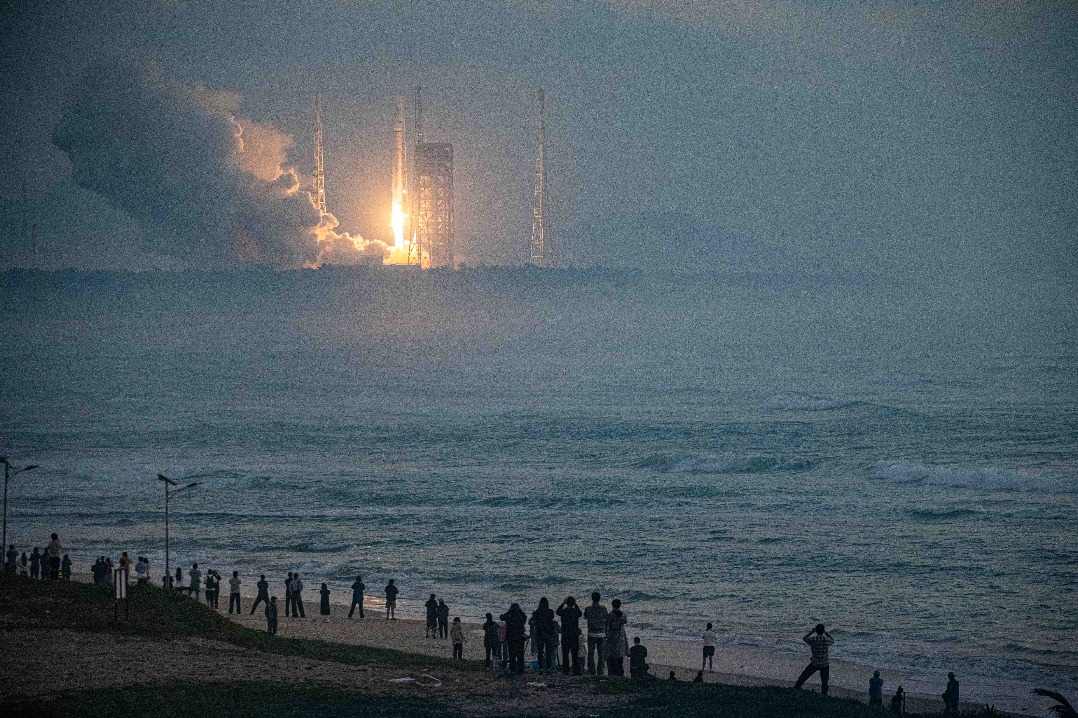
Expanding rocket family | Nowadays, the mightiest and tallest in China's carrier rocket family is the 20-story-tall Long March 5, which has a liftoff weight of 869 tons and a maximum carrying capacity of 25 tons to a low-Earth orbit.
However, the colossal rocket is still not strong enough to take manned missions to the moon or other deep-space mega projects.
In response, researchers at the China Academy of Launch Vehicle Technology in Beijing have begun designing the Long March 9 superheavy-lift carrier rocket.
According to the designers' plan, a Long March 9 will be capable of lifting 140 tons of payload into a low-Earth orbit or a 50-ton spacecraft to a lunar transfer orbit. The 100-meter rocket will also be able to ferry 44 tons of payload to a Mars transfer orbit.
Long March 9's carrying capacity will be as much as five times that of the Long March 5 - powerful enough to take the equivalent weight of a Boeing 787 jetliner into space or to place 25 Volkswagen sport utility vehicles on the moon.
If research and development proceed well, the Long March 9 will carry out its first flight around 2030, and then will enable China to land astronauts on the moon and take humans and probes beyond the moon and into deep space, said Li Hong, deputy general manager of China Aerospace Science and Technology Corp.


- Wave of freezing weather brings snow to northern China
- APEC 'China Year' kicks off at Shenzhen meeting
- HKSAR chief executive says to conclude residential complex fire probe within 9 months
- Viral scenic valley in China, not Japan, operators of tourist attraction clarify
- European Chamber Shanghai Chapter calls for stronger EU-China sustainability ties
- Former senior official at State Council body under investigation