


Is Confucius still relevant?










The ideas of the ancient Chinese sage may need a little tweaking, but their imprint on the nation and world is undeniable. He helped carry Chinese culture through difficult times, and his ideas now point the way to world peace.
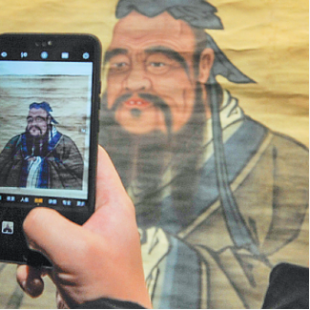
At a ceremony in September to commemorate the 2,570th anniversary of the birth of Confucius in Qufu, Shandong province, hundreds of students and residents recited classic quotes from the ancient sage's Analects. More than 2,000 people — including UNESCO officials, scholars and descendants of Confucius — attended the ceremony, which featured ritual dances by performers in costumes from the Han Dynasty (206 BC-AD 220).
Memorial ceremonies were held on the same day in more than 30 Confucian temples across the country, as well as in cities abroad, including Tokyo — testimony to the widespread influence of China's philosopher of the people, whose ideas have become articles of national faith.
Yet Confucius remains an enigma to many Chinese. They know Confucius is an important element of the culture, but they can offer only references to a handful of the social principles he advocated. Most learned about him in school, but they're not too sure about his current influence in fast-moving modern China.
The sage's soaring reputation in the country's history became a target of ideological attacks during the "cultural revolution" (1966-76), but recent decades have seen a revival, fostered in part by the government. He has emerged again as a central figure in defining what it means to be Chinese, and the message is spreading through hundreds of teaching institutions worldwide — the Confucius Institutes.
But while many people pay glib lip service to Confucius, do they really sense his presence in their day-to-day lives? Or does he merely serve as a sort of national decoration, like a plant relegated to the corner of one's sitting room? You know it's there, but nobody really thinks about it.
This is no small matter. In fact, Confucius reaches deeply into the souls of ordinary Chinese people, whether they realize it or not.
Signal vs. noise
Like a strong, steady radio signal, or carrier wave, emanating from the distant past, the essence of Chinese identity has survived troubled times, despite some noisy interference.
"That's a very nice metaphor," said Roger T. Ames, a Confucius expert in the Department of Philosophy at Peking University in Beijing.
"During the 10-year national nightmare they tried to root out the ancient tradition, to pull it out of the ground. And then a few years later, it grew back again. It's like rain in the desert. That indigenous impulse — the signal — is so strong that you just can't override it. It's there in the language. It's in the people, in the institutions, in the family. It's in the way people relate to each other."
China's dramatic rise can be explained in part by looking at its ancient social underpinnings and the cultural threads that have connected its people. Confucius played a crucial role in knitting those threads into a national fabric: He crystallized principles of social cohesion and lubrication that had been evolving in China for centuries before him. Crucially, these were written down, thereby binding his ideas across the arc of time and elevating him as an oracle for a nation.
It was Confucius who brought ideas of right and wrong down to earth from the more abstract philosophical works of philosopher Laozi and delivered them to the common people in a simple, gritty form they could understand.
His impact on China is arguably greater than that of any other intellectual.
"It is hugely important to make this connection between the past and present in China," Ames said, adding that people are "profoundly aware" of the cultural wave that's embedded in the Chinese character.
"It's tihui (體會(huì)). It's tiyan (體驗(yàn)). It's something that you know through practice, through language, through experience. It's a way of thinking. Maybe ordinary people don't have a vocabulary to express it, but that's the way they live their lives," he said.
"First of all, it's the idea that today is better than yesterday; tomorrow will be better than today. So there's this kind of optimism."
Zhang Jun, 33, a construction projects supervisor in Jinan, cannot quite put his finger on it, but he definitely feels the power of the cultural signal carried forward by Confucius.
"I can't speak specifically how it influences my life, but it is there. Everybody knows it. After thousands of years, Confucius is still quoted by people. His sayings are seen all over this city, such as on the bus."
Cultural realignment
Guo Jiulin, 51, a professor of American studies at Dalian Minzu University, also senses the cultural carrier wave.
"As a broad and profound ancient Chinese philosophy, Confucianism has been affecting — unconsciously — the behavior of each individual Chinese person for more than 2,000 years," he said.
What stands out for Guo are the doctrines of "not doing to others what you don't want others to do to you" and cultivating moral character.
"From these I understand that if a person wants to fulfill his social ambition, he must first of all perfect his own moral character and be strict on himself in words and deeds," he said.
"As an educator for more than 20 years, I have been trying my best to become a positive role model for my students, doing nothing pompous. I believe that deeds speak louder than words, and I am determined to exert silent influence on them by example.
"Only in this way will a person be able to contribute more to his country, or to become a harmonizer within his circle — a trustworthy person with a tranquil mind."
For Ames, such attitudes are a sign that China is regaining its ancient identity and realigning with its own cultural radio wave, not taking cues exclusively from the West.
"With the rise of China in the last generation, there's this notion of zixin (自信), of confidence," Ames said, adding that while the younger generation tends to look to the West as the icon of modernity, they will not always do so.
"One of the things you have to say about the present government is that they are collaborating with the academy to try to promote a revival of Chinese culture," he said. "So there are forces at work, and there's no need to be impatient. You know that China will come back to its own culture gradually over time. After all, in just one generation, we've seen progress in China that is unprecedented in human history."
Spreading the word
Shandong province, by virtue of being the birthplace and family home of Confucius, has played a leading role in promoting the values detailed in the sage's philosophy. Around 23,000 lecture rooms have been created in communities in the province to spread Confucian wisdom, according to the provincial government.
In a program funded locally, elders, prestigious community members, college professors and volunteer scholars give lectures to residents, mostly on traditional Chinese classics and Confucius.
Confucian harmony is being put into practice in settling disputes between rural residents in Qufu, a county-level city in Jining. More than 400 mediation rooms have been operating for more than four decades, the city's information office said. The success rate for resolving disputes is around 98 percent.
And Confucius continues to attract disciples, just as he did more than 2,500 years ago. More than 5.8 million people visited his temple, family cemetery and family mansion in Qufu last year.
The buzz over Confucius in Shandong is palpable, especially during summer breaks. Students ranging from primary school to college mingled with a steady flow of tourists to feel the vibe and learn about the sage.
More than 145,000 students participating in nearly 800 study tours visited various Confucian legacies during the first half of this year, according to the information office.
But not everyone shows such enthusiasm. Li Gong, a 52-year-old migrant worker in Jinan, for example, was reserved.
"I'm not sure whether Confucius has any influence on me. I didn't learn his works," Li said. "I just work as hard as possible so I can live a better life."
He may not have realized that diligent work is also found in the list of Confucian values. In fact, at virtually every level, the ancient sage remains instructive in modern times, said Yan Binggang, deputy head of the Advanced Institute for Confucian Studies at Shandong University.
"Confucian values are like DNA in Chinese people and will always be in their blood no matter how the social structures change," he said.
For Yan, the key Confucian values are he (和), meaning harmony; li ((禮)), propriety; and ren ((仁)), benevolence.
"The Chinese word he is the essence of Confucian wisdom and has been central to the family and social life," he said. "Only a harmonious relationship between human beings can ensure that society develops in an orderly way."
Once a month, Yan and his students travel to Sandefan village in Jinan's Zhangqiu district to deliver free lectures on Confucian values. They tell stories that advocate benevolence, righteousness and courtesy, among other qualities.
He said many people come to tears when he shares stories about filial piety, the love of family.
"During the past 100 years, Confucian values have been heavily criticized. Even now, many people prefer Western concepts to traditional culture," Yan said. "What we need to do is awaken the essence. The values must come out of the ivory tower so they can reach people and guide their behavior."
Feeling of family
Prominent among China's ancient intellectuals is Laozi, the reputed founder of Taoism, who some say may have interacted with Confucius. But the respective works of the two giants are quite different. Laozi's Tao Te Ching ((道德經(jīng)) is abstract and appeals to scholars, Peking University's Ames said. By contrast, the Analects of Confucius "is all about the everyday".
"It's all about making the ordinary extraordinary. It's all about family. It's all about ancestors. It's all about teachers and students," he said. Relationships are the key, starting with jia, or family.
"The idea of family is pervasive in the culture. It's a kind of feeling," he said.
"Another term that is really fundamental is the notion of li. Part of li is achieving propriety in your roles and relationships. It's being a good daughter. It's having a good life. It's living life elegantly, with refinement.
"This is an aspiration in life. It's paying attention to your roles and relationships with other people, with your family, with your colleagues. These ideas are fundamental to being Chinese. Without them, there's no Chinese."
Such core concepts are the wellspring of Confucianism, Ames said. With Confucius, life is a group project.
"In the Chinese world, things make each other. ... If there's only one person, there are no persons, because you need other people to become human. We literally make friends. Human beings are 'human becomings'. You don't begin as an individual. Your individuality is something that you accomplish, not exclusive of relationships but by virtue of the quality of the relationships you're able to cultivate with other people. The language itself reflects this cosmology."
Aristotle, the Greek philosopher who expanded the Western concept of individualism, asked, What is a man?
"The ontological answer is a subject, and the essence is a soul," Ames said. "But in Chinese, the fundamental question is not what is something, but where does it come from? If you want to know a person, you don't know them by knowing their soul or by analyzing them. You know them by knowing their narrative: Where did they go to school? Who were their teachers?
"And so in Chinese, the most important question is the story. It's not what is somebody, it's whence and whither."
Yin Jianghong, 42, a journalist in Jinan, acknowledged the "very big influence" of Confucian concepts in her life.
"He not only influenced my values and behavior but my way of educating my child — sayings such as, 'A wise man won't stand beside a collapsing wall' and other concepts about how to treat people. If there were no Confucius, we wouldn't have stories to teach our children," she said.
And that is a crucial concept. For any culture to survive, its narrative must be passed down through rich channels of tradition, language and social structure. The key, Ames said, is in the concept of dao (道), "the idea that there is a kind of orthodox way, a center — dao tong (道統(tǒng)), a center of Chinese culture that moves on from generation to generation".
Upgrade needed?
Still, one might ask whether the ancient sage of Shandong province needs a reboot for the new era, an upgrade to Confucius 2.0, to remain relevant in a supercharged modern world.
Zhang, the construction supervisor in Jinan, said Confucian ideas are good, as far as they go, but they may not be adequate to handle all aspects of life in the 21st century.
"His ideas work most of the time in life. But in some situations the law or the military work more efficiently than Confucian concepts," Zhang said.
Sunyu Zhuoran, 19, a college student in Hangzhou, Zhejiang province, can recite a dozen Confucian teachings in one breath — so nobody can say she doesn't know her Confucius. But she thinks the sage may be obsolete in some areas.
"I learned a lot of the Analects in middle school. It was in our exams, and there was a Confucius statue where some of my classmates would go to pray for blessings," she said.
"But some Confucian teachings need to be updated, such as 'Women are hard to handle' — which I can't agree with.
"We shouldn't inherit all the Confucian teachings without considering whether they fit for the current situation, because the environment in which Confucius lived is very different from the one we now have. We need to draw good things from Confucian teachings and discard the outdated ones."
That may be true, but Wang Xuedian, chief editor of the Journal of Literature, History and Philosophy at Shandong University, said Confucian concepts such as he and ren are being shortchanged if they are regarded merely as ethics concepts to manage relationships between people. They should be used to cure the seemingly endless political and social maladies that plague mankind.
"It's actually a theory of social science and social development," he said. "But there is still a long way to go to activate Chinese traditional culture and integrate it with people's daily lives."
Like Wang, Ames also sees value in applying the Confucian approach to global problems.
"My argument is not that Confucianism is the answer but that it deserves a place at the table, that it has some important things to say to the world when it comes to rethinking what it means to be human in light of the problems we face today. Global warming, pandemics, food and water shortages, environmental degradation, international terrorism. Whether it's an individual, a corporation or a country, we can solve these problems only if we work together.
"The Confucian concept says that the only way I can take my stand is by helping other people take theirs. If my neighbor does better, I do better. That's the Confucian wisdom. This is really needed in the world today."
As for the current state of world affairs, "What we're doing now is madness, just absolute madness — the idea of 'us versus them'. We're just swimming right against the tide," Ames said.
"The human predicament requires that we change our values and practices. We have to see the world differently. That's why Confucianism has to be brought in, not as the answer to everything, but as something that can help fashion a new culture for our time."
Contact the writers at zhaoruixue@chinadaily.com.cn