


Pro-consumption policies can stabilize economy









At this year's two sessions, expanding domestic demand was identified as one of the means to better achieve a series of goals and tasks in six key areas that the government said are closely connected with stabilizing China's economy.
An important part of expanding domestic demand is to increase consumption. Domestic consumption is the base of China's economy, accounting for 60 percent of the GDP increase. Only when consumption is stabilized can economic stability be guaranteed.
Problems of China's consumption have become more prominent in recent years. The actual growth rate of consumption in 2019 was 6.36 percent, a decrease of 1.7 percentage points from 2018. Contribution of consumption to economic growth was 57.8 percent, down 8.1 percentage points from 65.9 percent in 2018. The decline in consumption growth had led to increased downward pressure on the economy in 2019.
Furthermore, the novel coronavirus outbreak has had a negative impact on consumption of China's residents. China's total retail sales of consumer goods from January to April had seen a 16.2-percent decline.
As a new driving force for consumption, sales of online goods and services only increased 1.7 percent year-on-year, down 14.8 percentage points from the 16.5-percent growth rate in the first quarter of 2019. In the first quarter of this year, consumption dragged negative GDP growth by 4.36 percentage points, accounting for more than 60 percent of the negative GDP growth.
With the effective control of the domestic epidemic, will there be a "retaliatory rebound" in consumption? The answer is negative. So-called revenge consumption means that residents' consumption patterns should change. However, residents will not turn to revenge consumption from the perspectives of both micro-or macro-economics.
On the one hand, the coronavirus impact on the economy will continue for a period of time, which will increase the risk of unemployment. As of April, the accumulative number of new jobs in urban areas declined by 22.9 percent year-on-year, and the surveyed unemployment rate rose to 6 percent. Faced with huge uncertainty, consumers will be more cautious and their savings tend to rise. "Staying in house" has become a normal behavior, and the impulse to purchase will be suppressed.
On the other hand, speaking from the perspective of micro-behavioral patterns, the consumption pattern is at most at the normal level before the coronavirus outbreak, and the increase in compensatory consumption will not occur.
Residents will not intensify their efforts to eat five meals a day in the second half of the year simply because they did not eat out in the first half of the year, nor will they get a haircut every day in the second half of the year because they did not go out for haircuts in the first half.
The consumption of durable goods such as home appliances is a delay in consumption in the first half of the year, not a retaliatory growth. People will not buy two TVs or five refrigerators because they did not purchase in the first half of the year.
In general, what has been lost has been lost. In most consumer categories, consumers will not automatically increase their purchases in the second half of the year to make up for the lost consumption in the first half of the year.
In short, considering the general trend of declining consumption growth in 2019 and the coronavirus impact, the direction of efforts in the second half of the year is to reverse the rapid decline of consumption growth in 2019, instead of expecting explosive growth. Therefore, the overall policy orientation for consumption is to achieve "stable" growth.
In order to stabilize consumption, central and local governments have implemented a series of policies, such as issuing consumer vouchers and starting car purchase subsidies. These policies have worked well. However, in order to better stimulate consumption, it is also important to stabilize residents' assets and liabilities in addition to focusing on the upgrade of consumption content.
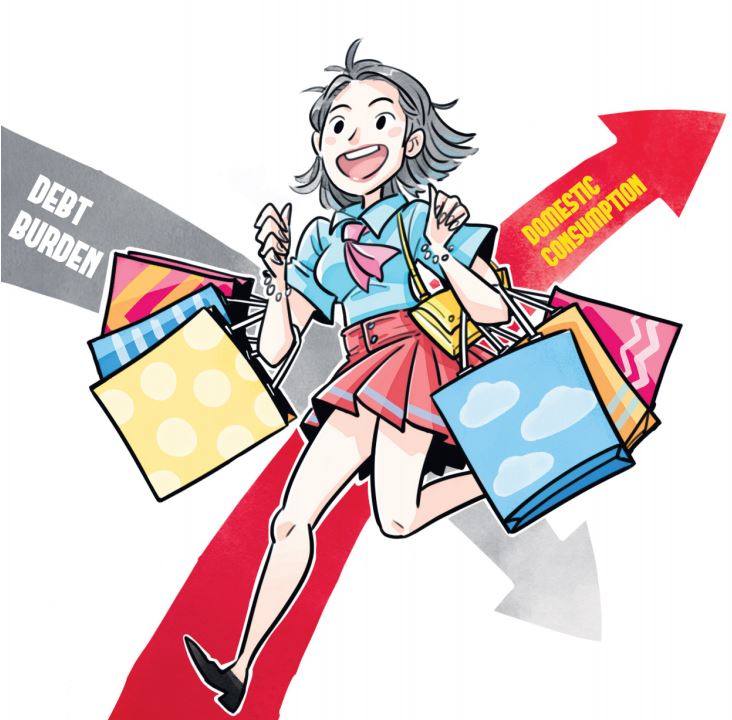
After seeing the coronavirus impact on residents' income, the high debt burden on the residents' balance sheets has increasingly hindered consumption. In recent years, the resident debt has continued to accumulate, resulting in the rising debt-to-income ratio in the household sector and increasingly tight cash flow for residents. Under the coronavirus impact, the growth rate of residents' income this year has declined, which has led to increased pressure on debt payments and less money for consumption.
According to a report by the People's Bank of China, the central bank, the country's leverage ratio of the household sector was 60.4 percent, lower than the average of 72.1 percent in developed economies, but higher than the world average of 59.7 percent and the average of 39.9 percent for countries considered as emerging markets as of the end of 2018.
At the same time, the increase in the leverage ratio of China's household sector is higher than that of major countries in the world. In 2018, the leverage ratio of China's household sector increased by 3.4 percentage points, while the leverage ratio of the household sector in the United States and Australia decreased by 1.5 and 0.7 percentage points respectively. The leverage ratio of the household sector in Japan and the United Kingdom also increased slightly.
With the rising leverage ratio, residents are facing increasing pressure to repay their debts. According to the PBOC, disposable income of China's household sector increased by 8.7 percent year-on-year in 2018, which was 7.5 percentage points lower than the growth rate of debt in the household sector during the same period.
The ratio of loan balance to disposable income in the household sector was 99.9 percent, an increase of 6.5 percentage points year-on-year. In 2019, household sector loans continued to grow by 15.53 percent year-on-year, and by April this year, loans in the household sector rose by 13.88 percent year-on-year, far exceeding the income growth.
Household debts have uneven pressures on different families. Once low-income families are in debt, their burden is heavier than that of others. However, it is indeed some low-and middle-income industries that have been affected most by the coronavirus outbreak.
According to data from the National Bureau of Statistics, industries of agriculture, forestry, animal husbandry and fishing, accommodation and catering, residential services and other services ranked the bottom in terms of average income. However, services industries such as accommodation and catering were the coronavirus hardest-hit industries this time, and recovery was very slow, exacerbating the financial burden on employees' families.
Based on the previous analysis, stabilizing China's economy lies in stabilizing consumption. In addition to government consumption, 70 percent of China's total consumption comes from household consumption. Owing to the rapid accumulation of debts in the past few years, and a slowdown in income growth resulting from the coronavirus outbreak, residents in China have increasing pressure to repay debts and interest.
Such burden on low-and middle-income families is even heavier. Rigid debt expenditures have greatly restricted household consumption.
Macroeconomic policies also need to be more targeted to stabilize residents' balance sheets. Measures should include further increase in support for labor-intensive industries, improvement in the quantity and quality of employment, and efforts to stabilize residents' income.
At the same time, government can consider a monetary policy that lowers interest rates. The current interest rate level is basically the same as that in 2009, but the economic growth rate is not the same, so the burden of interest on household and corporate debt is still relatively large.
Finally, in order to make up for the insufficiency of residents' consumption, fiscal policy should play a larger role in the field of government consumption. On the one hand, increasing government consumption can increase total consumption. On the other hand, protecting people's livelihood can also partially ease the pressure on residents' balance sheets.
The writer is a professor at the Beijing-based Renmin University of China's School of Economics, and a researcher at the university's National Academy of Development and Strategy.