


E-tailers change China, world









Rise of online platforms transforms shopping, shapes consumption, drives economy
Editor's note: To celebrate the 100th anniversary of the founding of the Communist Party of China, China Daily is publishing a series of stories on the changes and developments in various fields and industries.
When the COVID-19 pandemic locked down most of China in early 2020, fitness enthusiasts such as Shen Lei were forced to exercise in their apartments instead of going to gyms.
Shen would access workout sessions online via Xiaohongshu, a Shanghai-based social media site somewhat akin to Instagram.
But the livestreamed training courses were only part of the deal: Shen managed to purchase groceries and food ingredients needed for a healthy salad bowl with a few taps on the phone, and the parcels would materialize on her doorstep within half an hour.
E-commerce was a term largely unheard of two decades ago, but today it is one of the pillars of the Chinese economy. According to estimates from consultancy GlobalData, the Chinese e-commerce market is forecast to enjoy a compounded annual growth rate of 12.4 percent between 2021 and 2024 to reach $3 trillion.
Top of retail world
The initial thrust of e-commerce takeoff was to make up for China's relatively underdeveloped retail infrastructure compared with the West. It turns out, however, that the sector is turbocharging retail growth with such robustness that it has effectively catapulted the country to the world's top retail market.
According to Jonathan Cheng, a partner and retail practice lead in China at consultancy Bain &Co, the decade of 2001 to 2010 witnessed the rapid transition of retail from traditional mom-and-pop stores to hypermarket chains, whereas the massive digitalization leapfrog from 2011 to 2020 was "characterized by merchants and brands flocking to establish virtual stores".
Mention e-commerce and one cannot afford to miss Alibaba Group Holding Ltd, whose innovative array of gameplays is definitely rewriting China's, and even the world's, retail playbook.
Alibaba's Taobao started out as an obscure site in 2003, aiming to facilitate cross-border trade among bulk merchants. Its aim was to connect a horde of individual business owners with the vast number of Chinese customers looking for cost-effective deals.
With Taobao up and running, Alibaba introduced five years later a sister site called Taobao Mall (later rebranded as Tmall in 2012) to lure more established sellers (as compared to smaller-scale vendors gathering in Taobao).Taobao and Tmall are essentially the early prototypes of so-called customer-to-customer and business-to-customer e-commerce models.
Over the years, entrants have been flocking to the scene. JD, China's second-largest e-commerce platform by gross merchandise volume, was founded in 1998. It is characterized by a unique strength in selling computers, communication devices and gadgets, and consumer electronics.
Pinduoduo, which adopts a mobile-based group-purchase model and peddles cost-effective agricultural produce, quickly captured the attention of both users and the capital market. Established in 2015, the firm claimed it garnered 788 million annually active users by the end of last year, and went public on Nasdaq just three years after the company's birth.
The vicissitudes of e-commerce also witnessed the fall of once high-flying players like online supermarket Yihaodian and apparel seller Vancl, which are struggling amid increasingly fevered competition.
11-11 phenomenon
For a long time, e-commerce acted as a supplement to brick-and-mortar business, until a promotional event called Singles Day turbocharged its stellar rise.
Called the "Double Eleven"-Nov 11 or 11-11-festival, it celebrates singlehood. The Singles Day shopping extravaganza initiated by Alibaba in 2009 has morphed into the world's biggest online shopping event.
The gala initially featured discount items, luring bargain hunters to splash on everything from clothing to hair-dryers. Sales figures were also eye-catching: participating e-commerce sites have been breaking their own sales records of each year.
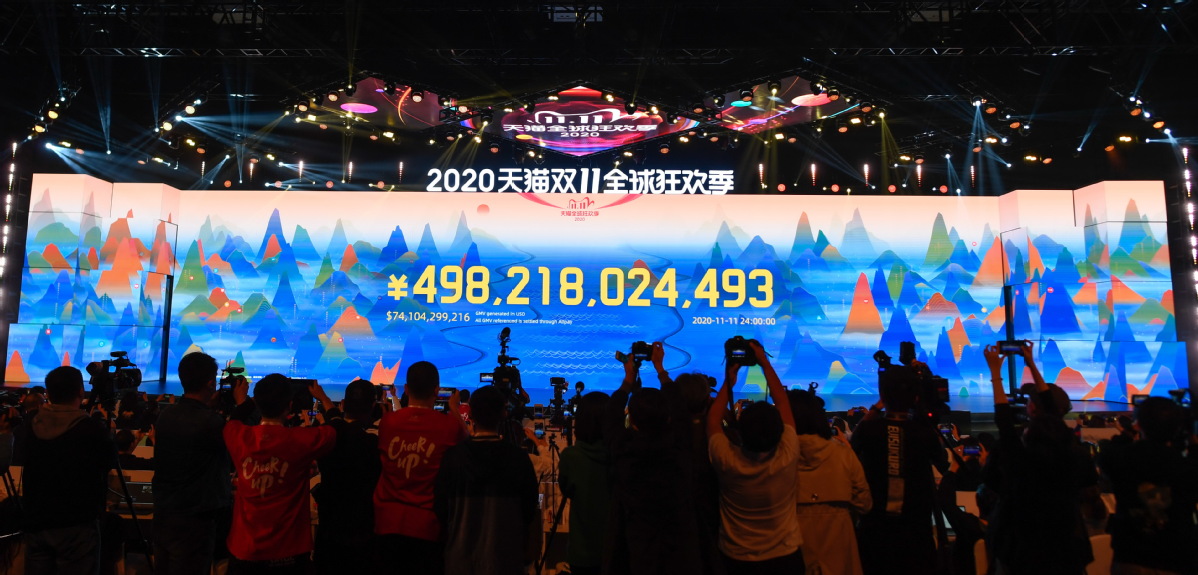
For instance, during last year's event, gross merchandise value (GMV), or sales revenue from across Alibaba's shopping platforms, was 498.2 billion yuan ($77.1 billion), up 26 percent from the level of 2019, in spite of COVID-19. The figure dwarfed the US Black Friday and Cyber Monday promotions combined.
While Alibaba is the name often associated with the mega shopping event, competitors JD and Pinduoduo all offer their own sales. JD offers some Double 11 discounts before the actual day. Even Southeast Asia's e-commerce platforms have jumped on the bandwagon.
If 11-11 was a smashing success from the word go, JD-founded June 18-"618"-h(huán)as been shaping up as a worthy challenger, becoming the mid-year e-shopping carnival where brands slash prices to boost sales.
But the story isn't just about growth in transaction volume or the number of participants. As online shopping festivals grow, shoppers have used them as an opportunity to try out new items rather than simply bag a bargain, said Matthew Crabbe, Asia-Pacific research director at consultancy Mintel.
"That changing sentiment (toward the likes of Singles Day) also aligns with China's shifting focus from quantity to quality growth," Crabbe said.
For instance, with COVID-19 hindering international travel, digital sales channels are quickly becoming the primary way for foreign merchants to tap into the Chinese consumer market through shopping fairs.
The sales of JD Worldwide, the company's cross-border commerce unit, surged by over 120 percent on a yearly basis in the first 10 minutes of the 618 festival, while JD's imported goods supermarket saw sales rise by 2.5 times month-on-month within 30 minutes.
What's more, companies are using the occasion to make product debuts or unveil limited-edition items through technologies.
"Using big data analytics powered by Chinese tech firms can help us locate … and retain customers in a precise manner …something we wouldn't have achieved using old-school retailing," said Gary Chu, an executive at US skincare company Estee Lauder Group.
The same held true for this year's 618: Among the 13 million items offered at discounts during the gala, which in Tmall's case commenced with a presale on May 24, 1.4 million made their debut, according to Yang Guang, vice-president of Tmall.
New offerings included both physical goods and catering and sightseeing options, from international brands like Hermes, Gucci and Dior, to local restaurants and tourist sites that are being endorsed by internet celebrities and have gone viral online.
Yang said new product rollout has been a driver of both brands and the site, noting transaction growth of new products jumped 50 percent in the past year. Such campaigns are helping Tmall to "become the world's top new brand incubation center".
Digital infrastructure
Shopping festivals have also given rise to new conundrums: super quick sales of newly advertised products, often with seconds of a sale or promotion opening, present a huge test to computer servers to handle numerous payment requests, and parcels keep piling due to a sudden surge in orders.
According to Crabbe, e-commerce has unexpectedly given rise to a wealth of related industries in China: digital payment, smart logistics and cloud computing, and they have in turn bolstered the nation's growth of e-commerce.
Launched in 2004 as an online payment and escrow service, Alipay addressed the payment dilemmas encountered by Taobao.
At the turn of the 21st century, China had no entrenched credit card culture. Smaller online businesses with relatively low sales volumes were unable or unwilling to accept credit card payments due to high transaction fees, and it was too costly to build their own e-commerce checkout systems with sufficient fraud protection.
So Alipay created an encrypted digital wallet that stored and safeguarded bank cards and enabled customers to make payments via their accounts. The money would not reach the sellers until customers confirmed they had received the goods.
Together with WeChat Pay, the pair has taken China to the world's top mobile payment market, according to consultancy Research and Markets. Estimated amount of mobile-based transactions reached 777.5 trillion yuan last year, up 31.8 percent year-on-year.
In a similar vein, to ensure fast and smooth delivery, the traditional labor-intensive courier industry required a serious revamp. With China churning out billions of parcels a year, a consortium of leading couriers formed a bloc called Cainiao Smart Logistics Network to improve efficiency and slash delivery times.
Under a smart logistics system, transportation routes aren't chosen by intuition but decided by real-time calculation of road conditions. Sought-after goods, based on data-based predictions, are normally pre-stored in warehouses at key transportation nodes to ensure faster delivery.
Behind the scenes is cloud computing, which is the backbone technology supporting both payment and logistics. Today, Alibaba Cloud and Tencent Cloud have moved beyond home turf, establishing data centers in dozens of economies.
'New Retail'
E-commerce firms have moved to revamp traditional retail.
One approach is to team up with large retailers and build a novel type of consortium. Chinese real estate conglomerate Dalian Wanda Group formed a joint venture three years ago with Tencent and Groupon Inc's former local unit to integrate online and offline businesses. That's just one of Tencent's endeavors to push "smart retail".
Likewise, Alibaba acquired retailer Sun Art Retail last year to improve the shopping experience for customers. Whether through in-store fulfillment of online orders, interactive kiosks or a selection of popular products from Tmall, RT-Mart, a supermarket chain under Sun Art, said it wanted to deliver the best of online and offline commerce in a country where the line between the two has been getting increasingly blurred.
The company also created a prototyped O2O-online-to-offline-supermarket chain called Freshippo, which features the use of big data and algorithms to predict customer preferences, co-create products with established and emerging brands, and offer 30-minute deliveries within a radius of 3 kilometers.
Another approach of Alibaba is to modernize mom-and-pop stands in lower-tier townships and villages, soliciting them to adopt smart management systems to enhance their capabilities in marketing, delivery and inventory management.
China has nearly 6 million retailers ranging from street stands and kiosks peddling soft drinks and snacks to street corner stores selling groceries, most of which have less financial leeway and limited negotiating power.
As such, an inventory monitoring system is in operation to give real-time advice on product display and portfolio adjustment. This is coupled with a three-layer warehouse system covering 200 cities and townships to ensure the timely delivery of products, based on geographical shopping preferences that are logged in Alibaba's data book.
Luo Dandan, who operates the Dandan Supermarket in Yiwu, Zhejiang province, is a beneficiary of such a program. She said normal daily revenue stood somewhere between 1,000 yuan and 2,000 yuan, thanks to the string of smart recommendations offered by the digital solutions.
"During the height of the pandemic, when other physical stores were forced to shut due to social distancing, we saw online orders surging via multiple online channels like Alipay and Ele.me," she said, adding that the average order value was around 500 yuan.
Regulation needed
Any sector enjoying skyrocketing growth could hit a rough patch, and e-commerce is no exception.
Malpractices like abusing monopolistic positions to crowd out new players are now under scrutiny, with the country's antitrust regulators imposing a record fine on Alibaba in April following a months-long probe into its business operations.
Sun Nanxiang, a researcher at the Chinese Academy of Social Sciences' Institute of International Law, said that antitrust measures are a worldwide trend and the ultimate purpose is to leverage legal tools to restore fair and effective competition in the market.
"It's not targeting the e-commerce sector per se but the monopolistic behaviors in general," Sun said. "Anti-monopoly supervision over those tech giants didn't cause them to lose core competence, but helped them to stimulate innovation and entrepreneurship and, at the same time, restore market confidence."
With enhanced regulation of the market, experts forecast new models will take shape and chart the future course of e-commerce.
Hyperlocal retail-location-based omnichannel sales of goods-is set to become brands' new battleground to win and retain customers over the next decade, according to Bain's Cheng.
Meanwhile, residents of cities in different tiers-with varying levels of socioeconomic development-h(huán)ave varying preferences in hyperlocal retail channels.
While people in Beijing and Shanghai favor on-demand service like the one-hour delivery offered by the likes of Alibaba's Freshippo, those in lower-tier cities see community group-buying as a more desirable choice, because it promises lower prices, thanks to the bulk purchases of merchandise by a group of people.
Liang Changlin, founder and CEO of omnichannel grocery e-tailer Dingdong Maicai, attributed the trend to internet technologies that are transforming traditional industries previously run on intuition and thus meeting the needs of people in pursuit of efficiency.
"For instance, big data can predict customer needs and calculate the best route in real time to ensure smooth and in-time door-to-door delivery," he said.