


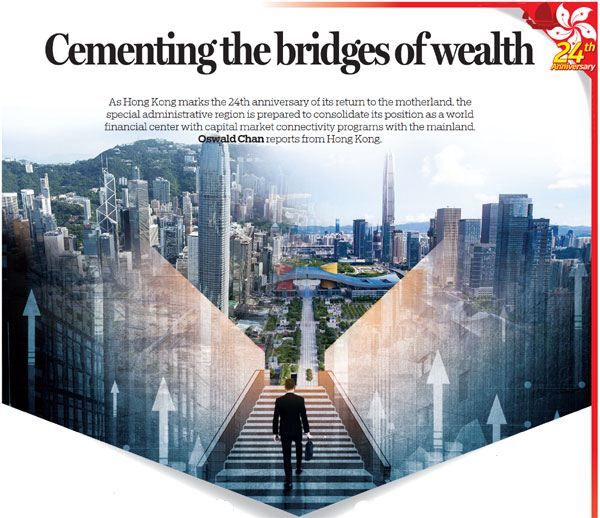
Cementing the bridges of wealth
As Hong Kong marks the 24th anniversary of its return to the motherland, the special administrative region is prepared to consolidate its position as a world financial center with capital market connectivity programs with the mainland. Oswald Chan reports from Hong Kong.









Cross-border fund flows between Hong Kong and the mainland are set to accelerate with the impending launch of the Wealth Management Connect and southbound trading of the Bond Connect - seven years after the start of the historic stock "through train" of the Shanghai-Hong Kong Connect, followed by the Shenzhen-Hong Kong Stock Connect in 2016.
The WMC's pilot scheme was promulgated on June 29 last year - two days before the 23th anniversary of Hong Kong's return to the motherland. The investment scheme - the first such project aimed at boosting economic integration in the Guangdong-Hong Kong-Macao Greater Bay Area - allows residents of Hong Kong and Macao, as well the nine Guangdong provincial cities in the 11-city cluster, to buy low-risk investment products sold reciprocally at banks in the Greater Bay Area.
The People's Bank of China, the Hong Kong Monetary Authority and the Monetary Authority of Macao have set an aggregate investor quota of 150 billion yuan ($23.1 billion) in each direction - southbound and northbound. But financial analysts reckon that the total aggregate investor quota of 300 billion yuan, with an individual quota of 1 million yuan, is expected to be less than 10 percent of the gross savings of the Greater Bay Area's population of more than 72 million. So the quotas are likely to be taken up fairly quickly provided the products meet the needs of targeted investors.
"The WMC represents another step forward in linking financial markets between Hong Kong and the mainland following the connectivity programs in the stock and bond markets," said CPA Australia Deputy President Eden Wong.
"This will make residents in the Greater Bay Area more willing to use the renminbi as an investment currency. It will boost cross-border renminbi capital flows, accelerating the currency's internationalization and opening-up of the nation's financial sector," he told China Daily.
Freddie Chui, national FSI clients and industries leader at Deloitte China, agreed that more widespread use of the renminbi in cross-border financial services, such as wealth management, will foster financial integration between Hong Kong and the mainland.
"The multi-jurisdiction investor protection platform mentioned in the memorandum of understanding on the launch of the Cross-boundary Wealth Management Connect Pilot Scheme also reflects closer financial integration in the region," he said.
Allowing multi-jurisdiction investor protection will also support the launch of other cross-border financial services in the Greater Bay Area, such as insurance, said Chui.
Mutual fund companies in Hong Kong are ramping up investments in the Greater Bay Area for a slice of the WMC business. According to a survey conducted by the Hong Kong Investment Funds Association, about 95 percent of 1,036 mainland residents (those with a monthly household income of more than 20,000 yuan or with over 500,000 yuan in liquid assets) polled in the Greater Bay Area were interested in investing in products offered under the WMC program.
The association expects up to 300 Hong Kong-registered mutual investment funds to be sold through the scheme.
Initially, OCBC Wing Hang Bank expects the program to see net capital inflows from the mainland to Hong Kong based on the track record of the Mainland-Hong Kong Mutual Recognition of Funds scheme, which was jointly launched by the China Securities Regulatory Commission and Hong Kong's Securities and Futures Commission in July 2015.
Under the MRF scheme, eligible mainland and Hong Kong funds can be distributed in each other's market through a vetting process. The SFC had authorized 50 mainland-domiciled funds, while the CSRC had approved 29 Hong Kong-registered funds by the end of December 2020.
Potential awaits unleashing
Hong Kong-domiciled funds tend to attract more cross-border capital flows from mainland investors, as the cumulative net subscription for Hong Kong funds since the MRF scheme started was about 17.39 billion yuan by the end of February.
For mainland-registered funds, the cumulative net subscription stood at 640 million yuan.
Louis So, co-chairman and co-chief investment officer of Value Partners, a Hong Kong-based mutual fund company, believes the WMC may start small and time its takeoff just like the Stock Connect programs, which now account for up to 15 percent of Hong Kong's stock market turnover.
Two of the mutual fund company's equity funds focusing on the Chinese and Asian markets were launched in the mainland market under the MRF scheme. The company sees positive net inflows in the first half of this year and will continue to expand its distribution channels for MRF products.
According to the Hurun Wealth Report 2019, there were more than 452,000 high-net-worth families with more than 6 million yuan in investable assets in the Greater Bay Area. Their estimated aggregate investable assets were 2.7 trillion yuan, making it the world's wealthiest region.
The Greater Bay Area boasts a gross domestic product in excess of $1.67 trillion, with GDP per capita of more than $23,100.
There were more than 200 banks operating in Guangdong province, 164 fully-licensed banks in Hong Kong and 30 licensed lenders in Macao as of August last year, according to a report by Deloitte and CPA Australia.
Wong said he believes the WMC will benefit large banks with sizable operations in the Greater Bay Area, so medium-sized banks should catch up by strengthening their presences in the 11 city-cluster, or teaming up with other banks. When the WMC is formally launched, banks in the SAR should ensure they are able to open remote investment accounts for residents in the Greater Bay Area's nine cities in Guangdong, and that all investment transactions comply fully with regulatory requirements.
The WMC will encourage banks in Hong Kong to invest in various financial technology initiatives as mainland clients are more technology-savvy in making their financial dealings and investment decisions. They should also start training employees on investment mindsets, and the appetites and habits of mainland investors if they want to attract more customers.
Chui said that if banks in Hong Kong wish to instill greater confidence in their customers in the Greater Bay Area, they should have a robust and compliant cross-border arrangement to handle clients. Banks with vast experience in corporate governance, sales, systems and technology, regulatory compliance and handling complaints will be able to boost their competitiveness in the WMC business.
OCBC Wing Hang Bank predicts that the WMC program will also launch cross-border account openings, speed up collaboration between banks and expand banks' client base.
Integration boosts markets
Another financial market milestone between the mainland and Hong Kong will be the launch of southbound trading of the Bond Connect that will provide further stimulus for Hong Kong's financial services sector. Northbound trading of the connect began in July 2017, allowing international investors to access the China Interbank Bond Market through Hong Kong.
Southbound trading will enable mainland investors to purchase overseas bonds through the SAR. OCBC Wing Hang Bank expects net investment flows from the mainland to the SAR to be muted at first as onshore bonds still offer relatively attractive yields. But interest in offshore bonds may rise in the long run as onshore investors need stronger portfolio diversification.
Global investors have been snapping up mainland bonds through Hong Kong. According to Hong Kong Exchanges and Clearing, 2,352 international institutional investors had been trading in mainland bonds through Hong Kong by late last year - up 47 percent from the previous year - with the average daily turnover having surged by 85 percent to 19.8 billion yuan. Total net inflows by the end of 2020 had reached 1.2 trillion yuan, compared with 133.4 billion yuan at the end of 2017 - six months after northbound trading started.
Financial links between Hong Kong and the mainland have been strengthened over the past decade with the launch of the Shanghai-Hong Kong Connect in 2014, the MRF scheme in 2015, the Shenzhen-Hong Kong Stock Connect in 2016, northbound trading of the Bond Connect in 2017 and the ETF Connect last year.
The first exchange traded fund (ETF) listed in Hong Kong and Shanghai under the Hong Kong-Mainland ETF Cross-listing Scheme announced last year and launched in June.
The new ETF listed in Hong Kong - CSOP Huatai-PineBridge CSI Photovoltaic Industry ETF - has been approved by the SFC. With a Renminbi Qualified Foreign Institutional Investor status, the ETF invests 90 percent or more of its total net assets in an ETF approved by the CSRC and currently listed on the Shanghai Stock Exchange.
The ETF listing connect is expected to boost Hong Kong's ETF market, with the trading volume of more than 140 listed ETFs exceeding HK$7.6 billion ($979 million) daily - up from an average daily turnover of HK$6.4 billion in 2020, and with assets under management of over HK$400 billion.
The two stock connect programs between Hong Kong and the mainland have made the Hong Kong equity market one of the world's largest, with a market capitalization of $6.1 trillion.
For the Shanghai-Hong Kong Stock Connect, the average daily trade value in northbound and southbound trading last year stood at 39.11 billion yuan and HK$13.07 billion respectively. For the Shenzhen-Hong Kong Stock Connect, the average daily trade value in northbound and southbound reached 52.17 billion yuan and HK$11.29 billion, respectively, during the same period, according to Hong Kong's bourse operator.
The total cumulative turnover in northbound and southbound trading for the two stock connect programs had exceeded 40 trillion yuan and HK$14 trillion respectively, by the end of December last year.
The stock market links have significantly increased cross-border equity ownership. As of December last year, Hong Kong and international investors held a total of 2.3 trillion yuan in A-shares, compared with 86.5 billion yuan at the end of 2014. In the same period, mainland investors held HK$2.1 trillion worth of Hong Kong-listed shares - up from HK$13.1 billion six years ago.
Economists are adamant that deeper financial integration between Hong Kong and the mainland will not only boost the size of the assets market, but also benefit other businesses.
"In the longer term, we may see further financial integration, such as creating a cross-border renminbi cash pooling mechanism and promoting the use of the digital yuan in Hong Kong," said OCBC Wing Hang Bank Economist Li Ruofan.






- Astronauts barbecue chicken wings, steaks in China's space station
- China's 'mice astronauts' and their challenging journey to space
- Bookstore manager fosters connections through love of reading
- Welcome home, Shenzhou XX astronauts!
- UN official: China, EU to lead at COP30 amid US absence
- Five members of northern Myanmar telecom fraud syndicate sentenced to death