


Fiction and fantasy——On the hypocrisy of overseas anti-China 'cultural products' related to Xinjiang









Xinjiang Development Research Center
In recent years, out of the purpose to tarnish the image of Xinjiang and disturb the development in Xinjiang, some anti-Chinese forces abroad have successively produced a number of anti-Chinese "cultural products" including novels, films, documentary films, cartoons, stage plays and video games, which have had a bad influence in the international community. These so-called "cultural products" are imbued with ideological prejudice, telling nonexistent stories full of distorted historical views. They are suffused with the vicious attacks on Xinjiang, completely constitute blasphemy to the word "culture".
I.False content: Exposing the ugly nature of anti-Chinese "cultural products" related to Xinjiang
According to investigation, overseas anti-China "cultural products" related to Xinjiang involve anti-terrorism, de-radicalization, ethnicity, religion, culture, education, population, labor, human rights and many other aspects. They try to deceive readers by putting together all kinds of "appalling things" to sell their sympathy.
For example, the book Reeducation of Xinjiang Muslims, the film and television video Fear and Oppression in Xinjiang, Exposing: How China Creates the World's Largest Prison, Xinjiang Reeducation Camp, Brainwashing and Eradicating Culture, the Chinese Government detains More Than One Million Muslims and other works claim that vocational education and training center in Xinjiang is "concentration camp", "reeducation camp" and "detains more than one million Uygurs". The book 209 Stories fabricated by an Indian woman writer, Jumana Shubana, through collecting, concocting and processing information such as propaganda and speculation hyped up by western anti-China forces and "three forces" and online video of testimonies by relatives of trainees from vocational education and training center, falsely alleges that China has implemented "cruel oppression" on the "East Turkistan" people, more than 3 million "East Turkistan" people have been detained in "concentration camps" and subjected to unimaginable torture, and Uygur women have been suffered and insulted in the concentration camps. The film Uygurs Are Suffering in Concentration Camps falsely claims that Uygurs have been "suppressed" in China for as long as 10 years, and that the Chinese government treats them as terrorists and imprisons them in "reeducation camps". In fact, the vocational education and training centers established in Xinjiang in accordance with the law are all schools in nature, which are not essentially different from the DDP (Desistance and Disengagement Programme) set up in the UK and the "de-radicalization center" set up in France. They are both beneficial attempts and positive preventive explorations on anti-terrorism and de-radicalization, aiming at eliminating terrorism and religious extremism from the source. The vocational education and training center follows the concept of "providing education and economic opportunities for violent extremist groups and encouraging them to break away from violent extremist groups" advocated by UN's Action Plan on Preventing Violent Extremism, which is fully in line with the principles and spirit of the UN global counter terrorism strategy, and is also an important measure for de-radicalization. The so-called "more than one million Uygurs have been detained" is even more untrustworthy. According to the US Grey Zone website, the data is the "conclusion" of the website of "China human rights defenders "(CHRD) based on interviews and rough estimates of eight Uygurs, and can not stand up to scrutiny at all. In August 2019, the Information Office of the State Council of China issued the white paper Vocational Education and Training in Xinjiang, which systematically elaborates the realistic background, legal basis, learning content, management measures and remarkable results of the work. In August 2020, the CCTV Chinese international channel broadcast the documentary Lies and the Truth: Vocational Education and Training in Xinjiang, which vividly shows the learning and living conditions of the students in the vocational education and training center with real people, real stories and real scenes, and effectively refutes the lies and fallacies of some anti-China forces.
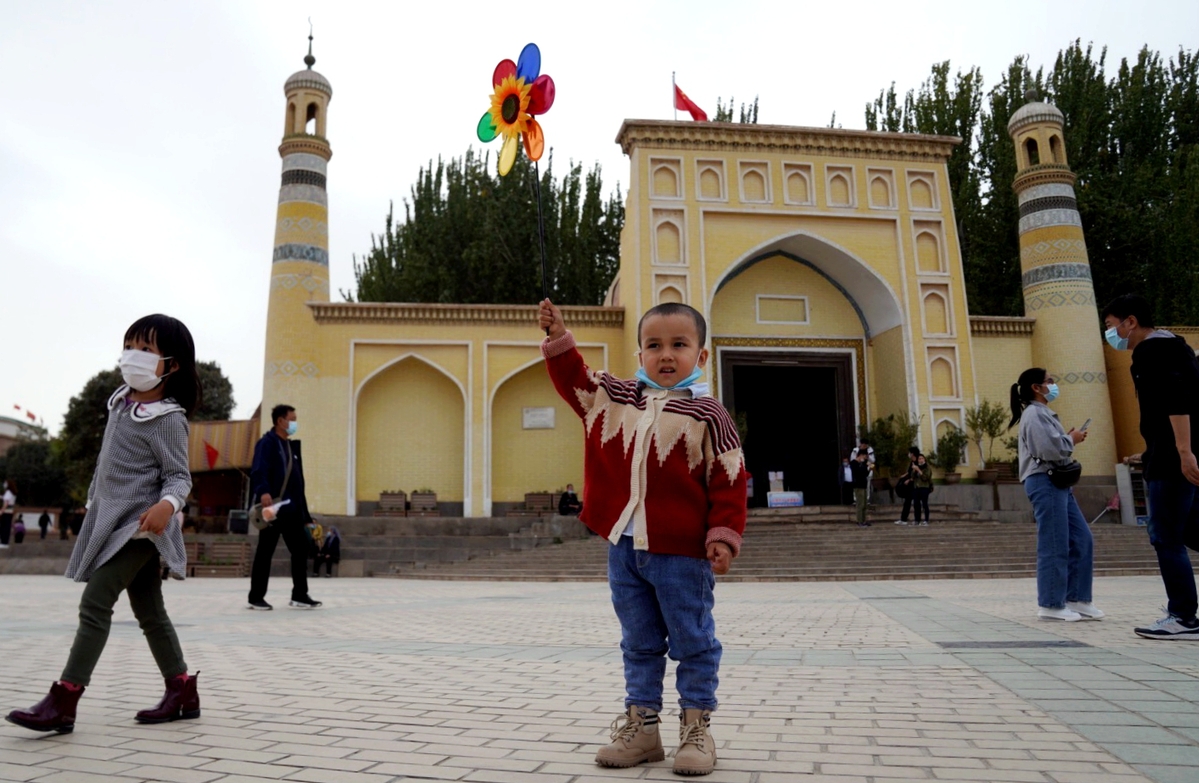
For example, the book Haze: Sunset in East Turkistan claims that "the Chinese government implements the policy of 'religious extinction' in Xinjiang". In fact, Xinjiang fully implements the policy of respecting and protecting citizens' freedom of religious belief, and ensures that religious citizens and non religious citizens enjoy the same rights in political, economic, social and cultural aspects. The state protects normal religious activities. Judging from the practical work, there are four key points needed to be pointed out. Firstly, the legitimate religious activities of Muslims of all ethnic groups are protected. Muslims of all ethnic groups can have normal religious activities according to the teachings, regulations or traditional customs of the religion either at mosque or at home based on their own wish. The government also arranges chartered planes for Muslims' hajj in Mecca, Saudi Arabia each year and provides services along the trip except in the year of 2020 when the hajj had to be canceled for the outbreak of COVID-19. Secondly, the issue and publication of Islamic classics are guaranteed. The Xinjiang Islamic Affair Steering Committee, specially set up by the government, organized the publication of many classics including the Koran, the Essence of Buhari's Sermon in Chinese, Uygur, Kazakh and Kyrgiz. The access to religious knowledge for Muslims have been expanded. Thirdly, the professional Islamic staff have increased significantly. There are 10 Islamic schools in Xinjiang: the Xinjiang Islamic Institute and its 8 branch schools all over Xinjiang together with Xinjiang Islamic School of Scriptures. These institutes enroll undergraduates, junior college students and secondary school students on the basis of demand. Thus the sound inheritance of Islam are guaranteed. Fourthly, the right of religious circles to participate in and discuss state affairs has been fully guaranteed. There are over 1,000 religious personnel of ethnic groups who serve as deputies in the National People's Congress or members of the Chinese People's Political Consultative Conference at different level, playing their role in democratic supervision and deliberation of state affairs. While guaranteeing the freedom of religious belief, Xinjiang attaches great importance to the protection and repair of mosques. What needs to be emphasized here is that the majority of mosques in Xinjiang were built in the 1980s-1990s or even before. Some of them were built of adobe, some were narrow and some were in a state of disrepair. Thus, whenever a gale or rain strikes, normal religious activities would be disturbed. Not to mention, in case an earthquake occurs, the safety of Muslims would be threatened. Moreover, some of the mosques were laid out improperly, bringing inconveniences for Muslims in carrying out religious activities. In recent years, as urbanization and rural revitalization accelerate, in response to the appeal and application of local Muslims, combining with renovation of urban shanty areas, regulation on human settlements in rural areas, and relocation for poverty alleviation, relevant governments have well solved the problem of dilapidated mosques through building, relocation and extension of the mosques. All these measures were taken in line with the plan on urban and rural development. Muslims are content with the safer and better laid out mosques. Up till now, mosques in Xinjiang can totally satisfy the need of Muslims. On November 3, 2020, the Xinjiang Islamic Association issued The Report On the Reality of Religious Belief in Xinjiang, which comprehensively introduces the situation of freedom of religious belief in Xinjiang. The policy of respecting and protecting freedom of religious belief in Xinjiang has been positively appraised by the international community, including Muslim countries. In March 2019, The Council of foreign ministers of OIC passed a resolution to appreciate the efforts made by Xinjiang to care for the Muslim people.
For example, the book Solving China's Indivisible Problems: Xinjiang Class And Uygur Identity and the documentary Xinjiang Uygur: China, Where Are My Children claim that "the Chinese government takes Uygur children to official detention camps and forces them to be separated from their parents". As we all know, Xinjiang has a vast area, and the distance between villages and towns is far, so it is very inconvenient for students to go to school, and it gives parents a hard job to pick up their children to and from school. In order to solve this problem, nearly 400 boarding primary and secondary schools were built in Xinjiang as early as in the 1980s. In recent years, the state has made arrangements to strengthen the construction of boarding schools. According to the requirements, Xinjiang has made scientific and reasonable planning in combination with the development of new urbanization, the implementation of Rural Revitalization Strategy, the changing trend of local school-age children, as well as factors such as geography, transportation, environment and safety. Boarding school construction strictly abides by the relevant national and regional construction standards, and all kinds of learning and living facilities are very complete. The teaching staff in boarding schools are guaranteed through recruitment, training, supporting education program from the inland provinces, and government purchase services. In the stage of compulsory education, students in boarding schools are free of tuition and textbook fees, like students in other schools. Rural boarding students are free of board and lodging fees, and enjoy special living subsidies. Each student in primary school is given 1,250 yuan per academic year, and each student in junior middle school 1,500 yuan per academic year, which effectively reduces the financial burden of students' families. As for whether students are boarding, it is entirely up to the students themselves and their parents to choose voluntarily. Boarding schools in Xinjiang have never restricted the contacts between students and their parents. Boarding school students go home on weekends. They get to school every Monday morning and go back home after school on Friday afternoon. They stay at home on holidays, and winter and summer holidays. If it is necessary, students can ask for leave at any time. In order to facilitate the contact between parents and students, each dormitory of the school is equipped with a telephone, and students can call their parents at any time. The telephone number of every head teacher of every class is known to all students' parents, and the parents can call the head teachers if it is necessary. The so-called "forcing ethnic minority children to attend boarding schools, resulting in the separation of flesh and blood" is a complete slander.
For example, the book Sterilization, Intrauterine Device, And Compulsory Family Planning: The Movement of The Chinese Communist Party to Suppress The Birth Rate of Uygur Population in Xinjiang states through the analysis of the so-called "official statistics of China" that "Xinjiang has carried out genocide against Uygurs and other ethnic minorities. The film Pulse: Reeducation Camp in Xinjiang interviews ethnic minority people in Xinjiang, Qinghai and Ningxia, as well as the so-called "survivors of the vocational education and training center" in Kazakhstan, claiming that China has engaged in "genocide" in Xinjiang on the grounds of counter-terrorism and eliminating extremism. The film Evidence Accuses China of Forcing Uygur Women to Sterilize claims that "the Chinese government forces Uygur women to sterilize or install contraceptives in an attempt to limit the Uygur population." Uygur Massacre (another English title, Worse Than Death: Thinking about Uygur Genocide), a book in Uygur language published by Maimaitiming Aila, the former chairman of "the Uygur Association of Australia", falsely alleges that the Uygur people are faced with genocide, suffered from brainwashing, torture, rape, organ removal, slave labor, and eventually die. In fact, the main data of the seventh national census of Xinjiang Uygur autonomous region show that the total population of Xinjiang and the Uygur population have maintained a steady growth trend, and the so-called "genocide" problem is sheer nonsense.
For example, Sean R. Roberts, associate professor of international affairs practice and director of international development research program at Elliott School of International Affairs of George Washington University in the United States, wrote the book "Uygur war", which falsely claimed that "the theory that Xinjiang has been China's territory since ancient times is invented by the Chinese government and is imposed on the Uygurs as the history of Xinjiang" through the so-called "extensive interviews with Uygurs, refugee communities and exiles from Xinjiang. It also slanders China by saying that China packages the "policy of oppressing the Uygur people" and arbitrarily detains the Uygur people under the pretext of combating terrorism and extremism, which leads to the assimilation and marginalization of the Uygur people. The book General History of Uygur, written by Nabijiang Tu'erxun, editor of Radio Free Asia and published by the so-called Uygur Research Institute, fabricates the history of the "Founding of the Republic of East Turkistan" around 1944. The book Political History of Uygur: 1949-2012 slanders China for "occupying East Turkistan and persecuting Uygurs". In fact, Xinjiang has long been an inseparable part of Chinese territory. As early as 60 BC, it was incorporated into China's territory and became an integral part of China which has been an unified multi-ethnic country. In the history of China, Xinjiang has never been called "East Turkistan", let alone "East Turkistan State". In July 2019, the Information Office of the State Council of China issued a white paper entitled Historical Matters Concerning Xinjiang, which elaborated on this in detail. The Turks (Tujue in Chinese) were nomads who originated in the Altai Mountains in the middle of the 6th century. The Turkic Khanate with vast territory was established successively (later divided into East Turkic Khanate and West Turkic Khanate). In the late 8th century, the nomadic Turks dissolved as its last khanate collapsed. They mixed with local tribes during their migration to Central and West Asia, but these newly formed peoples were fundamentally different to the ancient Turks. From the 18th century to the first half of the 19th century, as the West made a distinction between the various Turkic languages (branches of the Altaic languages), some foreign scholars and writers coined the term "Turkistan" to refer to the region south of the Tianshan Mountains and north of Afghanistan, which roughly covered the area from southern Xinjiang to Central Asia. They called the two areas on either side of the Pamirs "West Turkistan" and "East Turkistan". At the turn of the 20th century, as "Pan-Turkism" and "Pan-Islamism" made inroads into Xinjiang, separatists in and outside China politicized the geographical concept and manipulated its meaning, inciting all ethnic groups speaking Turkic languages and believing in Islam to join in creating the theocratic state of "East Turkistan". It is not difficult to see that the advocacy of this so-called "East Turkistan state" has become a political tool and program for separatists and anti-China forces attempting to split China. The so-called "occupying East Turkistan and persecuting Uygurs" is absurd and ignorant, which is a typical "conspiracy theory".
For example, books including Travelers and The War against the Uygurs falsely allege that Xinjiang adopts a "predatory and enslaved" economic development model. This is not the fact at all. First, Xinjiang adheres to the new development philosophy and speeds up high-quality economic development. From 2014 to 2019, the GDP of Xinjiang increased from 919.59 billion yuan to 1359.71 billion yuan, with an average annual growth of 7.2%. The general public budget revenue increased from 128.23 billion yuan to 157.76 billion yuan, with an average annual growth of 5.7%. With the continuous improvement of infrastructure, all prefectures and cities have entered the era of expressway. Secondly, the livelihood of the people of all ethnic groups has improved significantly. From 2014 to 2019, the average annual growth rate of per capita disposable income of Xinjiang residents is 9.1%. More than 1.69 million rural housing projects and 1.56 million urban affordable housing projects have been completed, and more than 10 million people have moved to new houses. The level of basic public services in urban and rural areas has been continuously improved, and the social security system has been gradually improved. The free physical examination has been implemented, the medical facilities in agricultural and pastoral areas have been significantly improved, and the standardization rate of township hospitals and village clinics has reached 100%. The participation rate of residents' basic medical insurance has reached 99.7%. Thirdly, we have won an all-round victory in poverty alleviation. Under the current standard, 3.0649 million poverty-stricken people have been lifted out of poverty, 3,666 poor villages have shaken off poverty, 35 poor counties have been removed from the lists of poverty-stricken counties, and the Millennium absolute poverty problem has been solved historically. From 2014 to 2019, the central government's transfer payments to Xinjiang Uygur autonomous region and Xinjiang production and Construction Corps(XPCC) increased from 263.69 billion yuan to 422.48 billion yuan, with an average annual growth of 10.4%. In six years, the financial support to Xinjiang is over 2,000 billion yuan. The 19 aiding provinces and cities have strengthened all-round counterpart support to Xinjiang. They have invested 96.4 billion yuan in Xinjiang (including XPCC), implemented more than 10,000 aiding projects in Xinjiang, introduced 1,684 billion yuan from enterprises in aiding provinces and cities to Xinjiang, and invested more than 700 billion yuan from central enterprises in Xinjiang. Facts have fully proved that the so-called "predatory and enslaved" economic development model of Xinjiang is unreasonable and inconsistent with reality, and totally untenable.



- Police punish shopper after AI video used in fake crab claim
- Historians identify Chinese pilot saved by John Rabe in Nanjing
- Rainforest-themed activities launched in Hainan
- Hebei advances intelligent construction and prefabricated housing
- Seventh Hainan Island International Film Festival opens in Sanya
- Former chairman of Guangxi government expelled from CPC, public office