


China's growing trade benefits the world










Editor's note: What was the Chinese economy like in 2001 and how will its trade develop in the coming years? Wei Jianguo, a senior councilor of China Center for International Economic Exchanges and former vice-minister of commerce, gives the answers to this and many other questions in a conservation with China Daily's Liu Jianna. Excerpts follow:
Q: This year marks the 20th anniversary of China's accession to the World Trade Organization. How has China's entry into the WTO benefited the country and the world?
A: China opened its window to the outside world through reform and opening-up it launched in the late 1970s. By joining the WTO, it opened its door to the world. That helped China gradually transform from an impoverished country into the "factory of the world" and the world's second-largest economy, as well as boost global economic development by making significant contributions to global growth-nearly one-third for the past more than a decade.
The problem is, the WTO hasn't been able to keep pace with the times.
Western developed countries dominate the rule-making process of the global trade body with developing countries having little say. While developing countries, represented by China, with their rising global influence, particularly after the global financial crisis, want to have a bigger say, in proportion to their contribution to the global economy, in international trade and investment rule-making, the WTO has failed to do so.
However, the emergence of regional trade agreements including the Regional Comprehensive Economic Partnership agreement and the criticisms leveled against the WTO does not mean the world doesn't need the global trade body anymore. It remains a vital international organization where the interests of all countries are respected and all members can make their beneficial trade and investment policy.
In a sense, China's higher-quality opening-up could set an example for WTO reform. And China's participation in and promotion of WTO reform could set an example for others to demand a bigger say for developing countries in international organizations.
China can also help the WTO set rules in emerging fields such as the digital economy, smart cities, 5G, blockchain and cloud computing, given that it is a leader in these sectors.
Q: Some people claim the "dual circulation" development paradigm signifies self-seclusion. What is your opinion?
A: The introduction of the "dual circulation" development paradigm means China is advancing higher-quality opening-up.
China has held high the banner of opening-up since 1978 and will not retreat an inch from its promise to further open up its economy to the outside world, because it is vital to its own development and that of the rest of the world.
Pascal Lamy, former director-general of the World Trade Organization, once told me that China, which has fulfilled its commitment to reduce tariffs from about 15 percent to 9.5 percent way ahead of schedule, is the most ardent follower of WTO rules.
China, one of the staunchest supporters of free trade, is marching toward zero tariff, zero trade barriers and zero subsidies. That it has not only ratified the RCEP, which will come into force on Jan 1, but has applied to join the Comprehensive and Progressive Agreement for Trans-Pacific Partnership (CPTPP) and the Digital Economy Partnership Agreement shows its determination to further promote opening-up and free trade.
And the fact that China is the only country to hold expos during the pandemic specifically to increase imports reflects its commitment to higher-level opening-up and shouldering its responsibilities as a major economy. These developments would not have happened if China intended to isolate itself from the rest of the world.
As for "dual circulation", external (international) and internal (domestic) economic flows are not mutually exclusive like some people assume; instead, they are complementary and mutually reinforcing.
For instance, when electric sewing machines are in high demand in some countries, we sell them such machines and, when they are not, we relocate big garment manufacturing and perhaps sewing machine making units to central and western China, in order to optimize the domestic industrial structure.
This ensures that enterprises engaged in foreign trade can avail of international supply channels, and their product at home gets due attention. International and domestic circulations are like the two wheels of a bicycle, which will move only when both wheels turn.
Q: What will be the impact of the RCEP on China and the world after it takes effect on Jan 1? How will people feel the changes it causes?
A: Most importantly, about one-third of global goods will flow freely after the RCEP comes into effect. More goods will enjoy tax exemption regardless of their complicated production, processing and trade processes in a number of countries, thanks to the Cumulative Rules of Origin clause in the agreement.
Through the much convenient and favorable trading of goods, China's trade with the Association of Southeast Asian Nations, Japan and the Republic of Korea is expected to set new records. This will turn the ban on Xinjiang cotton by some Western countries, including the US, into a joke.
It should be noted that the RCEP is not a simple combination of countries. It will facilitate exponential growth. The faster the flow of capital the more the profit it will create and the shorter the consumption process will be.
For ordinary people, the prices of goods, for instance fruits from Southeast Asian countries, will decline. They will also get more quality services and experience when visiting RCEP member countries. And more goods will flow more easily among the RCEP countries.
The priority for us should be personnel training. For instance, entrepreneurs need to get acquainted with the rules of the RCEP. There is also a need for government officials to know well the related rules.
Q: Will the China-EU Comprehensive Agreement on Investment be shelved forever? And where will the China-US trade dispute lead to next year?
A: That the EU has postponed the investment agreement based on rumors on so-called human rights issues in the Xinjiang Uygur autonomous region signifies its retrogressive policy, which is harmful not only to the EU but also the global economy. The EU stands to lose a lot if it doesn't abandon its prejudices and instead allows politics to get in the way of economic cooperation.
On the other hand, US President Joe Biden has been following in the footsteps of his predecessor Donald Trump and taking punitive measures against Chinese entities, especially high-tech enterprises. But the sanctions it has imposed on the Chinese entities could become an albatross around its neck. Since time is on China's side, it will eventually offset the impacts of the US' scientific and technological blockade through innovation and research and development.
It is therefore important for China and the US to strengthen communication and understanding. They should draw a cooperation list to mark the areas in which they can work together, such as combating climate change, the COVID-19 pandemic and terrorism. They should also prepare a list of the redlines they should never cross-for example, the US should never cross the redline on the Taiwan question-to avoid confrontation.
And Sino-US trade, which has not decoupled like some said, will continue to grow in the coming year.
Q: In the first 11 months of this year, the value of China's exports and imports reached a record high of $5.47 trillion, up 31.3 percent year-on-year. What will be the trade and growth rate for the whole of 2021?
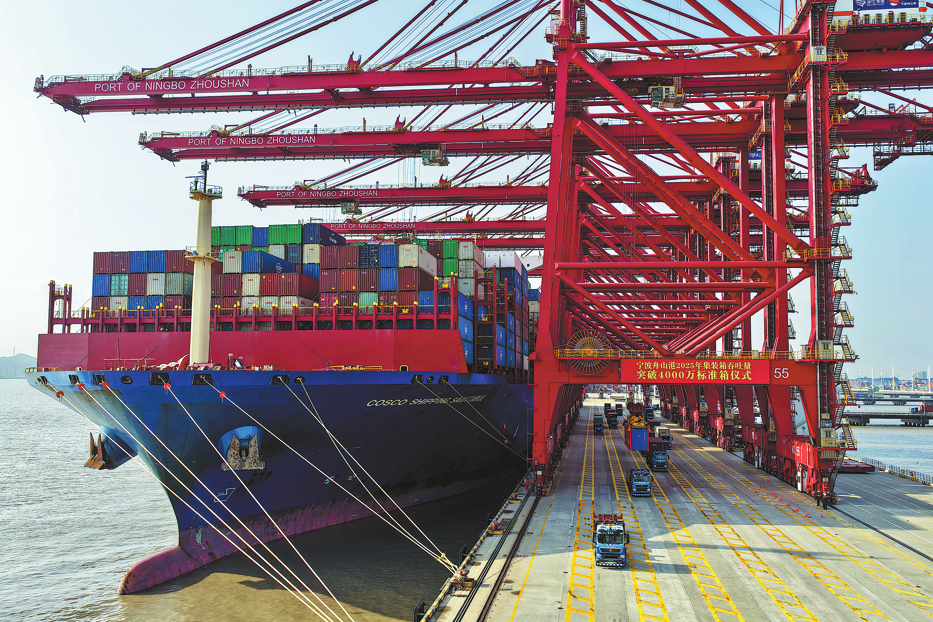
A: China's foreign trade could grow by 25-30 percent to reach $5.5 trillion by the end of this year, which would be another record. The achievement would be especially remarkable given the economic disruptions caused by the COVID-19 outbreak, the surge in commodity prices and freight, especially shipping costs, the shipping jam at ports, and the shortage of labor.
China is also expected to achieve double-digit growth in trade next year through to at least the first quarter of 2023. It is essential therefore that China's foreign trade enterprises take precautions, and promote innovation in the science and technology sector, in order to further explore the global market.
Q: What's the brightest aspect of trade this year?
A: China's cross-border e-commerce has turned out to be the dark horse this year. It helped arrest the much-feared downward growth trend, ironically because of the rise in the shipping index, shipping jams at ports, and the shortage of labor in the transport sector.
Cross-border e-commerce has grown 19.5 percent in the first 10 months. At the end of this year, cross-border e-commerce, along with general trade and processing trade, will become three strong pillars of the economy.
Next year the scale of cross-border e-commerce could exceed that of general trade and processing trade because of several factors conducive to its development. For example, the COVID-19 pandemic, most unfortunately, is likely to continue, given the constant emergence of new novel coronavirus variants such as Omicron.
This will increase the demand for Chinese consumer goods, especially electronics and other high-tech products and pandemic-prevention products. In the meantime, the State Council, China's Cabinet, has introduced a series of policies and measures, including granting preferential loans, making clearance and inspection more convenient, and giving tax breaks, in order to further encourage cross-border e-commerce.
Q: How China achieved such trade growth despite headwinds?
A: That China has largely diversified its market beyond the United States, the European Union, Japan and the Republic of Korea and made greater efforts to meet the growing demands from Africa, Latin America, Southeast Asia and Belt and Road countries has ensured that its trade didn't suffer much because of the over-dependence on a single market or exclusive group of markets. Plus, the good quality of Chinese goods and ever improving after-sales service, thanks to the opening of more branches by Chinese companies overseas, have significantly increased Chinese goods' appeal in foreign markets.
Besides, production in many countries has suffered due to disruptions in their industrial and production chains because of the pandemic, while China resumed near normal production last year after largely containing the pandemic at home, which helped increase exports of automobiles, electric motorcycles, refrigerators and electronics products.
Also, the 2,000 distribution centers set up for cross-border e-commerce overseas, which facilitated swifter and more cost-effective distribution of goods, have played a key role in the growing of China's trade, This has prompted Chinese e-commerce giants such as JD.com, Alibaba and Xiaomi to set up more distribution centers overseas.
Besides, the stable renminbi exchange rate has accorded strong support to enterprises engaged in foreign trade.
Q: Private enterprises have contributed a lot more to imports and exports growth this year. And how did they increase their share in trade?
A: Most remarkably, private enterprises have contributed 57.6 percent of total exports in the first 10 months because the more refined the division of labor the greater the chances of private enterprises "going global". Although 32 countries removed China from the preferential tariff treatment list on Dec 1, private enterprises will continue to thrive, because of their arduous efforts and meticulous planning to expand their customer base and market.
For instance, Chinese electric blow torch companies had about 65 percent of market share in Vietnam up to a few years ago. Some Chinese private enterprises helped train Vietnamese workers to use blow torches. Therefore these workers naturally chose Chinese brand electric blow torches, and Chinese enterprises increased their share in Vietnam to about 90 percent.
Q: How will the new novel coronavirus variants affect the world economy?
A: New variants have dealt another blow the world economy just when it has started recovering from the almost-two-year-long pandemic. More countries are expected to implement stricter anti-pandemic measures, including lockdowns, to contain the new variants, which could delay the global economic recovery by a year at least.
Thanks to the impacts of the pandemic, however, the idea of a community with a shared future for mankind has gained greater acceptance in the international community, because it is more than obvious that the pandemic cannot be contained by one country alone. Each country, especially developed ones, needs to shoulder its respective responsibility to effectively contain the pandemic.
The fact that China has vowed to provide 1 billion doses of COVID-19 vaccines for Africa is a huge contribution to the global fight against the pandemic.
The emergence of new virus variants will likely cause more overcrowding of ships at ports, and thus prompt the authorities to run more China-Europe freight trains to offset the impact of declining shipping services. Even Japan, the ROK and Russia could turn to the China-Europe Railway Express to export their products and import goods, given its high efficiency and low cost. The China-Europe railway will also help transport pandemic-prevention goods and equipment, boosting the fight against COVID-19.
Q: How to optimize China's foreign trade?
A: First, China's exports should be upgraded based on thorough research into the global supply and industrial chains, in order to increase added value, and guide more investment into the destination countries. That Haier, Chinese consumer electronics goods maker, and Chery, a Chinese automobile company, have both set up factories abroad shows the trend of exports upgrading.
Second, we should diversify our markets, deepen and expand research into the markets of major trade partners, including the US, the EU, Japan, the ROK and Australia, while paying greater attention to research on Belt and Road countries, as well as African, Latin American and Southeast Asian countries.
And third, China should join, even propose more free trade agreements and realize the goal of zero tariff and zero trade barriers. Since the RCEP is set to come into force on Jan 1, China should expedite the process of joining the CPTPP, finalize a China-Japan-ROK FTA, and propose FTAs with Belt and Road countries, the African Union and even the Gulf Cooperation Council.
Q: In the first 10 months of this year, the actual use of foreign direct investment in China reached $142 billion, up 17.8 percent year-on-year. China also accounted for more than 20 percent of global FDI in the first half of 2021. How do you see the increasing FDI in China?
A: The smearing of China won't prevent foreign investors from investing in the country. An increasing number of chambers of commerce has found that a majority of foreign enterprises want to invest in China and many of them are ready to make additional investments. The total FDI China is likely to attract this year could cross $185 billion, and next year China could overtake the US as the largest FDI recipient as it is expected to receive over $200 billion in FDI.
The fact that China has attracted nearly one-fourth of the global FDI last year proves that it has been better protecting intellectual property rights, and has created a fair and stable investment environment for foreign investors. Still, China needs to further improve the investment environment by establishing an international and legal market system.
The views don't necessarily reflect those of China Daily.

If you have a specific expertise, or would like to share your thought about our stories, then send us your writings at opinion@chinadaily.com.cn, and comment@chinadaily.com.cn.