


Uneasy transition
Even after China peaks carbon emissions, coal-fired power will continue to provide bulk of its energy, necessitating a right balance between the old and the new and advancing low-carbon transition at a lower cost









Even after China peaks carbon emissions, coal-fired power will continue to provide bulk of its energy, necessitating a right balance between the old and the new and advancing low-carbon transition at a lower cost

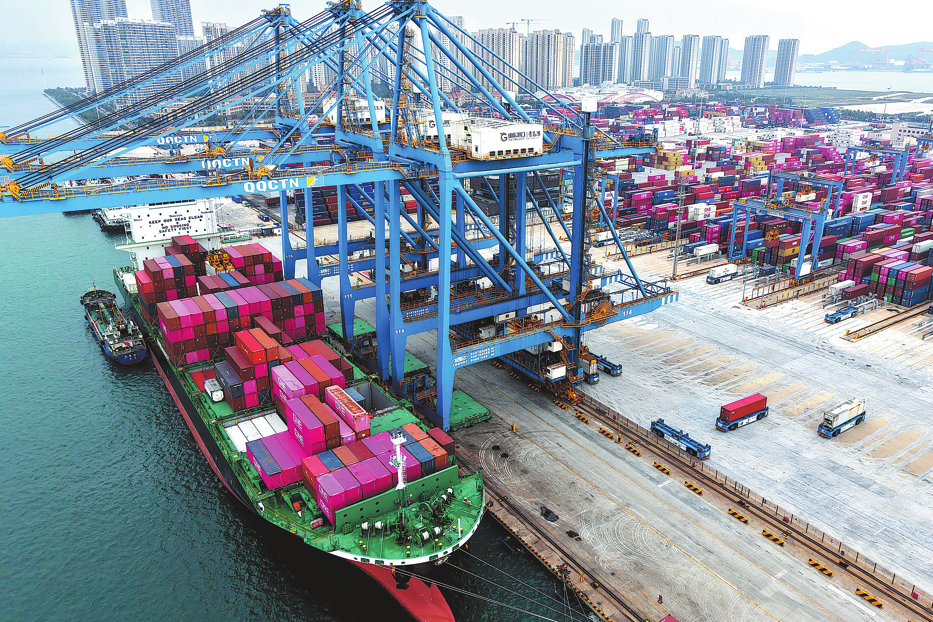
The new coal-fired power capacity permitted in China increased in 2022, raising some attention and concerns in the international community. However, it's also worth noting that China is going all out to develop clean energy, with the newly installed capacity of renewables hitting a record high in 2022.
As the world's largest developing nation and a major consumer of energy, China needs to secure stable energy supplies when striving to achieve its "dual carbon" goals — to peak carbon dioxide emissions before 2030 and achieve carbon neutrality before 2060 — so as to realize sustained economic and social development. China has a gigantic power system dominated by coal, which has been of crucial importance to its development, meeting the nation's fast-growing energy demand and fueling its economic growth for decades with sustained and stable supplies at a relatively lower cost.
To achieve the "dual carbon "goals, China will, in the coming decades, build a new energy system dominated by wind and solar energy sources and phase out fossil fuels (including coal) in an orderly manner. However, the phase-out would require replacing traditional energy sources with renewable energy sources. For the time being, China's low-carbon transition needs to take into account the cost of energy and energy security, making it impossible for the nation to wean itself off coal-fired power in the short to medium term.
As a developing nation whose energy consumption is closely related to economic expansion and where renewables account for a small portion of the energy mix, it is inevitable for China to register growth in coal-fired power capacity additions in the short run. However, renewable energy is also growing at an accelerated pace, as the nation strives to press ahead with the low-carbon transition.
In the years to come, China's power demand will continue to grow relatively fast (International Energy Agency forecasts a 5 percent growth annually for the next 3 years). Currently, China's energy consumption is dominated by production needs, with the industrial sector accounting for the lion's share of total energy consumption. China's power consumption is concentrated in the industry sector (67 percent in 2020), with six energy-intensive industries consuming close to 50 percent of its electricity. Such production-dominated energy consumption structure has led to a strong correlation between GDP growth and energy consumption as the energy sector bears the enormous responsibility of powering the economy.
Electricity generated from solar and wind power currently accounts for a small share in China's total energy mix (about 5 percent) and thus, fossil fuels (including coal) will continue to serve as an important source of energy for a certain period to come. Thus, the new coal-fired generation capacity that China approved rose in 2022 in accordance with growing demand from economic development amid an energy scarcity.
Coal power has been playing a positive role in driving China's quest for carbon neutrality, such as by ensuring a stable supply for the electricity system. It is foreseeable that China's coal-fired power will not be "retired" with a complete, large-scale dismantle, but by reducing utilization hours to make room for increased use of clean energy. Therefore, China should further cement coal power's role as the "ballast stone" of secure and stable energy supply by promoting flexibility retrofits on coal-fired power units and developing carbon capture and storage technologies to transform coal power into a peak regulation and back-up services provider for renewables and to strive for clean, highly efficient use of coal.
On the one hand, flexibility retrofits on coal-fired power plants are a technological choice for enhancing the comprehensive flexibility of the power system. However, such retrofits could undermine the ulitization hours of coal-fired power and reduce revenues for coal-fired power companies. Thus, the government should lower the cost of flexibility retrofits through policy means.
On the other hand, the development of carbon capture and storage technologies provides an important way out for the coal power industry, especially when China's gigantic coal-fired power capacity needs to play its due role in a new energy system that's dominated by solar and wind power. Furthermore, in the process of advancing low-carbon and green transition of coal-fired power, we should also vigorously promote technologies associated with the clean and highly efficient use of coal, by advancing both the R&D and the popularization and application of such technologies. For instance, we should popularize clean and high-efficiency coal-fired power generation technologies, accelerate the promotion of flue gas cleaning equipment at coal-fired power plants and further raise the emission standards for coal-fired power plants.
In a nutshell, coal-fired power has always been the base-load power supplier for China's power system. According to last year's government work report, "to advance China's energy revolution and ensure energy supply, we will, based on our resource endowment, push forward the transformation toward low-carbon development, in accordance with overall planning and the principle of establishing the new before abolishing the old. We will work harder to make coal usage cleaner and more efficient, while reducing the use of coal and replacing it with alternative energy sources in a well-ordered way. We will work to upgrade coal-fired power plants to conserve resources, reduce carbon emissions, make operations more flexible, and upgrade heating facilities".
China's low-carbon energy transition must be based on the national condition of "coal as the mainstay".When replacing the traditional energy sources with the new, we should have overall planning and carry out the replacement in a well-ordered way, attach great significance to energy security, and prioritize the clean and more efficient use of coal.
In the future, coal-fired power units will retreat to the back line to serve as auxiliary power supply and to provide peak regulation and back-up services for renewables. Therefore, coal power will remain an indispensable part of the nation's energy mix even amid the quest for carbon neutrality.
That said, ensuring energy security does not mean loosening restrictions over coal-fired power. The government needs to have a detailed overall plan for the nation's coal-fired power, strictly control permits for new coal-fired power capacity additions, and prioritize green and low-carbon transformation of coal power in its policy targets.
China should steadily phase out outdated capacity and resolutely shut down smaller-scale backward coal-fired power units that have poor technologies and are hard to manage and retrofit, so as to enhance the overall efficiency of the coal-fired power industry.
The world's installed capacity of coal-fired power is mainly concentrated in developing nations — with 51 percent in China, 11 percent in the United States and 6 percent in the EU. Therefore, the problems associated with a coal phase-out are mostly faced by developing countries, China in particular. We need to uphold the principle of "establishing the new before abolishing the old" and embark on a path of low-carbon transition of the power system suited to China's national conditions. Even when China peaks carbon emissions in 2030, coal-fired power will continue to provide the vast majority of electricity for fueling China's economic growth, and the plans to "retire" coal power capacity will be under heated debate. The key lies in recognizing the coal power's role as a "stabilizer" and "ballast stone" for ensuring power supplies and advancing low-carbon transition at a relatively lower cost.
The author is a researcher with Tan Kah Kee Innovation Laboratory and dean of the China Institute for Energy Policy Studies at Xiamen University. The author contributed this article to China Watch, a think tank powered by China Daily. The views do not necessarily reflect those of China Daily.
Contact the editor at editor@chinawatch.cn.