


Placing US-China relations on the road to recovery: Some hopeful thinking










In 1979, when the US and China normalized relations, US policy was driven by one cardinal principle: a stable modernizing China was good for China, good for the US, and good for the world. This principle served as an overarching philosophy that helped to drive the expansion of economic, investment, science and technology, and education and cultural ties for almost four decades.
Then, almost without warning, the steady rise of China's economy and S&T capabilities became a catalyst for questioning the validity of that cardinal principle. Three things seemed to drive a reconsideration of US policy toward China: 1) the rapidity of China's rise--which had not been anticipated since its reform and opening–up ; 2) the "global-ness" of China's impact--as China evolved from an aspiring regional power into a full-fledged global player; and 3) the apparent efficacy of China's model of state capitalism--which seemingly served as an alternative approach to Western-style market driven economic models. Moreover, as China's capabilities continued to advance, the sense of a so-called Chinese threat emerged as if a new zero-sum game was in place whereby Chinese gains meant some kind of loss for the US and other countries.
Unfortunately, due to the anxieties that emerged in the US, many American officials began to think about a process of decoupling and delinking from China. The idea of disengaging from China was exacerbated by the onset of the COVID-19 pandemic. Somehow, the benefits of engagement and connectivity with China had dissipated almost in their entirety.
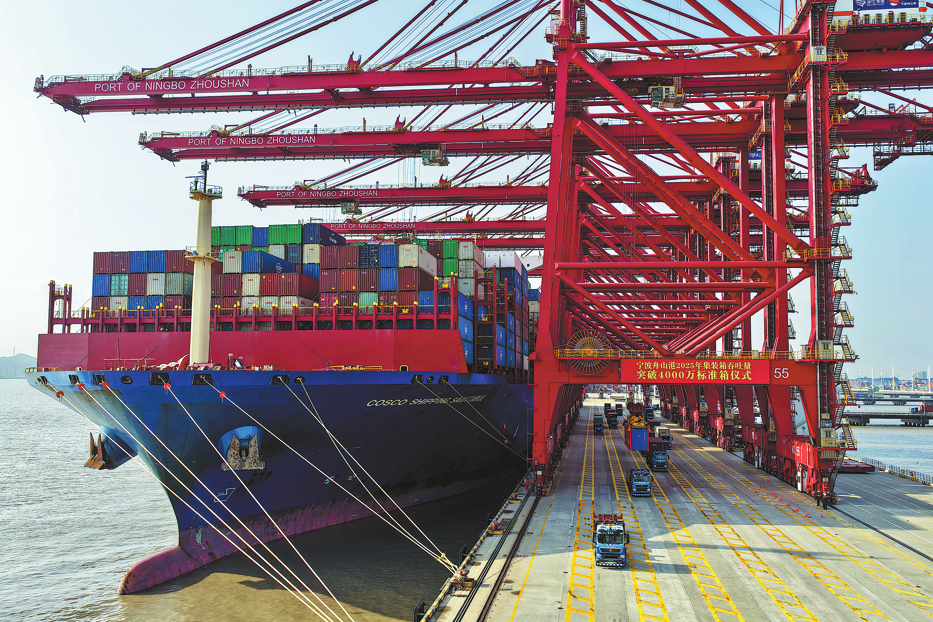
Today, as the last 6-8 months have demonstrated, the US finds itself trying to clean up the consequences of this rethinking about connectivity with China; American leaders have begun to recognize the level of interdependence between our two nations is simply too significant to ignore. The competition between the two countries does not necessarily need to invoke conflict. It goes without saying that the economic relationship through trade and investment has benefitted both nations, that cooperation in science and technology has produced research results that have been shared across both countries, and that the exchange of students and scholars has provided a pool of new talent that has served the economic and S&T goals of both societies.
US-China trade has generated many new jobs in both economies as China has exported manufactured goods to the US and the US has exported both agricultural and high technology products to China. And, while there has continued to be a gross imbalance in the numbers of American students and scholars going to China versus the numbers of PRC students and scholars coming to the US, both countries have worked hard to support and sustain education ties because they had become one of the bedrock elements in Sino-US relations.
Certainly, everything has not been rosy across all domains as the two countries have vastly different histories, cultures and values. We have some serious differences about important matters ranging from IPR protection to data protection and security to management of the South China Sea. These differences have made themselves felt in everything from difficult business negotiations to complex foreign policy decision-making to the multifaceted socio-political thinking that drives our respective government institutions. That said, for a while, during the 1990s and the early part of the 21st century, some observers believed that China and the US were on a path toward some type of convergence as the imperatives of science and technology along with the globalization of markets and cultural norms seemed to suggest that some of our core differences might fade away over time. While globalization did bring about greater levels of cooperation and cross-penetration, the tense history of this last decade has revealed that both nations must find a way to accommodate our differences rather than rely on some false expectation that we will become increasingly alike. If we have learned anything from our interactions since 1979, it is that we must respect our differences and figure out a path to live and work side by side without generating serious conflicts and misunderstandings.
Quite frankly, in many ways, while our two governments have found increased ways to disagree with one another over the last several years, the one stabilizing factor in the bilateral relationship has been the continued efficacy of people-to-people diplomacy. It is amazing to realize that while political disagreements may abound between Washington and Beijing, the citizens of both countries continue to engage with one another in very productive ways.
A recent visit by the vice-governor of Hunan to North Carolina is a case in point; at a welcoming dinner for the Hunan delegation, one could never imagine the tense discourse that has been occurring between the respective national governments. Not only was there a significant turnout from across business, academia and cultural organizations, but the atmosphere in the room was one of true friendship and understanding. The attendees on the US side reflected the diversity of American society—Chinese Americans, African Americans, Caucasians, and Hispanic Americans. This bodes well for rekindling the friendship between our two countries, especially if we can move beyond the pain and tensions of the last 5-6 years.
This is why the meeting between the two leaders of the countries was so important. Granted, there were few major breakthroughs and there remain many critical issues on the table that linger on and for which there are no easy solutions in sight. These include the issue of Taiwan—even though President Biden did reiterate America's one-China policy; events in Ukraine and the Middle East—especially the on-going war between Israel and Hamas in Gaza; the geopolitics of the South China Sea; cybersecurity concerns; and other issues.
On the other hand, it appears that some progress was made regarding expanded controls on fentanyl exports to the US, military-to-military communications and crisis management, climate control and clean energy, and governance regarding the application of artificial intelligence. China expressed particular concern about the growing number of restrictions on US exports to China of semiconductor and related technologies, highlighting the potentially serious impact of these restrictions on Chinese economic development. While all of this recognized, it is important to acknowledge that the chance for a face-to-face meeting between the leaders helped to reinforce the positive momentum that has been accruing from the growing number of visitor exchanges by senior officials from both countries over the last several months.
In the final analysis, there remains lots of work to be done to restore trust and confidence between Beijing and Washington. The onset of elections in China's Taiwan as well as the US presidential election only promise to add further complexity to the equation, whether you are sitting in China or the US.
Nonetheless, there continue to be an unlimited number of opportunities for cooperation between the US and China. One area of huge significance involves the renewal of the S&T Cooperation Agreement that was first signed in 1979 and renewed since every five years. At present, pending on-going negotiations and the insertion of new language, the agreement has only been extended for a 6-month period that started in late August 2023. This agreement has served the interests of both countries in a variety of ways, helping to connect the S&T communities in both societies and helping to establish a variety of shared norms, values, and protocols when it comes to research and innovation.
One hopeful sign in terms of the potential impact of the meeting between the two leaders of the countries would be a clear decision to revise and renew the S&T cooperation accord for another five years. Given the rapid advancement of Chinese S&T capabilities and the strong commitment of the US to improved R&D performance through legislation such as the Chips and Science Act, the prospects for achieving higher and higher levels of mutual benefit are clearly in place and should not be ignored, especially as we think about potential future solutions to our many pressing global problems.
The author is a distinguished fellow with the Institute of China America Studies.
The opinions expressed here are those of the writer and do not necessarily represent the views of China Daily and China Daily website.
If you have a specific expertise, or would like to share your thought about our stories, then send us your writings at opinion@chinadaily.com.cn, and comment@chinadaily.com.cn.