


For the common good









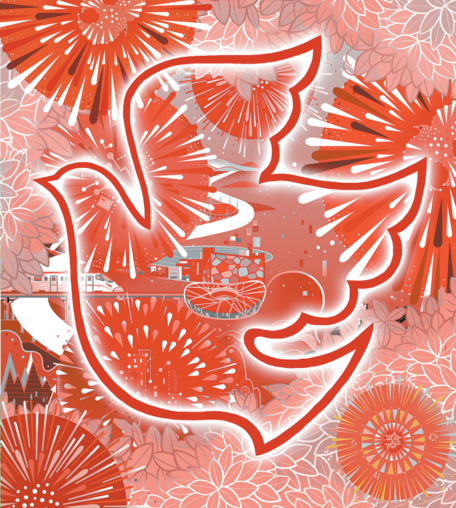
War reminds people to take opportunities to focus on dialogue and cooperation rather than conflict and confrontation
China is holding a series of commemorative events to mark the 80th anniversary of victory in the Chinese People's War of Resistance Against Japanese Aggression (1931-45) and the World Anti-Fascist War. These commemorations are not only a remembrance of the arduous struggle of the Chinese nation but also carry significant implications for world peace and development.
The primary purpose of the commemoration activities is to remember the past and to remind people of the immense disasters caused by war. The war against Japanese aggression represented one of the most tragic chapters in Chinese history and constituted a crucial part of the global anti-fascist struggle. The war brought profound suffering to the Chinese people: the devastation of cities, countless civilian casualties and the destruction of cultural heritage and social order. As the war escalated to a global scale, China's prolonged resistance gained strategic significance, and the Allies recognized China as one of the "Big Four" by providing aid and revising treaties, granting China the status of a major power politically. These historical events deserve to be remembered.
China is employing a comprehensive approach to its commemorations, encompassing national memorial days, museum shows, archival exhibitions, academic researches and audiovisual works. Institutions such as the Memorial Hall of the Victims in Nanjing Massacre by Japanese Invaders, the Pingxingguan Victory Memorial Hall and the Hundred Regiments Offensive Memorial Hall serve as key historical education centers, showcasing the brutality of war and the courage of the Chinese people. At the same time, China has invited international friends to attend commemoration events, and is hosting peace forums and exhibitions that enhance global understanding of China's wartime history.
Commemorating the victory in the World Anti-Fascist War is not unique to China. Countries around the world hold similar activities. But China's commemoration is distinctive in its dual character. On the one hand, it represents a national liberation struggle defending sovereignty and dignity; on the other hand, it is an integral part of the global anti-fascist effort. China was among the first countries to engage in combat, fought for the longest duration and suffered some of the heaviest losses.
China's commemorations also reflect its contemporary attitudes and choices. Following the victory in the war against Japanese aggression, China has framed the connection between "victory and national rejuvenation", which means that commemorations are not only a manifestation of China's anti-war sentiment but also a way to draw strength from the historical trauma to foster confidence in development and national unity. The lesson China drew from war was not the "law of the jungle" where the strong dominate the weak, but rather a steadfast commitment to maintaining peace, pursuing development and achieving national revival. Naturally, China has chosen the path of peaceful development, advancing modernization and national strength through economic growth, technological innovation, cultural advancement and international cooperation.
From a world historical perspective, victory in the World Anti-Fascist War brought epochal changes in peace, development, international relations and the democratization of world politics. The establishment of the Yalta framework incorporated principles of peaceful coexistence among states with different social systems, and national liberation movements advanced the democratization of international politics. This order inherited the major-power coordination logic of the Vienna system, absorbed the collective security concept of the Versailles-Washington system, and institutionalized and universalized these principles through the United Nations, providing a framework for the development of countries, including China.
Commemorating the victory in the war is also a defense of this international system. After World War II, China actively participated in constructing a fair and just postwar international order and positioned itself as a representative of the people of the East. In practice, China has enhanced national strength through economic development and engaged actively in global governance. Whether contributing to UN peacekeeping operations or participating in the multilateral initiatives in climate governance and public health, China demonstrated respect for international rules and promoted cooperation for mutual benefit. The rise of unilateralism and protectionism and the efforts to maintain hegemonism are challenging the international order. How should the world move forward? The answer for the future lies in the lessons from history. Economically, during the war, all available resources were mobilized, interlinking the production systems of nations. After the war, with peace restored and economies revitalized through technological advancement, global economic integration became irreversible, creating an interdependent and inseparable system of international economic relations. Politically, the postwar era saw sweeping national liberation movements, with newly independent states joining the UN and actively participating in multilateral diplomacy. These nations opposed power politics and hegemonism, promoting the democratization of international politics. Most importantly, reflecting on the world wars, humanity gradually learned to replace confrontation with dialogue, and conflict with cooperation, leading to decades without global wars.
Commemorating the war aims to apply historical lessons to the future: Peaceful development is humanity's rightful path, and win-win cooperation is the trend of the times. In this regard, China leads by example. Guided by the philosophy of harmony, China has demonstrated its commitment to peace and development through concrete actions. The Regional Comprehensive Economic Partnership promotes regional economic cooperation and supply chain connectivity, boosting trade growth. The Belt and Road Initiative has mobilized investment, improved infrastructure along its routes and facilitated regional economic integration. China has also been opening wider to foreign investment, attracting sustained capital inflows, reflecting an inclusive approach that transcends zero-sum competition. These measures not only benefit China but also provide international models for cooperation and mutual gain. The experience of World War II shows the importance of unity against common threats, and this spirit remains vital in today's unprecedented global transformations. China's concept of building a community with a shared future for humanity inherits and develops this legacy, offering new ideas and practical pathways for international relations and world peace in the new era.
Connecting the past, present and future embodies the unity of patriotism and internationalism. The deeds of international friends such as Norman Bethune, John Rabe and Rewi Alley are commemorated alongside the experiences of the Chinese people. This transnational and cross-cultural historical representation highlights the notion that humanity shares a common future. This is not only a national memory but also a reflection of global values: Peace and development should be the central themes of human society. In today's turbulent international order and growing challenges in global governance, this spirit reminds humanity that peace is not a given but must be achieved through cooperation, dialogue, inclusiveness and joint effort. Through education, commemoration, cultural dissemination and international exchange, the spirit not only awakens historical memory but also provides rational and ethical guidance for contemporary society, making peace, cooperation and development central forces in stabilizing international relations.
In conclusion, the commemoration activities transcend a mere historical review. They represent an organic integration of historical memory, contemporary development and future vision. Through the commemorations, China not only honors past sacrifices but also promotes the concept of peaceful development, facilitates international dialogue and mutual understanding among civilizations, and contributes Chinese wisdom and solutions to global peace and development.
The author is an associate professor at the School of Marxism at South China Normal University. The author contributed this article to China Watch, a think tank powered by China Daily. The views do not necessarily reflect those of China Daily.
Contact the editor at editor@chinawatch.cn.