 ?
?
Battles with illness, loneliness and post-retirement blues are pushing China's elderly population into a spiral of depression and fragile mental health. Cang Wei and Song Wenwei report from Nanjing.
'Granny" Li has attempted suicide three times. First, she tried to gas herself by leaving the oven turned on, but her neighbors smelled the gas and intervened. The second time she took an overdose of sleeping pills, and on the third she jumped into a deep pond and tried to drown herself. However, Li's now-vigilant neighbors saved her on those occasions too.
The 60-year-old lives alone in the Pukou district of Nanjing in East China's Jiangsu province. One day in 2011, she opened the door to a young man selling healthcare products. On hearing the young man call her "mum", Li - whose son and daughter live in different districts of Nanjing and hadn't visited her for more than a year - was reduced to tears and bought products worth more than 30,000 yuan ($4,800).
After that, the young man visited Li frequently. Sometimes he even took her to the local gardens. However, once she stopped buying his products, the young man disappeared. Driven to despair, Li began her series of suicide attempts.
Zhang Chun, director of Nanjing's Psychological Crisis Intervention Center, where Li received therapy each time she tried to end her life, said that many empty-nesters are deceived by the unscrupulous because they are lonely and desperate for human contact.
"Empty-nesters generally have little communication with other people and so there is a higher chance of brain atrophy," he said. "More attention should be paid to the mental health of the elderly."
Lonely and helpless
The suicide rate in China is highest among those aged 60 or older, according to Huang Runlong, professor at the Institute of Population at Nanjing Normal University.
"Compared with young people, the elderly are more sensitive to loneliness and helplessness," he said.
Statistics from the Chinese Academy of Sciences show that people aged 60 and older constituted nearly 50 percent of those who requested professional counseling in the year after a magnitude-8 earthquake battered Wenchuan in Sichuan province in 2008, leaving more than 80,000 people dead or missing.
In a recent investigation launched across Jiangsu province, 53.9 percent of empty-nesters described themselves as "useless", and 58.3 percent felt "very lonely", according to the Xinhua Daily newspaper in Nanjing.
The mental health of elderly Chinese is deteriorating "unexpectedly quickly", according to Li Bengong, president of the Gerontological Society of China.
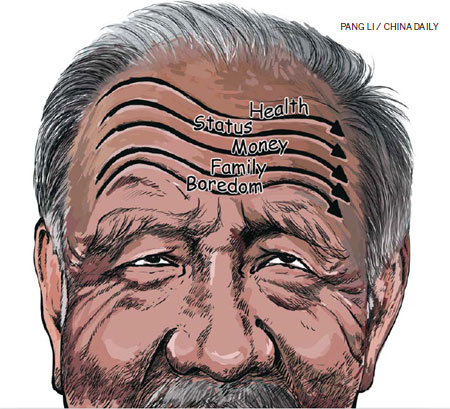
"The battle against illness, the loss of social status, and perplexity about what to do with the rest of their lives are to blame for the deterioration of elderly people's mental health," he said.
"The lack of an endowment insurance system and problems with the medical care system have caused great insecurity and anxiety among elderly Chinese, especially those living in rural areas, who mainly count on their children for support."
According to the Chinese Center for Disease Control and Prevention, one-sixth of Chinese people aged 65 or older have clinical depression. Cardiovascular and cerebrovascular diseases, cancer and depression are the most-common illnesses affecting the elderly.
Moreover, 7.8 percent of those people have Alzheimer's disease. The disease control and prevention center predicts that by the middle of the century the number of Chinese people with the condition will equal the total number of Alzheimer's patients in developed countries worldwide.
Lu Xuejing, director of the social security research center at the Capital University of Economics and Business, said that China will have more than 10 million Alzheimer's patients by 2030, and the incidence of the disease among people aged 80 and older will equate to 30 percent of the population.
"The mental health issues afflicting elderly Chinese people are the most serious in the world," said Li. According to the result of China's sixth national census, released by the National Bureau of Statistics in 2011, people aged 65 years or older will account for 11.92 percent of the population by 2020. And with the elderly population surpassing 300 million, China is expected to become an "aged society" by 2026 or 2027, the census shows.
"But the prevention and treatment of the mental health problems facing elderly people don't get enough attention," said Zhao Baohua, executive vice-president of the Gerontological Society of China.
"Currently, less than 20 percent of mental illnesses can be diagnosed in China and only about 10 percent of patients receive treatment," said Zhao. "The country has 20,000 physicians specializing in mental health issues, but in Beijing alone there are more than 100,000 patients with Alzheimer's disease. There is no funding for specific research, let alone a support system. The treatment and nursing of elderly people with depression and Alzheimer's disease haunts many families and communities across China," he said.
Filial piety
Lu said that only 1 percent of people with Alzheimer's currently receive professional treatment, partly because of their low financial status, but also because of traditional concepts of filial piety: "Many Chinese are afraid that if they send their parents to special medical institutions, friends and neighbors will blame them and say they are unwilling to take care of their elderly relatives."
"Besides, according to a survey launched by the Gerontological Society of Beijing, it will cost a family more than 20,000 yuan every year to take care of a patient with Alzheimer's. That may be equal to half the annual income of a working-class family," said Lu.
He added that in China Alzheimer's disease is not covered by either medical or commercial insurance. "Some of those who don't receive professional treatment in institutions are locked away at home by their family members to prevent them from getting lost," he said.
Generally, elderly men are more vulnerable than their female counterparts, according to Huang: "Normally, older men have higher self-esteem and independence in China, but, compared with women, their ability to adapt to the prevailing environment is lower and their connection with the children is not as close. Older men get less support because they are less likely to confide in others and explain their concerns."
Elderly people living in rural areas are confronted with serious problems, such as the need to perform heavy, laborious work, an unfavorable working environment and a low standard of living, said Huang, adding, "The prevalence of chronic disease has been noted among those people because of their habit of smoking and drinking heavily."
The transformation of the traditional family structure and economic background has also contributed to the plight facing senior citizens in rural areas, according to Huang.
"In a traditional rural Chinese family, the elderly have a certain authority and seniority among family members and are deferred to in many cases. But modern rural families have fewer members and the rate of migration to the cities is rapid. Those factors have resulted in the dilution of people's awareness of family and the lower status of the elderly," he said.
Remarriage seems to be another insurmountable problem for senior citizens.
Wang Sufang, has lived alone in the Jianye district of Nanjing for many years. Her husband died 22 years ago and her children have left home.
"My children may look down on me if I try to find another spouse," said 65-year-old Wang. "Anyway, I'm used to living by myself now."
Every day, she rises at 5 am to take a walk in the nearby Nanhu Park. Then she buys some food, before going home to read the newspapers and watch TV to kill time.
Wu Yemiao, a professor at the school of social sciences at Nanjing Normal University, said that many elderly people carry burdens imposed by both their children and society.
"Some people think they'll lose face if their parents remarry and often property disputes are also involved."
To avoid family disputes over property, some Chinese elderly simply choose to cohabit without a marriage certificate, while others reach a prenuptial agreement.
'Toys' for the elderly
Compared with elderly people overseas, those in China generally "don't know how to play", said Zhao. "Many people become confused after retirement and don't have an interest in anything," he said. "Society should provide more opportunities for the elderly to have fun, including producing "toys" especially designed for them," he said.
These toys range from electronic mathematical and spelling puzzles and brainteasers - designed to stimulate older minds - to dolls aimed at replicating the feeling of having a grandchild.
According to Zhao, China lags behind other countries, when it comes to manufacturing toys to stimulate older people. "About 99 percent of Chinese toy factories just produce items for children, but in more-developed economies about 40 percent of toys are designed for older people. It may take China 30 years to catch up with some countries in this area."
He added that more than one-fifth of elderly people in the United States play video games, but that the phenomenon is rarely seen in China.
Lu suggested that the issue of Alzheimer's disease in the elderly population needs to be addressed and that comprehensive measures should be put in place by the government and local communities.
"The government should put forward specific medical strategies to assure effective and affordable treatment for patients. Communities should also provide daycare centers and preferential policies to alleviate the burden on the families," he said.
"By 2050, China will have a population of almost 100 million people that have lost the ability to work," said Li. "That will pose a great challenge for society and the government."
According to the Ministry of Health, the medical expenditure on mental health issues tops the outlay for all other diseases in China, and the situation may still be the same in 2020.
The ministry has already highlighted the mental health issues afflicting the elderly in its working plan, according to Li. He suggested that the country should formulate "a positive aging strategy" to deal with the mental health issues prompted by China becoming an "aged society".
"One positive aging strategy is that of reducing the size of the population with mental health problems through the education and medical care systems, and to scientifically and effectively treat people who already have mental health issues."
"The elderly should realize that they've acquired total freedom and are their own masters after retirement" said Zhao. "Life can be colorful or even more attractive when people enter another phase of life."
According to Wu Yushao, vice-president of the China National Committee on Aging, the country will pay more attention to the establishment of the universities for the elderly.
Zhao suggested that older people should participate more in public affairs, visit friends and relatives frequently, fulfill their responsibility to their families and develop a range of hobbies to maintain a healthy mental outlook.
"It's the time to experience, to feel, and to enjoy," he said.
Contact the reporter at cangwei@chinadaily.com.cn


Copyright 1995 - . All rights reserved. The content (including but not limited to text, photo, multimedia information, etc) published in this site belongs to China Daily Information Co (CDIC). Without written authorization from CDIC, such content shall not be republished or used in any form. Note: Browsers with 1024*768 or higher resolution are suggested for this site.
License for publishing multimedia online 0108263 Registration Number: 130349