Society
Industrial zones come clean due to green drive
By Li Jing (China Daily)
Updated: 2010-11-11 08:32
 |
Large Medium Small |
|
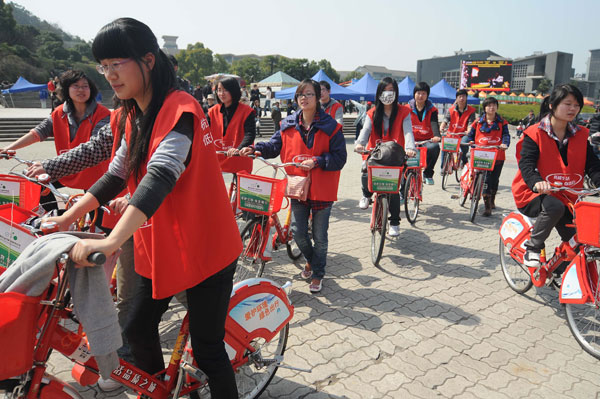 Young residents of Hangzhou, capital of Zhejiang province, use pedal power during a low-carbon campaign held in?the city in March. Zhu Yinwei/For China Daily |
With its designer architecture, wide boulevards and manicured garden, Qianjiang Economic Development Zone stands in stark contrast to the traditional image of dirty industrial parks spitting out smelly smoke from tall chimneys.
| ||||


Embracing only clean and green businesses, Qianjiang provides favorable incentives, such as cheap land rental and tax relief, but sets stringent standards for pollution levels and energy consumption.
The project is one of just many now running nationwide as China strives to reduce its overall carbon emissions.
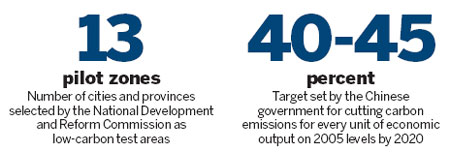
The National Development and Reform Commission (NDRC), the government body that steers the economy, has listed 13 cities and provinces as pilot low-carbon areas, with a view to identifying practices and policies that can help the country reach its carbon intensity target.
Before last year's Copenhagen climate conference, the Chinese government announced it will cut carbon emissions for every unit of economic output by 40 to 45 percent on 2005 levels within the next 10 years.
Although ambitious plans were unveiled to use more clean energy and increase forestry coverage, no concrete guidelines were published in terms of how to go low-carbon until now.
However, without any domestic experiences to draw on, pilot areas must start from scratch and strive for success by testing new development models that evaluate both growth rate and pollution.
Officials in these cities and provinces have to work out independent emissions targets, integrate them into social and economic development programs, transform economic structures, encourage citizens to change their lifestyles and set up mechanisms to report and monitor emissions, as stipulated by NDRC.
|
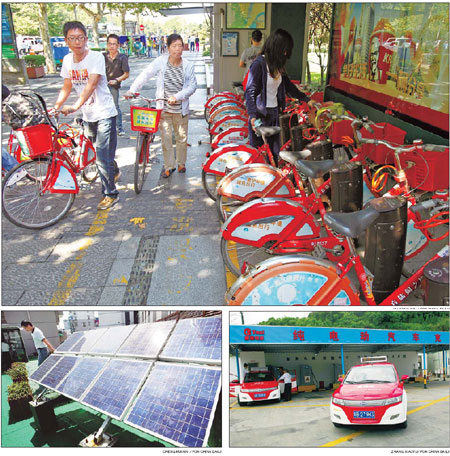 Clockwise from top: One of the bicycle rental points beside the scenic West Lake in downtown Hangzhou, capital of Zhejiang province. The city government has spent about 300 million yuan on establishing a system with 50,000 bicycles at 2,000 locations throughout the city to reduce the reliance on cars; Electric taxis wait at a recharging station in Shenzhen, Guangdong province. There are 50 electric cabs now running on the city's roads; A rooftop solar energy system atop a neighborhood community office building in Hangzhou. |
Early guess work
Several of the pilot zones have been brave enough to put their numbers on table and, although some are sticking close to the national goal, others have shown rather more ambition.
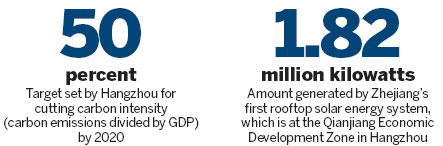
Hangzhou, capital of East China's Zhejiang province, for example, aims to reduce carbon intensity by about 35 percent by 2015 and 50 percent by 2020, said Xu Dongmin, who is overseeing the low-carbon plan for the city's development and reform commission.
Baoding in North China's Hebei province, however, is chasing a 48-percent reduction target by 2020, while Guiyang, a third-tier city in Southwest China, is keeping a modest pace and sticking to 45 percent.
A closer look at the numbers may help explain why some officials have been maintaining a low profile on their targets and plans.
As part of efforts to meet the energy efficiency target set in the 11th Five-Year Plan (2006-2010), China's energy auditing system was greatly improved nationwide. Yet, little information is still available in regard to greenhouse gas emissions.
Without a detailed breakdown of how much carbon each industry emits, it is difficult to judge what measures are most effective. As a result, some officials and experts admitted to China Daily they have made only "preliminary calculations and rough estimates" when proposing their targets.
Wang Ke, executive director of the Energy and Climate Economics Program at Renmin University of China, argued that estimations based on energy consumption statistics will not result in a fundamental change to the big picture and, therefore, provide a valid reference for policymakers.
But emissions from sectors such as construction and transportation, as well as household pollution, are often left out of these estimations, he said.
"We are working on a carbon-emissions inventory, which is expected to be finished next year." said Xu Dongmin in Hangzhou, "With that, it will be easier to break down targets into different industries and sectors."
Wang said he believes what matters now is action, not details.
"It would be ideal if we had all the calculations done before setting the targets and taking action," he said, "but considering we're basically starting from nothing, keeping the ball rolling is equally important."
It is also interesting that different cities and provinces have assigned the task of carbon accounting to different authorities.
Guiyang, capital of Guizhou province, plans to establish a new taskforce in collaboration with the energy auditing system; in Hangzhou, the development and reform commission will lead the task, meanwhile Guangdong officials have announced the provincial meteorological bureau will be in charge of setting up a monitoring platform for greenhouse gas emissions.
Having a clear picture of the sources of carbon emissions is a "prerequisite" for meeting the country's 2020 target, according to Sun Cuihua of the NDRC's climate change department. She said the government is working hard to enhance its capacity in terms of drafting a carbon-emissions inventory and improving the accuracy and credibility of statistics.
|
 |
|
 |
Cautious approach
Although the "low-carbon concept" has become a popular tag for authorities across China, officials in pilot areas were extremely cautious when talking to China Daily. Some even refused to be interviewed, saying that the issue is "too sensitive".
Facing the trade-off between environment and income, those who did comment said they need clearer signals from the central government.
"To put it frankly, which one do you want: low carbon or GDP?" asked Wu Hong, who works for the development and reform commission in Guangzhou, capital of Guangdong, who believes that turning green will surely result in a slowdown of economic growth.
Wu Changhua, Greater China director for The Climate Group, a British-based think tank, agreed and added: "I've met many Chinese officials who are really inspired by green practices, but when they sit down to consider their application it is impossible for them to ignore the pressures of GDP growth and carve out their own way."
When China adopted binding targets to control pollution and improve energy efficiency in 2006, officials' careers were no longer solely determined by economic achievements. Instead, they became responsible for reaching greener goals.
The carbon intensity target will feature heavily in the 12th Five-Year Plan (2011-2015), bringing mounting pressure for civil servants like Wu Hong in Guangzhou and Xu in Hangzhou.
Guangdong, South China's economic engine and net energy importer, is already feeling a "sense of urgency" to transform its growth path after suffering blackouts in recent years, said Wu Hong.
However, putting the brakes on a model that has worked for almost three decades to head in a new direction not only requires courage, he said, but also the ability to endure short-term economic loss.
In that sense, the low-carbon efforts could bring opportunities to cities like Guiyang to rush ahead.
Wang at Renmin University said he believes cutting carbon intensity (carbon emissions divided by GDP) does not necessarily contradict with economic growth: "If you can't reduce absolute emissions, expanding GDP will have the same effect," Wang said.
"China is still in the industrialization process and is not likely to reduce absolute carbon emissions for a moment," he said. "But to reduce carbon intensity, what we can do is slow down the pace of emissions growth while seeking larger increases in GDP. That is more pragmatic.
"However, that would require officials making the right choice on which industries to foster," he added.
Wang's team is helping Guiyang to draw up its low-carbon development plan and has discovered that extending the value chain of its aluminum fabrication industry would significantly increase the added value of products and result in few extra carbon emissions.
The city can also cash in on its rich tourism resources and mild summer climate to boost the low-emissions service industry, which can contribute about 26 percent toward fulfilling the city's carbon intensity target.
"As a third-tier city, Guiyang can avoid the carbon lock-in experienced by some well-developed cities and regions," added Wang.
Not just for show
There is no shortage of stunning low-carbon showcase projects in the NDRC's pilot zones, although most of them are running at a loss or are wholly dependent on government subsidies.
Observers are worried such expensive centerpieces might end up as "image projects", which merely gain approval from higher authorities without genuinely helping to transform the economy.
Jiang Kejun, a researcher with Energy Research Institute affiliated with the NDRC, said bluntly that "low-carbon" tags given to many cities are false, as officials there usually look to single projects without having an overarching consideration of how smart urban planning can reduce carbon emissions.
Equipped with the cutting edge of energy-saving technologies, one demonstration building in Qianjiang Economic Development Zone in Hangzhou costs 80 million yuan ($12 million) to build.
The zone also boasts a 64-million-yuan rooftop solar energy system that can generate 1.82 million kilowatts of electricity every year.
Despite subsidies from the Hangzhou government, though, generation of each kW still costs between 1.6 yuan and 2 yuan, while the feed-in tariff set by the power grid is only 1.43 yuan - meaning the more power it produces, the more money it losses.
Shenzhen, which is in Guangdong but is also a separate pilot city, already has 50 electric taxis on its roads. The cars' batteries take roughly one hour to recharge and can last as much as 300 kilometers. However, the owner of the recharging station is providing a free service during the trial stage and was reluctant to talk about the costs.
"The foundation of new industries remains weak and key technology has not yet been refined," said Wu Changhua with The Climate Group, who warned that it could take 10 years for the new technologies to mature and be accepted by the market, thereby driving down prices.
Some cities that have invested heavily on infrastructure to promote a low-carbon way of life are also struggling to create business opportunities aimed at raising funds to support the operations.
Hangzhou government has spent about 300 million yuan on establishing a system with 50,000 bicycles in 2,000 rental spots to reduce the reliance on cars. As rental is cheap, officials have attempted to make money by auction advertisement space on the bicycles. However, enterprises have so far been put off by the high prices.
Wu Changhua urged pilot areas not to be too ambitious in the early stages of green development.
"Plans should be developed according to the real situation of each region, including resources, knowledge and capabilities, and should not be too aggressive," she added.
 久久久无码人妻精品无码_6080YYY午夜理论片中无码_性无码专区_无码人妻品一区二区三区精99