

 Comments
  Print
Print  Mail
Mail  Large Medium Small
V. Social Changes and Development of All Undertakings
Tibet has achieved all-round development. With the changes in the political and economic systems, Tibet has made the transition from a traditional society to a modern one. Its people' s rights to education, employment, health and social security have been further protected, and all social undertakings are thriving.
Science and education have achieved rapid development
Before its peaceful liberation in 1951, Tibet had no scientific research institutes or staff in the modern sense except in the areas of Tibetan medicine, astronomy and the calendar. Now, Tibet has 33 state-owned independent scientific research institutes, ten private scientific research institutes, and 184 agricultural and animal husbandry science and technology promotion organizations at the autonomous region, prefectural (municipal), and county (district)levels; 29 agricultural science and technology parks and key laboratories at the national and autonomous region levels; 27 state-level new and high-tech enterprises and 46 autonomous-region-level small and medium-sized sci-tech enterprises, and five state-level innovative enterprises and corporate technology centers. Currently, Tibet has 56,264 technical professionals, of whom 43,552 are from ethnic-minority groups, accounting for 77.41 percent; 2,870 senior technical professionals (including one member of the Chinese Academy of Engineering, 244 experts enjoying special government allowances, 16 young and middle-aged experts with outstanding contributions and three national outstanding technical professionals), 13,869 intermediate technical professionals and 36,216 junior technical professionals. All these people play an active role in scientific innovation and application in agriculture, animal husbandry, industry, Tibetan medicine, new energy, tourism, cultural creativity, ethnic handicrafts and other fields. In 2012 the contribution rate of science to economic growth reached 35 percent, to agricultural and animal husbandry growth 42 percent, and the popularization rate of science and technology 85 percent.
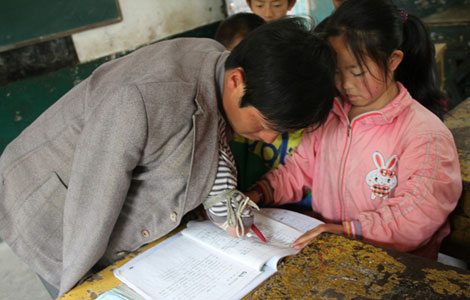
Before the peaceful liberation of Tibet, the educated were mostly aristocrats, while serfs and slaves, accounting for 95 percent of the total population of Tibet, had no right to education at all, and the illiteracy rate among young and middle-aged people was 95 percent. Now, Tibet has established a modern education system covering pre-school education, basic education, vocational education, higher education, adult education and special education. Since 1985 China has covered all tuition, food and boarding expenses for students from farmers and herdsmen' s families in the stage of compulsory education, raised the subsidy standard 12 times and benefited 510,400 people. In 2007 Tibet became the first place in China to enjoy free nine-year compulsory education, and in 2012 the first place in China to enjoy 15-year free education (three-year preschool, six-year primary school, three-year junior middle school and three-year senior middle school). By the end of 2012 Tibet had 292,016 primary school students, with an enrollment rate of 99.4 percent among school-age children; 130,266 junior middle school students, with an enrollment rate of 98.6 percent; 47,825 regular senior middle school students and 18,291 secondary vocational school students, the senior middle school enrollment rate reaching 70.2 percent. In addition, there were 33,452 undergraduate students and 1,079 postgraduate students, the higher education gross enrollment rate reaching 27.4 percent. In China 26 senior and junior middle schools in 20 provinces and municipalities directly under the Central Government have classes specially for Tibetan students; 60 key senior middle schools enroll students with registered permanent residence in Tibet; 48 state-level demonstration secondary vocational technical schools and 170 institutions of higher learning enroll students from the Tibetan classes. These schools and universities have accumulatively enrolled 42,040 junior middle school students, 47,492 senior middle school students (secondary vocational school students), and 16,100 undergraduate students. Currently, inland Tibetan classes have 42,460 students. The campaign to get rid of illiteracy has reached all population in Tibet, the illiteracy rate among young and middle-aged people has decreased to 0.8 percent, and the average length of education for people above the age of 15 has reached 8.1 years.
Citizens' right to employment is protected
Since the democratic reform in Tibet in 1959, all trades in Tibet have thrived, areas of employment have expanded and the requirement for employees' knowledge and skills raised. The government vigorously encourages farmers and herdsmen to seek employment locally by promoting free vocational training, building labor service brands, and improving the mechanism for organized transfer employment and providing better employment environment for migrant workers. The government helps "zero-employment" families, the disabled and other groups with employment difficulties to find jobs by increasing public welfare positions, "enacting policies and providing jobs, skill training, employment services" and other employment assistance. In recent years the government has provided public welfare positions for 19,867 people with employment difficulties, thereby eliminating the number of "zero-employment" families. The government has actively built a two-way selection platform for urban and rural employers and workers. In 2012 new jobs in other fields were found for 450,000 farmers and herdsmen. At the same time 14,153 higher-education graduates were employed, with an employment rate of 98.36 percent. To protect the lawful rights and interests of the workers, the government has set a standard for minimum wages, promoted the adoption of labor contract and collective bargaining, enhanced labor supervision, mediation and arbitration, and improved the mechanism of preventing and handling labor-management dispute cases. In 2012 Tibet' s newly increased urban employment totaled 25,000, and the registered urban unemployment rate was below 2.6 percent.
The people's health has increasingly improved
Before the peaceful liberation of Tibet, only Lhasa and Shigatse had government-run Tibetan medical institutions, private clinics and Tibetan doctors, which were small in both number and operating size. Now Tibet has a public medical and health service system combining Tibetan medicine, Western medicine and traditional Chinese medicine that covers all urban and rural areas of the autonomous region with Lhasa as the center, thereby realizing the objective of "one clinic for one village." In 2012 Tibet had 6,660 medical and health institutions, 8,352 hospital beds and 21,558 health workers (including 9,336 health technicians). The medical institutions provided treatment on 10.12 million occasions and accommodated patients in hospitals on 145,500 occasions. Free medical services are now available to all the farmers and herdsmen in the autonomous region. The subsidy for these medical services was raised from 5.5 yuan annually per person in 1993 to 300 yuan in 2012. The autonomous regional government allocated a special fund of 23 million yuan to set up a major disease supplementary health insurance for farmers and herdsmen. Tibet was the first in China to provide free physical examinations for urban and rural residents, and the subsidy has been raised to 300 yuan annually per capita. In 2012 Tibet provided free medical treatment to 1,032 children with congenital heart defects (CHD). Tibet has set up 81 disease prevention and control institutions; promoted an immunization program throughout the autonomous region; improved the epidemic disease reporting and monitoring system; basically contained plague, tuberculosis (TB), leprosy, Kashin-Beck disease (KBD) and iodine deficiency disorders (IDD); reduced the incidence of measles, diphtheria, pertussis, tetanus, poliomyelitis and other infectious diseases by a large margin; and basically eliminated IDD, with an iodized salt coverage rate of 96.59 percent. In 2012 Tibet implemented a fitness program for farmers and herdsmen in 1,000 administrative villages; enhanced the construction of urban physical fitness zones and gymnasiums; ensured that agricultural and pastoral areas have fitness sites and equipment; promoted a scientific fitness program; and enhanced the building of community-level sports organizations, community sports clubs and nationwide fitness centers to improve the people' s health and quality of life. Tibet has been implementing a flexible birth-control policy, which exempts the farmers and herdsmen, who account for over 80 percent of Tibet' s total population, from the limit set on the number of children one couple could have. The government encourages late marriage and postponed childbearing, healthy pregnancy and scientific nurture, and healthy and civilized marriage lives.
Before the peaceful liberation, Tibet's population remained stagnant for a long period of time because of economic backwardness, low survival rate of newborns, poor medical conditions and a large proportion of monks and nuns in the total population. But since the peaceful liberation, Tibet' s population increased from 1.1409 million in 1951 to 3.002 million in 2010, of which 2.716 million were Tibetans, accounting for more than 90 percent of the total; over 40,000 were from other ethnic-minority groups, accounting for 1.3 percent; and 245,000 were Han people, accounting for 8 percent. In 2012 Tibet' s total population reached 3.08 million. The average life expectancy there has increased from 35.5 years in 1951 to 68.17 years now; the death rates of infants and women in childbirth have dropped greatly and the people' s health has been remarkably improved.
Social security system increasingly improved
In recent years Tibet's social security system has been increasingly improved, so that the sick can seek medical treatment, the elderly are cared for and the financially straitened can receive aid. By the end of 2012 Tibet had established a social security system consisting of basic old-age insurance, basic health insurance, unemployment insurance, work-related injury insurance and maternity insurance, and covering all urban and rural residents, with an insured population of 2.397 million. In 2012 Tibet covered all types of social insurance to the tune of 2.38 billion yuan. The basic living allowance coverage keeps expanding in urban and rural Tibet, and the amount of allowance granted has been raised several times. In 2012, 48,047 urban residents and 329,000 rural residents received basic living allowances from the government, with 400 yuan per person per month in cities and 1,600 yuan per person per year in the countryside. The yearly payment to those who enjoy the "five guarantees" (for food, clothing, medical care, housing and funeral expenses) has been raised significantly to 2,600 yuan per person per year in 2013. People with economic difficulties in urban and rural areas received medical aid on nearly 120,000 occasions, with total funds amounting to 205.75 million yuan. A total of 6,925 urban and rural households with economic difficulties received temporary relief funds totaling 7.762 million yuan. A total of 6,432 students with financial hardships were provided with 16.769 million yuan in assistance. By August 2012 a total of 394,636 urban and rural residents entitled to basic living allowance, the "five guarantees" and special social care received temporary price subsidies totaling 126.069 million yuan. Under the special care of the government, all the monks and nuns in Tibet have been included in the social security system and covered by health insurance, old-age insurance and basic living allowance. Monks and nuns above the age of 60 receive a 120 yuan monthly pension; nuns above the age of 60 and monks above the age of 65 enjoy permanent basic health insurance.


Copyright 1995 - . All rights reserved. The content (including but not limited to text, photo, multimedia information, etc) published in this site belongs to China Daily Information Co (CDIC). Without written authorization from CDIC, such content shall not be republished or used in any form. Note: Browsers with 1024*768 or higher resolution are suggested for this site.
License for publishing multimedia online 0108263 Registration Number: 20100000002731