 |
|
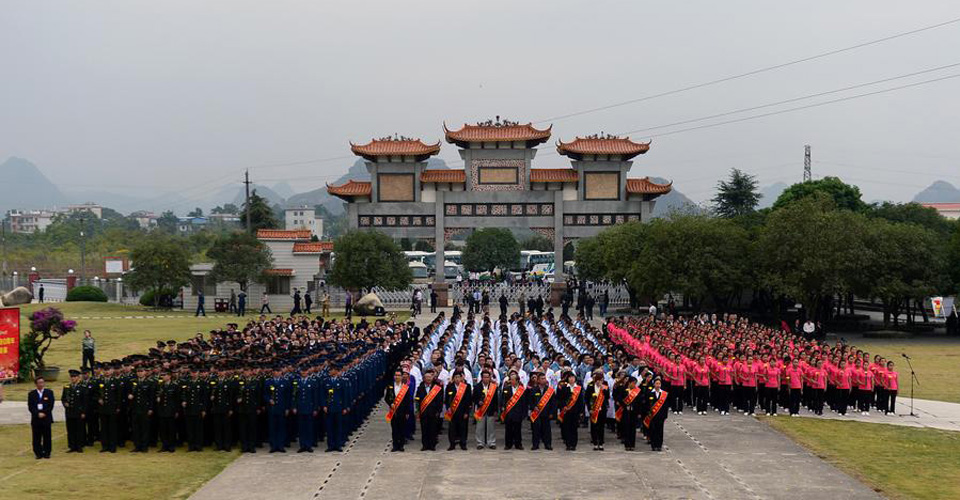
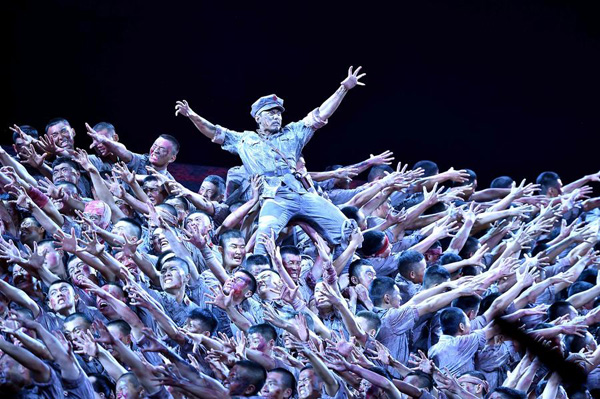
A gala commemorating the 80th anniversary of the victory of the Chinese Red Army's Long March is held in Beijing on Oct 19, 2016. [Photo/Xinhua] |
In recent years, some have started claim that the Red Army successfully finished the Long March because Chiang Kai-shek intentionally "let them off", according to People's Daily. Some media outlets started spreading this claim without scrutinizing it and those with ulterior motive hyped it.
Let's take a look at facts and see if this claim holds true.
1. The claim
Chiang Wei-kuo, the second son of Chiang Kai-shek, said in his oral autobiography that "rather than saying an unsuccessful encirclement lead to the Communist Party of China's breakthrough, it is better to say that we let it off." The purpose was to allow "the central government's forces for the first time to formally enter the southwestern region." Chiang Kai-shek had predicted that "Japan will invade us sooner or later, and at that time, we needed to build up a great rear area, transferring industries to the southwestern region in time." Chiang Wei-kuo said, "considering the situations at that time, it was a successful political strategy that we followed the Communist Part of China's army to enter Yunnan, Guizhou and Sichuan to realize China's union."
A foreign female writer said, "undoubtedly, Chiang Kai-shek released the main forces of the Red Army, the Communist Party of China and Mao Zedong on purpose", "Chiang's strategic plan was to build Sichuan a great rear area for the war against Japan, a place Chiang said was 'a base for nation's revival.'" She even made an assertion that "Chiang had a private motive to release the Red Army: he wanted Stalin to release his son Chiang Ching-kuo who had been a hostage for nine years in Soviet Union."
2. The rebuttal
Reason 1: If Chiang Kai-shek had intentionally let the Red Army move to the southwest, it would have been more convenient to not set up any blockades for the Red Army to retreat and the Kuomintang army to follow.
Fact: In the later stage of the fifth "encirclement and suppression" campaign, Chiang Kai-shek deployed a tactic to drive the Red Army to leave their bases with the aim to avoid excessive losses. He left a gap in the encirclement at the west side and exerted more pressure on other directions to force the Red Army to move west. Apparently, he released the Red Army, but it was a cat and mouse game since he had prepared a net, setting up many blockades along the way.
Reason 2: If Chiang Kai-shek had intentionally let the Red Army move to the southwest, then why did the Red Army lose about half of its forces at the Xiangjiang River battle?
Fact: Soon after the Central Red Army broke through the encirclement, Chiang Kai-shek wrote in his diary, "not to miss the good opportunity of successfully suppressing bandits."
He continued to deploy forces to block and pursue the Red Army, and expected to destroy the Red Army by setting up many blockades. "Make sure to annihilate the bandits east to Xiangjiang River," "prevent the Red Army from entering Guizhou."
The historical records from Kuomintang army's archives on intercepting and pursuing the Red Army show that in order to prevent the Red Army from "fleeing to the west," Chiang Kai-shek even issued "an outline on suppressing bandits," clearly demanding troops "wiping out bandits in regions east to the Xinagjiang River," and if the plan failed, troops should prevent "the bandits from entering Guizhou, converging with the bandits in Sichuan or moving to western Hunan to join forces with He Long and Xiao Ke." At that time, he worried about the Central Red Army moving along the route of the Sixth Corps of the Red Army to go northward from eastern Guizhou to join forces with the Second and Sixth Corpses in western Hunan or the Fourth Front Army in northern Sichuan. Therefore, he planned to destroy the Central Red Army in the border area of Hunan, Guangxi and Guizhou, preventing it from entering Guizhou.
Reason 3: If Chiang Kai-shek wanted to drive the Red Army to Sichuan, why they were blockaded when they tried to cross the Yangtze River, and had to cross the Chishui River four times?
Fact: After the Red Army entered Guizhou, Chiang Kai-shek started to think of combining the two factors together, suppressing the Red Army and unifying the southwestern region, but he still focused on "destroying the Red bandits." He still mobilized troops to block and pursue the Red Army, and he had no intent to drive the Red Army to Sichuan. Chiang Kai-shek's orders to his military leaders were clear that "regardless of all, the more urgent thing is to pursue the bandits," "it is the time for eradication." When the Red Army crossed the Jinsha River and the Dadu River to the north, Chiang Kai-shek sent several troops in an attempt to destroy the Red Army, and he wrote in his diary that he felt regretful for not achieving the goal.
Reason 4: The proposal of "releasing the Communist International's liaison officers to exchange for Chiang Ching-kuo" has been denied by Chiang Kai-shek. How could he drop the opportunity of eradicating the Red Army because of it?
Fact: On July 7, 1934, Chiang Kai-shek wrote in his diary definitely that "only by wiping out the bandits in Jiangxi, [he will] be able to talk with Russia." When Soong Ching Ling in 1931 suggested releasing the Communist International's liaison officers, the couple of Niu Lan, in exchange for Chiang Ching-kuo, Chiang Kai-shek refused firmly, "I would rather leave Ching-kuo not to return or killed by Soviet Russia, and I would never use the criminals harming the country in exchange for my son."
3. The reasons
The failure of Kuomintang's suppression is not because of Chiang Kai-shek internationally letting the Red Army off, but many factors.
(1) Warlords were outwardly united but actually alienated, protecting themselves
Though Chiang Kai-shek himself did not take the attitude of "let off," the warlords in places often performed sloppily. Guangdong warlords offered the Red Army a path to leave, Guangxi forces seeing off the Red Army, and Sichuan forces also turned a blind eye to the Red Army passing through.
Deng Xihou, a warlord in Sichuan, told his military officers that "the pursuing troops should keep about one-day distance with the Red Army, not losing the Red Army or really pursuing but firing at no target. It is okay to just make reports to the upper-level."
Feng Bochang, a deputy regimental commander of Sichuan forces, recalled that "during the pursuit, we stopped and moved when the Red Army stopped and moved. Every day, we asked locals and the lost injured Red Army soldiers about the Central Red Army's move, and then reported to Chiang's government."
This means it was not Chiang himself who let the Red Army off, but the warlords made it happen.
(2) Kuomintang soldiers had low morale and lacked combat capabilities
Kuomintang soldiers were in low morale under the heavy attacks from the Red Army, which could be seen in the historical records of Chiang Kai-shek.
On April 4, 1935, Chiang Kai-shek sent telegraphs to his military officers, "investigations show that major forces of bandits crossed rivers free and easily, but our defense troops could not prohibit the bandits from crossing, or attack them in the river. Even the major forces crossed the rivers, but our forces could not discover. The army is so corrupt, it is rare. …… military officers at different levels are sluggish, slow and careless, and they slacked to work. …… military officers performed like this, and they are lost to shame."
On April 8, he criticized Wu Qiwei's ineffective suppression of the Red Army, "dare not attack little groups of bandits, and fear of being ambushed, ……. It was so protracted, fearing the bandits," "It is not to fight bandits but avoid the bandits, and at last, indulging them to escape."
On April 21, Chiang Kai-shek wrote in his diary, "Xue Yue's troops have no discipline, and soldiers did not receive trainings. I worried about it much."
(3) Public support to the Red Army along the Long March routes
The three major forces of the Red Army passed through more than 10 provinces where tens of ethnic groups lived during the thousands of kilometers trek. Ethnic people joined in the Red Army to fight together, actively saved and protected the injured Red Army soldiers and provided food, clothes and money, which contributed a lot to the success of the Long March.
Some 20,000 from ethnic groups joined in the Central Red Army and the Second and Sixth Corpses in Yunnan, Guizhou and Sichuan. Many moving scenes happened along the journey, such as fathers seeing children off and wives seeing husbands off to join in the Red Army. Couples, brothers, sisters, fathers and sons, as well as mothers and daughters, or even a whole family joined in the Red Army.
From April 1935 to August 1936, when the Red Army's three major forces walked by and stayed in Aba prefecture for about 16 months, Tibetans, Qiang and Hui people provided some 15,000 kilograms of food, some 200,000 domestic animals, 2,500 kilograms of salt, lots of beef, cooking oil and vegetables. When the Red Army passed Longnan, locals offered tens of thousands of kilograms food.
(4) Right military command and bloody fight to secure the success
The most important reason for the Red Army's success of going through the inhospitable places and winning over the enemies was the right military command and soldiers' bloody fight.
Especially after Mao Zedong resumed the leadership of the Red Army after the Zunyi Meeting, he used flexible tactics to guide the army to move based on the actual situation of the battlefields, leading the Red Army out of the encirclement.
The Red Army took advantage of its mobility to lead and confuse the enemies. After crossing the Chishui River four times and crossing the Wujiang River, the Red Army jumped out of the encirclement. They gestured to attack Guiyang, send troops to eastern Guizhou, march toward Yunnan, but crossed the Jinsha River, which entirely broke Chiang's plan of destroying the Red Army and achieved a decisive victory in the transit.
The soldiers came through bloody and difficult battles in the Long March. The Central Red Army lost some 52,500 of its 86,800 soldiers in crossing the Xiangjiang River. All the soldiers of the rear-end division died. Chen Shuxiang, the division commander, was caught by the enemy, but he tore his bowels to die at 29 years old.
In general, Kuomintang's failure and the Red Army's success in the Long March were because of lots of factors. The claim that Chiang Kai-shek "let off" is groundless, opposite of the truth. Perhaps, Chiang's decisions might have helped the Red Army to break the encirclement, but it was not his intention.
The claim that Chiang's help leads to the Long March success is vicious slander on the great event and disservice to the martyrs and the people's army.