Tibet's liberation cast off scourge of feudalism
The reform of the social system in Tibet is clearly defined in the 17-Article Agreement. Article 11 states explicitly: "In matters related to various reforms in Tibet, there will be no compulsion on the part of the Central Authorities. The local government of Tibet shall carry out reforms voluntarily, and when people raise demands for reform, they shall be settled by means of consultation with the leading personnel of Tibet." Following the peaceful liberation, amidst the ever-growing demand of the Tibetan people for democratic reform, many enlightened people of the upper and middle classes also realized that, if the old system were not reformed, the Tibetan people would never attain prosperity. In light of Tibetan history and the region's special situation, the Central People's Government adopted a circumspect attitude toward the reform of the social system in Tibet, patiently persuading and waiting for the ruling strata to carry out the reform, and giving them adequate time for the reform. In 1956, the Central People's Government made a decision that no reform should be carried out in Tibet within six years, still awaiting a change in the attitude of the upper ruling class about the reform. During his visit to India in January 1957, Premier of the State Council Zhou Enlai handed a letter from Chairman Mao Zedong to the Dalai Lama and Panchen Lama, and the accompanying senior local Tibetan government officials. The letter informed them of the central government's decision that reform would not be conducted within six years; whether reform should be carried out after six years would still be decided by Tibet according to its own situation and conditions then. On February 27, 1957, Mao Zedong further pointed out clearly in On the Correct Handling of Contradictions Among the People, "According to the 17-Article Agreement reached between the Central People's Government and the local government of Tibet, the reform of the social system must be carried out, but the timing can only be decided by the great majority of the people of Tibet and their leading figures when they consider it practicable, and one should not be impatient. It has now been decided not to proceed with democratic reforms in Tibet during the period of the Second Five-Year Plan (1958-1962 - ed.). Whether they will be proceeded within the period of the Third Five-Year Plan (1963-1967 - ed.) can only be decided in the light of the situation at that time." It is obvious that the Central People's Government showed utmost patience and made the greatest concessions.
However, some members of the Tibetan ruling class were hostile to reform, and wanted to preserve serfdom forever so as to maintain their own vested interests and privileges. They deliberately violated and undermined the 17-Article Agreement, and intensified their efforts to split the motherland, and finally they staged armed rebellions. In March and April 1952, acting Silon (chief minister - ed.) Sicab Lukangwa and Losang Zhaxi of the local Tibetan government gave secret support to an illicit organization known as the "People's Conference" to oppose the 17-Article Agreement and create disturbances in Lhasa, demanding that the PLA "pull out of Tibet." In May 1955, as the 14th Dalai Lama returned to Tibet via Sichuan Province, two accompanying local Tibetan government officials - Galoin Surkang and the Junior Tutor Trigyang - took two different routes on the pretext of participating in Buddhist activities. The former took the northern route through Garze and Derge, while the latter followed the southern route via Chatreng and Lithang. On their way, they met with local headmen and abbots of various monasteries, plotting an armed rebellion against democratic reform. The leader of the "People's Conference," Gyale Choze, and four others, on the pretext of welcoming the return of the Dalai Lama, made a special trip to Yanga and Kangding. They helped Trigyang organize an armed rebellion in collaboration with reactionary headmen, the abbot of Litang Monastery and some Kuomintang secret agents long-hidden at the monastery. They pledged by mixing their blood to stage the armed rebellion. In 1957, Losang Samten (third elder brother of the Dalai Lama) incited Chimed Gonpo, the headman of Jomda Dzong in Qamdo, to act upon "the Dalai Lama's orders" and gather rebels to launch an armed uprising. In May 1957, with the support of galoins Neuxar Tubdain Tarba and Xainga Gyurme Doje, a rebel organization named "Four Rivers and Six Ranges" (namely, the four main rivers and six mountain ranges in Tibet and the Tibetan-inhabited areas of Sichuan Province in southwestern China - ed.), and later rebel armed forces named "religious guardians" were founded. They raised the slogan of "Independence of Tibet" and "Oppose Re-form," and further intensified their rebellious activities. The armed rebels harassed Qamdo, Dengqen, Heihe and Shannan. They disrupted communication lines, attacked institutions and troops stationed there by the Central Authorities. They looted, cruelly killed officials, persecuted people, and raped women.
In view of the situation, the Central People's Government repeatedly urged the local government of Tibet to punish the rebels and maintain public order. However, the reactionary clique of the upper social strata in Tibet took the extreme forbearance of the central government as a sign of weakness. They declared, "For nine years, the Hans have not dared to touch our most glorious and sacrosanct system. When we attacked them, they could only parry our blows without being able to strike back. So long as we transfer a large number of troops to Lhasa from outside, the Hans will surely flee at the first blow. If they don't run away, we will carry His Holiness the Dalai Lama to Shannan, and gather our strength there to launch a counter-attack and seize back Lhasa. If all these efforts fail, we can go to India."
With the support of foreign anti-China forces, the reactionary clique of Tibet's upper class elaborately plotted and instigated a full-scale armed rebellion in Lhasa on March 10, 1959. On February 7, the Dalai Lama took the initiative, and said to Deng Shaodong, deputy commander of the Tibet Military Area Command, and other officers: "I was told that after its return from studies in the hinterland, the Song and Dance Ensemble under the Tibet Military Area Command has a very good repertoire. I would like to see its show. Please arrange it for me." Deng and the other officers expressed immediate readiness, and asked the Dalai Lama to fix the time and place for the performance. They also conveyed the Dalai Lama's wish to Surkang and other galoins of the local Tibetan government and Paglha Tubdain Weidain, adjutant general of the Dalai Lama. On March 8, the Dalai Lama said he would go to the performance in the Tibet Military Area Command Auditorium at 3 pm on March 10. The Tibet Military Area Command made careful preparations for the occasion. But on the evening of March 9, the Miboin (official in charge of public security of old downtown, equivalent of the present chief of the Public Security Bureau of Chengguan District of Lhasa) of Lhasa instigated the citizens of Lhasa by saying, "Tomorrow, the Dalai Lama will go to the Military Area Command for a banquet and a performance. The Hans have prepared a plane to kidnap the Dalai Lama, and take him to Beijing. Every household should send people to Norbulingka (the residence of the Dalai Lama - ed.) to urge him not to attend the performance in the Military Area Command." The next morning, the rebels coerced more than 2,000 people to mass at Norbulingka, spreading the rumor that "the Military Area Command is planning to poison the Dalai Lama," and shouting slogans such as "Independence of Tibet" and "Away with the Hans." The rebels injured Sampo Cewang Rinzin, a former galoin of the local Tibetan government and at that time a deputy commander of the Tibet Military Area Command. They stoned to death Kainqoin Pagbalha Soinam Gyamco, a progressive patriot and member of the Preparatory Committee for the Tibet Autonomous Region. His body was tied to the tail of a horse and dragged through the downtown area. Subsequently, the rebel leaders convened a so-called "people's congress" and a "people's conference of the independent state of Tibet," intensifying their efforts to organize and expand armed rebellion. They brazenly tore up the "17-Article Agreement", declared "the independence of Tibet," and launched a full-scale armed rebellion against the motherland.
|
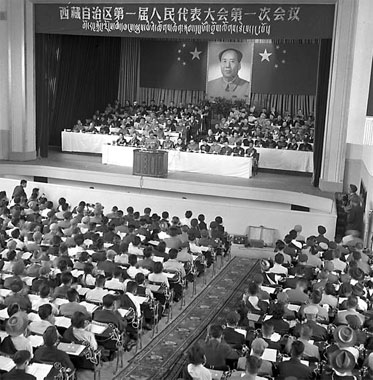
In 1965, the Tibet Autonomous Region was founded, marking the establishment of the regional autonomy system for ethnic minorities in Tibet. Xinhua |
Although Norbulingka was controlled by the rebels, and it was hard to make contact with the Dalai Lama, Tan Guansan, the acting representative of the central government, managed to send three letters to the Dalai Lama on March 10, 11 and 15, respectively, through patriots. In the letters, Tan expressed his understanding of the Dalai Lama's situation as well as his concern for the latter's safety. He pointed out that the rebels were making reckless military provocations, and demanded that the local Tibet government immediately take measures to stop them. The Dalai Lama wrote three letters in reply to Tan on March 11, 12 and 16, respectively. In his letters, the Dalai Lama wrote, "Reactionary, evil elements are carrying out activities endangering me on the pretext of ensuring my safety. I am taking steps to calm things down." "The unlawful activities of the reactionary clique cause me endless worry and sorrow.... As to the incidents of yesterday and the day before, which were brought about on the pretext of ensuring my safety and have seriously estranged relations between the Central People's Government and the local government, I am making every possible effort to deal with them." In his letter of March 16, he said that he had "educated" and "severely criticized" officials of the local Tibet government. He also said he might go to the Military Area Command a few days later. However, on the evening of March 17, the Dalai Lama, together with galoins Surkang, Neuxar, Xaisur and other rebel leaders, fled from Lhasa to Shannan, the "base" of the armed rebel forces. When the armed rebellion failed, they fled to India.
After the Dalai Lama left Lhasa, about 7,000 rebels gathered to wage a full-scale attack on the Party, government and military institutions early in the morning on March 20, 1959. The PLA, driven beyond forbearance, launched, under orders, a counterattack at 10 am the same day. With the support of all ethnic groups in Tibet, the 1,000-odd PLA troops completely put down the armed rebellion in Lhasa within two days. Before long, the PLA rapidly quelled the armed rebellion in other places in Tibet.
Just as Chairman Mao Zedong pointed out, "The Dalai Lama's plotting to launch a rebellion started just after his return from Beijing in 1955. He prepared this rebellion for two years - from early 1957, when he returned from India, to 1958." After he fled from China in 1959, the 14th Dalai Lama and his clique went further and further down the road to splitting the motherland. They established the so-called "Tibetan government-in-exile," publicly declared "Tibetan independence," reorganized rebel forces to carry out military harassment along the Chinese border for many years, engaged in long-term international anti-China activities, and instigated many riots in Tibet and other Tibetan-inhabited areas.
The armed rebellion in Tibet was supported from the very beginning by foreign anti-China forces. According to a Western media report on January 26, 1971, a certain country's intelligence agency trained members of the "Four Rivers and Six Ranges" in February 1957 on a certain Pacific island. From 1956 to 1957, the above-mentioned intelligence agency handpicked some 170 rebels, and sent them to the "Kamba guerrilla training base" in that country. Several hundred trained "Kamba guerrillas" were air-dropped into Tibet, carrying sub-machine guns, and small gold boxes containing the portrait of Dalai Lama. This intelligence agency trained 2,000 Tibetan guerrillas in total. From July 1958 to February 1959, it launched two weapon air-drops to rebellious armed forces, including 403 rifles, 20 sub-machine guns, 60 boxes of hand-grenades, and several bags of Indian rupees. In November 1958, it transported 226 loads of weapons to the Shannan rebel army via the Indian-occupied area to the south of the "McMahon Line." In January the following year, it transported 40 loads of goods to Shannan rebel army via Nepal and Shekar. It launched more than 30 air-drops to the Kham rebel army, and dropped over 250 tons of goods, including approximately 10,000 M1 Garand Rifles, assault rifles, 57 mm recoilless guns, and antiaircraft machine guns. According to another Western media report on August 16, 1999, a certain Western country air-dropped more than 400 tons of goods to Tibetan guerrillas from 1957 to 1960. This country "spent US$1.7 million on such operations in Tibet annually".
While the Dalai Lama was fleeing, the above-mentioned intelligence agency re-equipped a plane and air-dropped goods for him and his companions on the way, keeping contact with the rebel army and nearby intelligence stations via radio, and recording the whole course of the flight. Based on a Hong Kong media report on February 11, 1974, according to participants in the operation, the Dalai Lama's flight from Lhasa was planned by the Western intelligence agency. The country's spy planes sneaked hundreds of miles into Tibet, providing protection for the Dalai Lama clique from air, air-dropping food, maps, radios and money, as well as strafing Chinese installations and taking photos of the operation.
Since the reactionary Tibetan ruling class had taken the road of betraying their country, on March 28, 1959, Premier Zhou Enlai promulgated a State Council Decree dissolving the local Tibetan government. The Preparatory Committee of the Tibet Autonomous Region took over local government power, and the 10th Panchen Lama acted as its chairman. At the same time, the Central People's Government implemented a policy of "quelling the rebellion while conducting the reform," and led the Tibetan people to start the surging tide of democratic reform, wrecked the feudal serfdom of theocracy, and helped a million serfs and slaves realize their lifelong wish of being their own masters.
Abolishing the oppression and exploitation of the feudal serfdom system, liberating a million serfs and slaves. After the quelling of the armed rebellion in 1959, the Central People's Government immediately dissolved the Kasha regime and its armed forces, courts and prisons, which had oppressed the Tibetan people for hundreds of years. At the same time, it repealed the old Tibetan Code and barbarous punishments. This was followed by a planned and step-by-step campaign in the rural areas against rebellion, corvee labor and slavery, and for reduction of rent for land and of interest on loans; a campaign launched in the pastoral areas against rebellion, corvee labor and slavery, and helping hired herdsmen and herd owners; a campaign launched in the monasteries against rebellion, feudal privileges and exploitation, and to square accounts with political persecution, hierarchical oppression and economic exploitation; a campaign launched in the urban areas against rebellion, the feudal system, exploitation and privileges, and on reduction of rent for land and of interest on loans. In addition, the democratic reform was conducted in the border areas by stages, abolishing the bondage of the serfs and slaves to their feudal masters, as well as the feudal system, exploitation and privileges, and corvee labor and high-interest loans.
The one million serfs and slaves in Tibet were emancipated. They became the masters of their country, as well as Tibet. Their lives and personal freedom are now protected and safeguarded by the Chinese Constitution and law. They no longer suffer from the serf-owners' political oppression, forced labor and inhuman treatment, as well as heavy corvee taxes and usurious exploitation. Nyima Tsering, who was elected the first chairman of the Farmers' Association during the democratic re-form, used to be a serf of Surkhang Wangchen Gelek, a galoin of the Tibet local government. Wangchen Gelek once said, "Nyima Tsering is my property. I will do whatever I like to him. If I like, I can roll him into a ball and put him in my pocket, or stretch him into a belt and tie it around my waist." After the democratic reform, Nyima Tsering said, "Now my personal freedom is protected by the law. I am no longer another's private property. How wonderful this is!" Tsering Lhamo had been a serf for more than 30 years. After the democratic reform, she organized the first Nangsan Mutual Aid Team at Kyerpa Township, in Nedong County, Shannan Prefecture. Later, she held the post of vice chairwoman of the Standing Committee of People's Congress of the Tibet Autonomous Region.
Implementing land reform, abolishing the feudal land ownership, making serfs and slaves masters of the land. On September 21, 1959, the Preparatory Committee of the Tibet Autonomous Region passed the "Decision on Abolishing Feudal Land Ownership System and Implementing Farmers' Land Ownership," stipulating that farmland and other means of production originally occupied by those serf-owners involved in the armed rebellion were to be confiscated and distributed to landless serfs and slaves, and the land and other means of production of serf-owners who had not participated in the rebellion were to be redeemed by the state and then distributed to the serfs and slaves. According to statistics, in the democratic reform the central government spent 45 million yuan on the redemption of 900,000 mu of land and over 820,000 heads of livestock from more than 1,300 households of serf-owners and agents who had not participated in the rebellion. Over 2.8 million mu of land was confiscated or redeemed from serf-owners, and distributed to 800,000 former serfs or slaves of 200,000 households. Each of the former serfs and slaves got about 3.5 mu of land. The laboring Tibetan people who had been enslaved generation after generation stood on their own land, celebrating all night. They cried, "The sun of the Dalai Lama shone on the nobility, while the sun of Chairman Mao is shining on our poor people. Now the Dalai Lama's sun is set, and our sun is rising."
Tibet's one million serfs and slaves became masters of the land and other means of production for the first time. Their unprecedented enthusiasm for production and life gave rise to a rapid change in Tibet's social situation and their living conditions. When the land reform was basically completed in 1960, the total grain output for Tibet was 12.6 percent higher than that in 1959 and 17.5 percent higher than in 1958, the year before the land reform. Moreover, the total number of livestock was 10 percent more than in 1959. During the democratic reform, Tibet's first supply and marketing cooperative, first rural credit cooperative, first private primary school, first night school, first literacy class, first film projection team and first modern medical organization were established in its history. By the end of 1959, 28 neighborhood committees had been set up in Lhasa, offering jobs to over 8,700 vagrants and beggars, providing relief to more than 8,500 poor people, and taking in over 120 childless, aged, sick and disabled people. In 1960, Ngachen Hydroelectric Station was completed and put into use, bringing electric lighting for the first time to the citizens of Lhasa. In 1959 and 1960, dozens of small-scale modern factories were set up in Tibet, employing over 20,000 Tibetan workers. Tibet's roads built in those two years totaled 12,500 km, and reached over 90 percent of the counties in the region.
Abolishing theocracy, separating religion from state, and protecting religious freedom. During the democratic reform, means of production, including land and livestock, originally owned by monasteries involved in the armed rebellion were all confiscated, while a policy of redemption was introduced with regard to the means of production of monasteries which had not participated in the rebellion. During the democratic reform, on the one hand, citizens' freedom of religious belief, and patriotic and law-abiding monasteries were protected by the law. Citizens have the freedom to become a monk or nun and monks and nuns can choose to resume secular life, regular religious activities as well as historical monasteries and cultural relics were all protected. On the other hand, a policy of "political unity, freedom of religious belief and separation of politics and religion" was adopted, abolishing monasteries' feudal privileges in economy and politics, repealing monasteries' feudal occupation and exploitation, and personal slavery, as well as feudal management and hierarchy inside the monasteries, and ensuring that all religious beliefs were politically equal. Public funds and properties inside the monasteries were managed democratically, serving as production funds and for supporting monks and nuns as well as regular religious activities; the monasteries' management committees uniformly administered the land distributed to monks and nuns in accordance with their labor ability, and managed production. When the income of a monastery was unable to cover its regular expenses, the government would grant a subsidy. Through the democratic reform, all the monasteries in Tibet elected their own management committees, and conducted democratic management. The democratic reform enabled the true features of religion to emerge, effectively safeguarded the Tibetan people's freedom of religious belief, and laid a foundation for the introduction of the political system of people's democracy in Tibet.
Establishing the people's democratic state power, ensuring that the people enjoy rights as their own masters. Overthrowing the system of feudal serfdom, the emancipated people of various ethnic groups in Tibet established people's democratic organs of state power. By the end of 1960, Tibet had established 1,009 organs of state power at township level, and 283 at district level, 78 at county level (including county-level districts) and eight at prefecture (city) level. The number of cadres of Tibetan and other ethnic groups totaled over 10,000 in Tibet. Among them, township-level ones were all Tibetans, more than 90 percent of leaders at the district-level were Tibetans, and over 300 Tibetan cadres held leading posts at or above the county level. More than 4,400 liberated serfs and slaves were trained as cadres at the grassroots level. In 1961, a general election was held in Tibet. For the first time, the former serfs and slaves were able to enjoy rights as their own masters. Tens of thousands of liberated serfs and slaves, dressed in splendid attire, holding had a (white symbolic scarves) in both hands, actively participated in the election of power organs and governments at all levels in the region, exercising their democratic rights with great political enthusiasm and a deep sense of responsibility. In August 1965, the election at the level of township and county was completed in Tibet. One thousand three hundred and fifty-nine townships and towns conducted elections at the basic level, and 567 townships and towns held their people's congresses. The people's democratic organs of state power at county level were established in 92 percent of the region, with the majority of participants being liberated serfs and slaves. In addition, 54 counties held their first people's congresses to elect the county magistrates and deputy magistrates, and established people's committees. In September 1965, the First People's Congress of Tibet was convened, at which the founding of the Tibet Autonomous Region was officially proclaimed. Over 80 percent of the 301 deputies were Tibetans or other ethnic minorities. More than 11 percent were patriots from the upper strata and religious figures in Tibet. Most deputies of the Tibetan ethnic group to the congress were liberated serfs and slaves. The founding of the people's democratic organs of state power politically guaranteed the Tibetan people's rights as their own masters.
The surging tide of democratic reform took only a few years to overthrow the feudal serfdom system which had been practiced in Tibet for centuries. The reform liberated Tibet's one million serfs and slaves politically, economically and socially, brought an entirely new look to Tibet's society, and ushered in a new era for Tibet's development. It was an epoch-making reform in Tibet's history of social advancement and development of human rights, marking the beginning of rapid social development in Tibet.
III. Tremendous historic changes over the past half-century
Over the past five decades since the democratic reform, and with the care of the Central People's Government and the support of the people of the entire country, the people of all ethnic groups in Tibet, as masters of their own destiny, have displayed great enthusiasm in building a new happy life, promoting development of local economy and society in a frog-leaping manner and scoring historic achievements in various undertakings, which captured world attention.
Tibet has experienced historic changes in its social system, which provides an institutional guarantee of the people's rights to be master of their own.
In 1965, the Tibet Autonomous Region was founded, marking the establishment of the regional autonomy system for ethnic minorities in Tibet and a historic leap from feudal serfdom under theocracy to socialism featured with people's democracy. From then on, Tibet entered a new era, with the people becoming master of their own destiny. The former serfs and slaves have since enjoyed political right to equally participate in the administration of state affairs and to deal with local and ethnic affairs on their own. The people of Tibet, as other ethnic groups in China, enjoy all rights guaranteed by the Chinese Constitution and other laws. They can directly elect, in accordance with the law, deputies to the people's congresses at county, district, township and town levels, who in turn elect deputies to the people's congresses at the national, autonomous regional and municipal levels. Through the people's congresses at various levels, the people of Tibet exercise their rights, in accordance with the law, to participate in the administration of state and local affairs.
In the elections for the people's congresses at the autonomous regional, prefectural (municipal), county and township (town) levels in 2007, 96.4 percent of residents with voting rights participated in the electoral process. In some places the voting rate was 100 percent. Of more than 34,000 deputies, directly or indirectly elected, to the people's congresses at the aforementioned four levels, more than 94 percent were members of the Tibetans or other ethnic minorities. Of the deputies to the current National People's Congress, 20 are from Tibet, including 12 Tibetans, one Monba and one Lhoba.
Tibetans' right to independently administrate local and ethnic affairs is guaranteed. Since 1965, the posts of chairman of the Standing Committee of the People's Congress and chairman of the People's Government of the Tibet Autonomous Region have all been held by Tibetans, and the chief leaders of the standing committees of people's congresses and the people's governments at various levels in the autonomous region are also Tibetans. So are the chief heads of local courts and procuratorates at all levels. Tibetans and other ethnic-minority people compose 77.97 percent of the staff of current state organs at the autonomous regional, prefectural (municipal) and county levels.
The Tibet Autonomous Region not only has the right to formulate local regulations as a provincial-level state organ, it can also decide on local affairs, and formulate autonomy statutes and separate regulations in line with local political, economic and cultural conditions. When resolutions, decisions, orders and instructions made by higher-level state organs do not suit to situations in Tibet, the autonomous organs can request adjustment or suspension of the relevant documents.
Statistics show that since 1965 the Standing Committee of the People's Congress of the Tibet Autonomous Region has enacted 250 local regulations, resolutions and decisions with regulatory nature, which cover political power buildup, economic development, culture and education, spoken and written languages, justice, relics protection, plus the protection of wild animals, plants, and natural resources. They protect the special rights and interests of the Tibetan people in the areas of politics, economy and social life, and promote the development of various local undertakings.
(China Daily 03/03/2009 page9)