|
Home>News Center>World | |
|
|
|
|
|
|
|
|
|
|
|||||||||||||||||||||||||||||||||||||||||||||||||||||||||||||||||||||||||||||||||||||||||||||||||||||||||||||
|
|
NASA: Salty sea covered part of Mars
A salty sea once washed over the plains of Mars at the Opportunity rover's landing site, creating a life-friendly environment more earthlike than any known on another world, NASA scientists announced Tuesday.
Scientists don't yet know how deep the ocean was, exactly when it existed or for how long. The finding builds on the March 2 announcement that Meridiani Planum, where Opportunity landed, had long ago been soaked with water. Geologists could not tell from those initial results whether the water was above the surface or only underground.
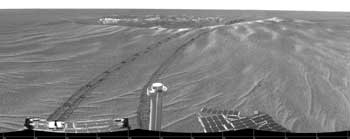
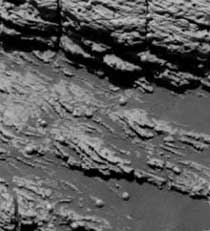
The rocks would be excellent preservers of biological signs, if life ever existed on Mars, Squyres said. That makes Meridiani Planum a prime target for future missions that would search for evidence of past biology. An ancient sea also implies that early Mars was warmer than today, said University of Colorado geologist Bruce Jakosky, who was not directly involved in the finding. And he said it suggests that any possible microbes on Mars would not have had to rely only on relatively inefficient subsurface, geochemical energy, but might have used direct sunlight as an energy source. "If it's surface water, that would allow the possibility of photosynthetic organisms," Jakosky said. "Once you can tap into sunlight, it leaves open the possibility for a much greater abundance of life if it was ever there." Scientists so far have no firm evidence that Mars was ever inhabited, however. Sedimentary signs The crucial clues that came together in recent days included the detection of chlorine and bromine, indicating a salty sea had evaporated over time, scientists said. Also significant were crisscrossing layers of sediment in the rock that revealed they formed beneath currents of moving water. Early interpretations of the same lines of research led to the previous discovery that the rocks were once soaked in water, but it wasn't clear if the water was present when the rocks formed, or if the water came later. Increased confidence in the bromine finding strengthened the case that the particles which formed the rocks had precipitated out of surface water, with salt concentrations that increased as the water evaporated. Some layers within the rock are at telltale angles to the main layers. Scientists call the patterns "crossbedding." Other features, called festooned layers, involve smile-shaped curves produced by shifting, rippled shapes of loose sediments under a current of water. The patterns indicate sediment the size of sand grains had bonded together into ripples in water that was at least 2 inches (5 centimeters) deep -- and possibly much deeper, said John Grotzinger, a rover science team member from the Massachusetts Institute of Technology. The water flowed at a rate somewhere between 4 and 20 inches every second (10 to 50 centimeters per second). That's up to about 1 mile an hour. "Ripples that formed in wind look different than ripples formed in water," Grotzinger said. The rocks may have been cast in a salt flat that was alternately wet and dry, Grotzinger added. Similar environments on Earth, at the edge of oceans or in desert basins, sometimes have currents of water that produce the type of ripples seen in the Mars rocks. Brighter prospects The discovery re-ignited enthusiasm over Mars as a potential well for biology, at least in the past. (Researchers are unsure whether any life that ever developed on Mars -- if it did -- could have endured into the present era, with Mars being cold and dry.) "The particular type of rock Opportunity is finding, with evaporite sediments from standing water, offers excellent capability for preserving evidence of any biochemical or biological material that may have been in the water," said Squyres, the rover mission's chief scientist. The discovery quite literally brightens the prospects for past life in another important way. Had the water been only subsurface, life would have had to rely on geochemical energy, such as the decay of rocks into methane. On Earth, dependence on geochemical energy is a limiting factor for underground microbes, said Jakosky, the University of Colorado geologist who is also director of the university's NASA-sponsored Center for Astrobiology. He helped pick the rover landing sites but has not been directly involved in the science explorations. Organisms that depend on geochemical energy are less diverse and of more limited scope than life that flourishes in sunlight, Jakosky explained. "This dramatic confirmation of standing water in Mars' history builds on a progression of discoveries about that most earthlike of alien planets," said Ed Weiler, NASA associate administrator for space science. "This result gives us impetus to expand our ambitious program of exploring Mars to learn whether microbes have ever lived there and, ultimately, whether we can." Most scientists agree that finding signs of past or present life will likely require sending a robot to bring back samples for study in laboratories on Earth. Meridiani Planum is, for now, the best destination for such a mission, which NASA has slated for launch sometime in the next decade. "Someday we must collect these rocks and bring them back to terrestrial laboratories to read their records for clues to the biological potential of Mars," said James Garvin, lead scientist for Mars and lunar exploration at NASA Headquarters. Hints at 'warm and wet' Mars Finding a sea on Mars also hints at the past climate. Scientists have been arguing for decades over whether Mars was once warm and wet or just wetter and cold. "I think that this seems to point toward Mars being warm enough and wet enough to allow standing water" in the distant past, Jakosky said. Jakosky also explained that Tuesday's announcement means the water was present as the sedimentary rock formed. The rocks are known to be from Mars' early epochs, so the water was likely there in the very, very distant history of the planet's roughly 4.5 billion years of existence. Had the new evidence pointed only to groundwater altering the chemistry of the rocks, such water might have coursed through the rocks at any time during the planet's history, including well after the rocks themselves were formed. Opportunity had spent its entire time on Mars, since landing in late January, inside a shallow crater studying soil and the exposed shelf of bedrock. The most recent and telling observations came by taking 152 microscopic pictures of a rock named Last Chance. The findings add to previous rover discoveries of hematite, a mineral typically formed in water, and the layered rocks being laden with salts, which led scientists to conclude the region was at least soaked with groundwater. Other investigations from orbiting spacecraft have revealed possible shorelines elsewhere on Mars, but no ground measurements have confirmed any of those findings, and some scientists had remained skeptical that Mars ever harbored any significant surface water. Scientists have said they see no visible shorelines surrounding the Meridiani Planum, so they can't yet deduce the size of the ancient body of water. The rover left the crater this week and will now try to examine what scientists think is a larger rock outcropping some distance away. The rover will roam across a vast plain that is, overall, the size of Oklahoma. At the larger outcropping, researchers hope to find more extensive layers and read them like pages of a history book, to learn more about the depth, breadth and timing of the ocean that long ago graced the Red Planet. |
|
|
|
|
||||||||||||||||||||||||||||||||||||||||||||||||||||||||||||||||||||||||||||||||||||||||||||||||||||||||||
|
|
|
|
|||||||||||||||||||||||||||||||||||||||||||||||||||||||||||||||||||||||||||||||||||||||||||||||||||||||||||||