|
Home>News Center>Life | |
|
|
|
|
|
|
|
|
|
|
|||||||||||||||||||||||||||||||||||||||||||||||||
|
|
Artist finds self through East-West fusion
The term "Bridging the East and the West" has become an almost wearisome cliche for today's artists, art critics and art enthusiasts.
Jointly organized by the National Art Museum of China, Shanghai Art Museum, Alisan Fine Arts (Hong Kong) and the Hong Kong Arts Centre, the grand retrospective show, titled "Love of the Cosmos," chronicles Chao's decades long endeavour to find his own voice, with well over 80 works of the artist in different styles. The show, which ends on April 27 in Beijing, will begin a tour, first to the Shanghai Art Museum, from May 8 to 18; then to the Enrico Navarra Gallery in Paris, from June 10 to July 31; then to the Hong Kong Arts Centre, from October 5 to 26; and possibly to some major cities in North America, according to Alice King, curator of the exhibition.
"Chao was an artist who questioned the centuries-old traditions of Chinese painting, working consciously to bring the genre into the modern world," said King. But she also pointed out that "during his lifetime, Chao was a much ignored, much misunderstood 'controversial' artist."
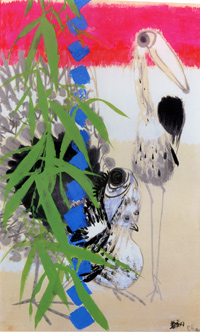
Chao was born into a family of intellectuals in Taikang, a small town in Central China's Henan Province. From an early age, Chao was exposed to the basics of Chinese philosophy, poetry, calligraphy, and painting. By the age of 15, he had already mastered the fundamentals of traditional Chinese painting. "At that time, I had a clear understanding of human relations and of the fact that art is a vital part of human life," he recalled late in his life. Chao then studied for three years in the Art Department of Henan Normal School. Under the guidance of such great masters as Lin Fengmian (1900-1991) and Pan Tianshou (1898-1971), he spent the following four years at the Painting Department of National Academy of Arts, now called the China Academy of Fine Arts, in Hangzhou, capital of East China's Zhejiang Province. During the 1930's when Chao was a student there, the academy was considered the most liberal art school in China and played an important role in introducing modern concepts into Chinese art. While there, Chao was exposed to Western techniques and was encouraged to develop his own style. During that period, Chao also devoted much of his time to studying the various schools of ancient Chinese philosophy. This equipped him with a thorough understanding of the heritage of Chinese culture - the doctrines of Buddhism, Confucianism and Taoism and also the philosophies of Lao Zi and Zhuang Zi. "All my studies served as a base for the formation of my own philosophy of life and broadened my understanding of such fundamental human concepts as life, death, waxing, waning, wealth, honour, sex and passion," Chao once said. "My frame of mind has therefore been profoundly influenced by an unbiased, 'middle-of-the-road' outlook, and my emotions abound with natural expressions of my 'love' for all things in the universe. "I submit that one's life can only be evaluated by the love one gives in one's lifetime, which also happens to be the final objective pursued by philosophers, theologists, and artists of the Western world." In the midst of the social and political upheaval in 1949, Chao moved to Taiwan, where he worked as an art professor. In 1956, he travelled to Barcelona, in Spain, on a scholarship from the Spanish Government. So successful was he there that he was made a Permanent Member of the National Art Association of Spain in 1957. Two years later, he settled down in New York. Chao died in 1991 in Taiwan, where he had just returned after living abroad for more than 30 years. Two traditions Surrounded by Western art, Chao experienced culture shock, but he did not retreat. In his own writings, he stated that he was strongly attracted by the paintings of Pierre Soulages, Hans Hartung and especially Franz Kline, whom he met after moving to New York. "He was attracted, but he was not consumed. Instead, during the following decades, there appears a special quality in Chao's art that oscillates between and even at times combines Eastern and Western traditions," pointed out Roger Goepper, an art researcher with the University of Cologne, in Germany. Arriving in New York when Abstract Expressionism was in its heyday, Chao was very much intrigued by this artistic movement. Although Chao became friends with Franz Kline and experimented with abstract art as well as European Surrealist techniques, he managed to develop his own style. Trained in Chinese painting and living in New York at a time when it was the leading centre of Western art, Chao chose to combine the two. Chao said his goal was to create a balance of East and West in his works. The outcome was an art of his own unique style. Chao believed that for diligent and earnest artists, "there is no such thing as right or wrong in art. It is the artist's experience, learning and cultivation that make the difference." In Chao's view, "art in the past was a unilateral activity, whereas modern art encourages interaction. In order to achieve self-realization and self-enlightenment, the former imported expression for the painter whereas the latter exports inspiration for the viewer." And Chao himself proved to be a successful example of the latter. For years, his unconventional art works have been highly valued by both Eastern and Western art lovers. To the former, his works embody the rhythmic vitality and conception of traditional Chinese ink painting; to the latter, they possess the lucidity and gravity of modern oil painting and the mystery and uncertainty of Abstract Expressionism, art critics say. His works find a balance between narrative and abstract forms, meaning and the absence of meaning. Chao's works maintain the intrinsic forms of both Chinese and Western culture in a pluralistic and composite structure. The visual effects derived from the interposing, juxtaposing, complementing, and contrasting of images are a key factor in the artistic charm of his work, said Taiwan art researcher Lu Fusheng. Using both Eastern and Western media (Chinese ink on rice paper as well as acrylic and canvas), Chao combined Eastern philosophy with Eastern and Western symbols to create something unique. Chao once said: "It was set forth in the ancient canons that 'poetry should possess the quality of painting and painting that of poetry.' This applies also to abstract painting. Only works with profundity reach the summit of art." Under Chao's brush, traditional Chinese images, such as birds, bamboo and fish, are overlaid with colourful and sometimes shocking fluorescent squares, dots, circles, splashes or runs. The bold shapes in his paintings are not just abstract forms but also symbols of Taoism, a philosophy that Chao strongly believed in and lived by. This is further exemplified by the various Yin and Yang (negative and positive) symbols that appear in his paintings. From the late 1960s, Chao used concentric circles for 25 years nearly always to represent the warm sun, thus infusing his paintings with the emotional tension of human experience. In that sense, Chao differed greatly from most of his contemporaries who treated the circle as merely an elemental shape. Absoluteness is the key to success in artistic creation. It is the most powerful form of spiritual representation. Placing a simple image against a void helps enhance the image's simplicity. A profound and inspiring work does not necessarily have elaborate images, claimed Chao. In Chao's view, "A painter is not just someone who is able to paint and sketch directly from nature. Nor is he simply an illustrator of historic places and monuments for tourist brochures. He makes use of his works to gain a thorough understanding of the intrinsic value of nature, and through them gains the ultimate goal of love and perfection." Window-scene painting has been part of Western art for hundreds of years and was a solution to the problem of linking the foreground with a distant background. The Post-Impressionists altered this concept by putting closed windows in their paintings, which were seen first hand by some Chinese artists studying in France at the beginning of the 20th century. Again, Chao used this concept in his individual way, for instance in his "The Early Bird Catches the Worm," where he reverses the perspective, painting the window from the outside. "Although there are only a few examples of such paintings among Chao's works, it proves once again that he was very much a unique and eccentric artist," said Taiwan art researcher Chuang Shen. Chao's paintings also capture the dimension of time. He captures different aspects of time. For example, there is the pronounced momentary effect that occurs when Chao splashes liquid colour, often a bright shining green, over the surface of a painting that seems to have already been completed. Reviewing his own artistic pursuit, Chao once wrote: "My whole life, time, space, outer and inner soul are totally immersed in Eastern and Western arts. A driving aspiration has inspired me to redouble my efforts to create so as to meet this new challenge and to achieve my own spiritual paradise. Hardship has given me a firm conviction that I shall continue to struggle ahead. "In the process of my creativeness, I make use of the very best qualities of the arts of the two worlds and incorporate them as the backbone of my own creativeness." |
|
|
|
|
||||||||||||||||||||||||||||||||||||||||||||||
|
|
|
|
|||||||||||||||||||||||||||||||||||||||||||||||||