
|
Home>News Center>Life | |
|
|
|
|
|
|
|
|
|
|
|||||||||||||||||||||||||||||||||||||||||||||||
|
|
What the future holds for Beijing's architecture
You are in a city like no other on earth. Beijing is not the New York of China, nor the London of northeast Asia, nor the Mexico City of the Orient. Within a few years it may resemble the set of Blade Runner or Fritz Lang's Metropolis more than any of those places. Consider that by 2008, the following are some of the ambitious projects that will be completed in the capital: More than ten million square metres of construction in the CBD (the area around the China World complex); 148.5 kilometres of new light rail and subway tracks, giving the city a total of 202 kilometres; the Fifth Ring Road, the Sixth Ring Road and the Beijing-Miyun Expressway, giving Beijing 718 kilometres of expressways and thousands of kilometres of motorways; the construction and expansion of 318 kilometres of downtown urban streets. Those figures are compiled from Xinhua reports and statistics released by the Beijing Organising Committee for the Games of the XXIX Olympiad (or BOCOG). Different sets of numbers are reported in newspapers in China and abroad on an almost daily basis, and that is one of the problems when trying to figure out what this city will look like in a few year's time: everything is in a state of flux. There motivations behind the construction of new infrastructure projects and new are different buildings: some of them are designed to alleviate problems that have been building for years, others have been planned especially for the Olympics, but built in the hope that they will contribute to the city's environment long after the athletes and spectators have departed. No matter what the results may be, Beijing in 2008 will be dramatically different from the city we know today. Let's take a closer look:
A Good First Impression
The design is by Norman Foster whose credits include the HSBC building, Hong Kong's airport at Chek Lap and the notoriously phallic Swiss Re building in London (otherwise known as the Gherkin). The airport itself is not the only facility getting changed. Whereas now the only way to get from Beijing's airport to the city is on shuttle buses or in not-always-fragrant cabs, by 2008 there will be a light railway going all the way to Dongzhimen, where a new public transport interchange is already in the early stages of construction. Beijing's transportation plans are vital to the sustainability of its ferocious urbanisation. The Dongzhimen interchange will link the airport to the city's subway system, long distance bus stations, and of course to the Olympic village. The rest of Beijing's plans for transport infrastructure include expanding the subway system, with two new lines to be operational by the Olympics and many more post-Games, as well as increasing road capacity along several major routes currently intersecting the city. Skeptics, however, are already raising questions about the efficiency of such massive transport interchanges, pointing out that existing transportation hubs at Dongzhimen and Xizhimen are already over-congested. A source close to the project noted that adding to the capacity of these hubs would not ease traffic congestion but increase pressure on them. In the case of Dongzhimen especially, its proximity to the airport may make it less efficient because it will be the only link to the airport. Compounded with the congestion of roads and the crowded subway that take people from other places in the city to Dongzhimen, it is unlikely that people will be attracted to making a special journey to Dongzhimen just to get on a train: Car owners are more likely to continue driving the extra 20 minutes to the airport. Another interesting feature of the area will be the future contrast between international travellers arriving from the airport, people from the countryside arriving on long-distance buses, and the upmarket residents of new apartment buildings surrounding the Dongzhimen interchange. The would-be upscale mall and apartment complex Oriental Kenzo, just south of Dongzhimen, is already open for business. Renowned film director Zhang Yimou recently bought the entire top floor of MOMA, a new development still in construction just north of Dongzhimen that is being sold as environmentally friendly, because of water recycling equipment and green heating technologies.
Tower of Power
Interestingly enough, while the CCTV headquarters may become the most avant-garde building in Beijing, Koolhaas has also been selected to write a report on the demolition and preservation of Beijing's hutongs, and how best to preserve them while keeping pace with the city's need to modernise. In the case of the CCTV building, some of the problems and criticisms it has faced are representative of the difficulties facing international architectural firms coming to China: that their designs are not Chinese enough, and that these ambitious projects are allowing foreign architects to use China as an experimental playground for designs that they will never have to inhabit.
Walking on the Eggshell
The oval dome of the theatre is already nearing completion and is a striking contrast to its surroundings. Complaints about the building have included objections that it ruins the feng shui of central Beijing, and that it matches neither the Great Hall of the People nor the traditional housing surrounding the nearby Forbidden City. Yet China's modern city planning has always looked to the West, starting from the grid plan of urban housing in cities like Tianjin, Shanghai and Harbin, to the more recent highways reminiscent of America's spaghetti junctions. Beijing's choice of cutting-edge international architects is a predictable manifestation of its desire to enter the modern world stage, and of what China perceives 'modern' to mean at the beginning of the 21st Century. With the Olympics as its greatest chance to showcase itself to the world, one cannot but expect notable, grand, and eye-catching projects. In the Red Zone Although these projects are truly Olympian in scale, and no matter how much it may appear that Beijing's skyline will be fantastic and futuristic, they may just end up being isolated reminders of the 2008 Games. The establishment of the Olympic Village has indeed helped push up property prices in the area to those matching the CBD, but it is still a long way from being a social or community centre of Beijing's northern districts. With the project needing to recoup its initial investment and remain financially viable post-Olympics, facilities such as the Water Cube will be hired out or used as ultra-high-class gyms. All indications from the financial directors of Beijing's Olympic Games to the media are that their primary focus is on making them commercially viable. The organisers have looked to the Barcelona Games as a model and hope the 2008 Games will raise the profile of the Chinese capital as the Games did for Barcelona in 1992. The Olympics did more for Barcelona than for any other Olympic city, mostly because its mayor saw the Games as an opportunity to develop and address underlying problems of the city as a whole. Barcelonans now occupy the villas where athletes lived, and the Olympic Village is a fully integrated, thriving part of the city, and a magnet for business and the arts. It is hard at this stage to imagine that Beijing will come to the same end, though the momentum and impetus to change the city is plainly there. One of the other problems facing the Olympic projects is a discrepancy between these world-name architects, and problems with workmanship and getting high quality materials. The architects have in mind a full vision of how their buildings will look, right down to the last detail and the texture of the materials, which doesn't always work out in the finished product. The Silver Lining Nonetheless, the current phase of Olympic-driven development certainly presents the city with many opportunities. There is a regulation in place that specifies all foreign architectural firms must work with a Chinese partner. This presents an unprecedented opportunity for interaction between Chinese and foreign architects and potentially bodes well for a new, cosmopolitan generation of Chinese architects. This is already happening. Some private sector property developers are pushing the architectural envelope with bold designs that are a radical departure from the poured concrete blocks and ersatz Chinese roofs that characterized late twentieth century urban Chinese design. One noticeable success in this respect is CLASS, an apartment complex near Wangjing in northeast Beijing. Trading on its unique designs alone, CLASS has managed to sell all its flats at prices comparable to those in the CBD despite its relatively disadvantageous location. The previously mentioned MOMA, Central Park in the CBD (a Hong Kong Land project), and Park Avenue (built by American construction firm Hines) are all examples of the private sector showing an awareness of high quality construction and design. The developer that pioneered this approach is SOHO China, headed by the media-savvy husband and wife team Pan Shiyi and Zhang Xin. SOHO first made its name with the Commune by the Great Wall project, which won Pan and Zhang awards at the Venice Biennale last year for their support of modern architecture, the first time Chinese nationals have received such international acclaim. SOHO has gone on to create SOHO New Town (Xiandaicheng) and the just-completed Jianwai SOHO, both of which appear at this stage to have been financially successful, as well as unique in their vision of building new modern complexes. Both projects have explicitly marketed themselves on the basis of their designs, using renowned architects in their bid to introduce high-quality international standard housing to Beijing. They are also projects that directly affect the living standards of Beijing residents, though of course only available to certain high-income earners. SOHO has now embarked on one of the largest and most ambitious private- sector architectural projects in the world: SOHO City. Situated to the southeast of Beijing next to the highway to Tianjin, SOHO City will be a million square metre community of apartments, offices, shops and parks. The project is being designed by Zaha Hadid, the Iraqi born British architect who has just been awarded the Pritzker Prize, the architectural equivalent of the Nobel Prize. Hadid's previous work includes designs for the just-opened Rosenthal Centre For Contemporary Art in Cincinnati and the Central Building of the BMW Plant in Leipzig. SOHO City comprises a variety of different buildings, all of them asymmetrical, which are supposed to flow together and facilitate the flow of people and activities. It is hoped that SOHO City will become a thriving micro-city, with its own socio-cultural life, that will grow organically without contributing to congestion and other problems associated with Beijing's development. As always with projects before they are fully realised, one will have to wait until SOHO City is built and inhabited before judging its marketing claims. But more importantly, the private property sector players show that investment in good quality housing is both sought-after and financially successful. This bodes well for the future of urban design in what is still the world's most populous nation. So when the first visitors arrive for the Olympics in 2008, will they find themselves in a city that resembles an anime Neo-Tokyo? Will the city work as a place to live or will it be a mere showcase for international architecture? Will there be anything distinctively Chinese left of Beijing? These questions are impossible to answer. What is certain is that in the next few years, Beijing will continue to be a world hot spot for avant-garde architecture, and a living experiment in the construction of a twenty first century city. |
|
|
|
|
||||||||||||||||||||||||||||||||||||||||||||
|
|
|
|
|||||||||||||||||||||||||||||||||||||||||||||||
 The Beijing International Airport received its last facelift in 1999
based on designs by the Beijing Institute of Architecture and Design (BIAD).
There is currently a new plan for the construction of a third terminal that will
do more than just increase capacity, it will provide the first impression of
Beijing, and China as a whole, for arriving passengers.
The Beijing International Airport received its last facelift in 1999
based on designs by the Beijing Institute of Architecture and Design (BIAD).
There is currently a new plan for the construction of a third terminal that will
do more than just increase capacity, it will provide the first impression of
Beijing, and China as a whole, for arriving passengers. 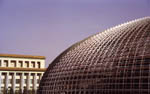 From Dongzhimen it will be possible to take the subway, light railway
or bus to the Olympic Village. The two most notable Olympic projects are the
Olympic Stadium, nicknamed 'Bird's Nest' and the National Swimming Centre, also
known as the 'Water Cube.' The Bird's Nest was designed by the Swiss firm Herzog
& De Meuron. This firm's previous projects include the renovation of an old
power station on the banks of the Thames in London, which was turned into the
Tate Modern Art Museum. Herzog & De Meuron also won last year's Sterling
Prize for Architecture for their design of the Laban Dance Centre in a rundown
area of London.
From Dongzhimen it will be possible to take the subway, light railway
or bus to the Olympic Village. The two most notable Olympic projects are the
Olympic Stadium, nicknamed 'Bird's Nest' and the National Swimming Centre, also
known as the 'Water Cube.' The Bird's Nest was designed by the Swiss firm Herzog
& De Meuron. This firm's previous projects include the renovation of an old
power station on the banks of the Thames in London, which was turned into the
Tate Modern Art Museum. Herzog & De Meuron also won last year's Sterling
Prize for Architecture for their design of the Laban Dance Centre in a rundown
area of London.
 The Water Cube was designed by PTW, an Australian firm that designed
the International Athletics Centre and the Aquatic Centre of the 2000 Sydney
Games, together with Ove Arup Engineering. PTW has completed many projects in
China and maintains offices in Shanghai and Beijing. Ove Arup is the renowned
architectural engineering firm that is single-handedly responsible for the
engineering work of the majority of new showcase projects in Beijing, including
the airport's new terminal, the Dongzhimen interchange, and the new CCTV
headquarters.
The Water Cube was designed by PTW, an Australian firm that designed
the International Athletics Centre and the Aquatic Centre of the 2000 Sydney
Games, together with Ove Arup Engineering. PTW has completed many projects in
China and maintains offices in Shanghai and Beijing. Ove Arup is the renowned
architectural engineering firm that is single-handedly responsible for the
engineering work of the majority of new showcase projects in Beijing, including
the airport's new terminal, the Dongzhimen interchange, and the new CCTV
headquarters.
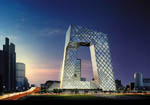
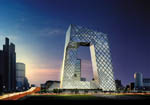
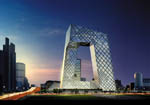 This building will probably become a must-see tourist site for Olympic
visitors. The CCTV building is like nothing China, and indeed the world, has
ever seen. It will challenge people's perceptions of the roles that such grand
architectural projects, all designed by foreign architects, have in China. The
CCTV project was designed by OMA, the studio led by Rem Koolhaas. In the 1980s
and '90s, Koolhaas was the enfant terrible of international architecture who
made his name by writing books such as Delirious New York before any of his
major designs were actually constructed. Koolhaas' credits include the Prada
flagship store in New York and the Dutch embassy in Berlin. He is now on the
commission charged with designing new headquarters for the European Parliament.
This building will probably become a must-see tourist site for Olympic
visitors. The CCTV building is like nothing China, and indeed the world, has
ever seen. It will challenge people's perceptions of the roles that such grand
architectural projects, all designed by foreign architects, have in China. The
CCTV project was designed by OMA, the studio led by Rem Koolhaas. In the 1980s
and '90s, Koolhaas was the enfant terrible of international architecture who
made his name by writing books such as Delirious New York before any of his
major designs were actually constructed. Koolhaas' credits include the Prada
flagship store in New York and the Dutch embassy in Berlin. He is now on the
commission charged with designing new headquarters for the European Parliament.
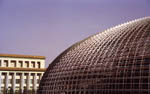 One of the most controversial new buildings is the new National
Theatre, designed by French architect Paul Andreu and nicknamed the 'Eggshell,'
on the west side of the Great Hall of the People at Tian'anmen Square. Paul
Andreu's previous works include the Osaka Maritime Museum and the Dubai airport.
One of the most controversial new buildings is the new National
Theatre, designed by French architect Paul Andreu and nicknamed the 'Eggshell,'
on the west side of the Great Hall of the People at Tian'anmen Square. Paul
Andreu's previous works include the Osaka Maritime Museum and the Dubai airport.


