|
Home>News Center>Life | |
|
|
|
|
|
|
|
|
|
|
|||||||||||||||||||||||||||||||||||||||||||||||||||||||||||||||||||||||||||||||||||||||||||||||||||||||||||||||||||||||||||||
|
|
Tibetan opera seeks heritage listing
As the 28th session of the World Heritage Committee is going on in eastern China's Jiangsu Province, a group of Tibetan artists in Southwestern China are eagerly watching its progress. The government of Tibet Autonomous Region has submitted an application to the country's cultural authorities requesting the nomination of Tibetan opera, an art form the region has cherished for generations, as another Chinese candidate for inclusion as a human oral and intangible heritage on the World Heritage list of the United Nations Educational, Scientific and Cultural Organization (UNESCO).
Actor's story Toinzhub, a 77-year-old Tibetan man, has never heard of this world heritage business. But Tibetan opera has always been his life. It represents both his past glory and his present incapacity.
But all this lives only in his memory now. For three years Toinzhub, an exponent of the Bindun school of Tibetan opera, one of the oldest schools of the performing art, has had no chance to perform, nor has he been able to find a devoted disciple to carry on his performing skills. The county government of Qiongjie selected 15 young people to learn from Toinzhub, but the old man says they did not show enough interest in learning. "Young people now have their own ambitions and I can't force them to learn," says Toinzhub. When asked whether he is the last of the leading exponents of the Bindun school, Toinzhub at first remains silent and then emits a helpless sigh. His story illustrates touchingly the problems faced by an ancient art form in a fast changing modern society. Dubbed a "living fossil" of Tibetan culture, Tibetan opera with its vivid facial masks, earthy dancing, unadorned singing and colourful costumes boasts a flourishing history of over 600 years. With numerous performing schools and unique performing skills, especially singing techniques, Tibetan opera has been handed down through personal instruction from generation to generation. The death of one aged artist might mean the loss of the performance art of one school, says Gachug, an expert on Tibetan folk culture with the Tibet Ethnic Art Institute (TEAI). "So, it is imperative for young actors to be organized to learn from these old artists," said Gachug. The question is, who is willing to learn? Tibetan village opera troupes, which perform only during slack season or major religious festivals, offer no regular financial remuneration to performers, so the actors earn only enough to cover their food and travel expenses during the performing season. "This kind of non-profit profession can hardly attract young people today, not even those with talent for the ancient performing art," says Gachug. As money is really the main problem, he says, the government should give more financial support to Tibetan opera. But he and other experts agree that other channels should be tapped to save the Tibetan cultural heritage, as the government can only selectively fund Tibetan opera troupes. Go to the market Liu Zhiqun, former TEAI director, suggests that Tibetan opera be treated as a financial cultural resource and that the different troupes go to the market for support. Shan Shaohe, general manager of Lhasa-based Shengdi (Holy Land) Co Ltd, which just purchased a community Tibetan opera troupe, says that governmental funding is only one of many ways to preserve Tibetan opera. "The key lies in keeping the ancient art form alive and operating it as a cultural industry, which is the only way to preserve it in the new era of the market economy," he says. Gelong, manager of the Tibetan opera troupe in Niangre Township of Lhasa, shares Shao's view. "We can't take it only as a cultural cause. We should be able to make money out of it, then we can survive," he says. Gelong, whose family ran a transportation business, took over the local Tibetan opera troupe 20 years ago when the township government decided to drop its support because of financial difficulties. The first few years were difficult, he recalls. The biggest headache was the market. The only places they could perform were the nearby villages, broadening their audiences only during the festive season. But gradually the troupe became known not only in Lhasa but also in Xigaze, Shannan and Nyingchi. The success, of course, should be attributed to the actors' excellent performances, but Gelong also likes to stress that self-promotion and advertisement are important as well. Gelong began to contact hotels and restaurants in Lhasa to advertise and promote his troupe in 1991 and now performances targeted at tourists have become a major source of income for Gelong's troupe. Gelong says now the troupe gives an average of three performances a day. Actors in Gelong's troupe, which has grown from 18 in 1985 to 69 people, can get 540 yuan (about US$65) a month plus an additional allowance for performances. The troupe recruited 12 teenagers this year. However, Gachug observes, market operation seems to work well only in cities and big county towns. Given the vast area of Tibet, most Tibetan opera troupes still face the problem of a limited market and financial difficulties. Experts also worry that adherence to the market system might compromise the traditional earthiness of the ancient Tibetan art, as it must inevitably cater to the tastes of consumers. Young and old audiences Gachug and Liu Zhiqun have noticed some changes in Tibetan opera. While traditional Tibetan opera performances had only drums and cymbals for accompaniment, some troupes now are using small orchestras. Some performances now have more spoken parts and less singing. "These modern elements may attract young audiences to the opera, but the old school of opera lovers feel that they spoil the ancient art," says Liu Zhiqun. Both Gachug and Liu Zhiqun admit that Tibetan opera is losing its viewing audience. "While senior and rural people are still loyal to the ancient Tibetan art form, young people in cities now have new alternatives for entertainment," says Gachug. Puncog Zhoima, an 81-year-old woman who lives on Barkor Street in Lhasa, says watching Tibetan opera was a great enjoyment in her childhood and over the years, and that Tibetan opera has become part of her life. Today, she goes to watch Tibetan opera whenever she has a chance in Lhasa. "I can't imagine the day when I can no longer watch Tibetan opera," says the old lady. But to teenager Cezhoin, a student from the No 3 Senior High School of Lhasa, Tibetan opera is by no means a good choice for entertainment. "It's too hard for young people to understand and it also moves too slowly. My parents like to watch Tibetan opera, but I never watch it. I like pop songs and TV dramas," the girl says. Liu Zhiqun even predicts that rural people might also lose their interest in opera in the future when rural Tibet becomes more culturally developed and people have more choices. Cultivating audiences So the question of how to preserve the ancient art in modern times remains. "Reform is necessary for the survival of Tibetan opera and the ancient art should be open to reform, but the bottom line of keeping its traditional flavour should never be broken," Gachug says. Personally, he says, he does not appreciate the practice of blindly changing the traditional style of Tibetan opera to court young audiences, as this kind of compromise will eventually lead to the demise of Tibetan opera. Qoinpe, a playwright with a government-funded Tibetan opera troupe , says that the 600 years of history of Tibetan opera represent a process of development, and that carrying on tradition has always been crucial for the development of Tibetan opera. "When one day it is full of imported artistic elements, with its original flavour fading away, it will no longer be Tibetan opera," says Qoinpe. Gachug says it might be better to cultivate young generations' taste for Tibetan opera by offering traditional culture education in schools rather than trying to buy them over with changes in the fabric of the form. He cites the Snow Primary School in Lhasa as a good example. The school organized a Tibetan opera team in 1993 and Benba Puncog, the teacher in charge of the team, says the team is a great attraction to the students. Many students want to join, but only 200 out of 1,000 students are allowed in. "The team was not organized just to provide students a chance for after-class activities or entertainment," says the teacher. "We also hope all the students, not only team members, can have a chance to know about traditional Tibetan culture and develop a feeling of love towards it when they are young." The school team gives ceremonial performances for governmental institutions and business enterprises. Xadog, a fifth grader who joined the team two years ago, says that he feels excited whenever he hears the drum for a Tibetan opera dance and is proud that many non-Tibetan people are interested in the ancient performing art. If possible, the child says, he wants to become a professional Tibetan opera actor when he grows up. According to Benba, their teacher, four graduates from the school are now in Lhasa's Troupe of Ethnic Art and seven are currently learning Tibetan opera or folk music and dance at art schools or colleges, and expect to enter regional Tibetan opera troupes or other folk art organizations. Gelong, manager of Niangre town's Tibetan opera troupe, says he believes Tibetan opera as a cultural heritage of the Tibetan ethnic group has permeated into the blood of Tibetan people. "It is true that some people might not like it, but for Tibetan people as a whole, Tibetan opera will never die," Gelong says. "We hope Tibetan opera can be listed as a world heritage by UNESCO. This would strongly support its preservation. It would at least bring more funding for the protection of the art," Gachug says. "We don't want Tibetan opera to be preserved like something displayed in a museum. We hope more people come to know about and appreciate the 'living fossil' of Tibetan culture."
|
|
|
|
|
||||||||||||||||||||||||||||||||||||||||||||||||||||||||||||||||||||||||||||||||||||||||||||||||||||||||||||||||||||||||||
|
|
|
|
|||||||||||||||||||||||||||||||||||||||||||||||||||||||||||||||||||||||||||||||||||||||||||||||||||||||||||||||||||||||||||||
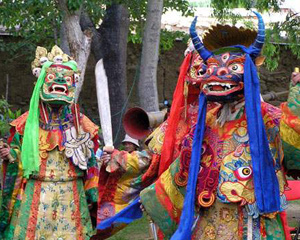
 As a young man, Toinzhub was a star Tibetan opera actor not only in his
native Bindun Village of Qiongjie County, but also on stage in Lhasa, the
regional capital 300 kilometres from his home.
As a young man, Toinzhub was a star Tibetan opera actor not only in his
native Bindun Village of Qiongjie County, but also on stage in Lhasa, the
regional capital 300 kilometres from his home.