|
Home>News Center>China | |
|
|
|
|
|
|
|
|
|
|
||||||||||||||||||||||||||||||||||||||||||||||||||||
|
|
Photographic evidence: Seeing Great Wall from space
The greatness of the Great Wall does not lie in its being visible to the naked eye from outer space. Yet fascination with the notion is unceasing: It is enshrined in textbooks and has been embroiled in periodic debates over recent years. It started as a typical urban myth. There are at least two versions of the story. The Chinese version goes that the Great Wall is one of two man-made structures astronauts can view from outer space without visual enhancements (the other being giant reclamation projects in Amsterdam of the Netherlands). The Western version is even more absolute. It states that the Great Wall is the only human erected object visible from the Heavens.
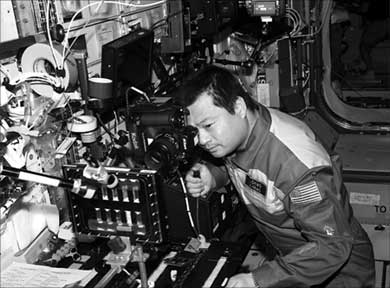
Yet the truth appears far more complex than a simple yes or no. Degrees of truth When Yang Liwei, China's first space orbiter, said he didn't see the Wall on his 21-hour mission in October 2003, there was almost a palpable collective sigh of disappointment. Yet many scientists felt vindicated. Some all along had been alleging, to no avail, that it was impossible to see a structure like the Great Wall from above. Wang Yusheng, curator of the China Science and Technology Museum, explains that a spacecraft usually orbits at 300-400 kilometres from the Earth and, from that elevation, only objects with a circumference of at least 500 metres can "register on the naked eye." After Yang Liwei's response to his space experience, there were calls to revise elementary school textbook articles "to reflect what has been proven with science and confirmed by China's own astronaut." But US astronaut Eugene Cernan, who logged 566 hours and 15 minutes in space, insists that he did spot the Great Wall while he flew on Apollo missions. On a recent visit to Singapore, he again told reporters that in "Earth's orbit at a height of 160 to 320 kilometres, the Great Wall of China is indeed visible to the naked eye." If anyone can spot the Wall and show proof of it, it should be Leroy Chiao (Jiao Lizhong in Chinese pinyin). Chiao, a veteran astronaut with three previous space flights to his credit, is currently on a six-month assignment on the joint US-Russian space station. A Chinese-American and an expert photographer, he has a passion for spotting and photographing Chinese landmarks from his uniquely lofty position in space. "It is hard to say whether or not I have seen it," he has said in a continuous string of email exchanges with China Daily over the past two months. "That's because from our altitude I cannot distinguish between the Wall and roads. I think that if I knew exactly where to look, I would have a chance." A sequence of photos that Chao sent back last month proved the accuracy of his descriptions. It really does strain the eye to distinguish the Wall from zig-zagging roads, ridges and valleys. It is tantalizingly possible, yet in reality, it is not very likely to know which is which. Anatomy of a photo Three photos Chiao emailed to this reporter were taken on February 20, which he reported to be of the "region northwest of Beijing." China Daily dispatched the photos to renowned Professor Wei Chengjie for analysis. All of them turned out to be of the Badaling area where the Badaling section of the Great Wall is located, confirms Wei, of the Institute of Remote Sensing Application at the Chinese Academy of Sciences and also of the National Remote Sensing Centre of China. Wei had participated in a research project of the Badaling section of the Great Wall, which was part of a 1983 project by the Beijing municipal government to use aviation infrared remote sensing technology - for the very first time - in measuring the city's resources. The photograph on the front page, one of the three photos, shows Badaling, the most popular tourist section of the Wall, right in the centre of the frame. To the layman's eye, the photo reveals just a few lines, which may be highways or railways as well as a swath of mountains. But Wei easily identifies all of them. "The Great Wall differs from them in one crucial aspect: It is dotted with beacon towers at regular intervals. If I have enough time, I can count all the towers for you," Wei said in a lengthy explanatory session. He blew the photos up so that every pixel showed clearly on his computer screen. "From the railroad, I can infer that each pixel represents a width of about 7-8 metres on the Earth - no more than 10 metres. An object of 3.5 pixels can usually be identified. A tower has an area of some 20 by 30 metres. It is usually made up of three pixels on the photo, one more than the width of the Wall," he explained. Wei further pinned down the time the photos were taken to be around 9 am, which was later corroborated by Chiao. Indeed, it was a sunny morning, as confirmed by Beijing Meteorological Bureau, and the sunlight had bounced off of the Wall and mountain ridges, providing objects of substantial height a sharper contrast. "It could have made it easier for the naked eye to spot the Wall, but does not make a difference for me in dissecting it in the photo," Wei illuminated. The funny thing is, people untrained on the scrutiny of space photos tend to mistake mountain ridges for valleys. One such photo, taken from a micro-satellite called Proba orbiting 600 kilometres above the Earth's surface, was annotated as showing a section of the Great Wall. However, it was quickly suspected to be erroneous when it was released by the European Space Agency in May 2004. "We studied that photo and it was definitely a stretch of valley or riverbed," Wei said. This misinterpretation is made because "it is easier to distinguish valleys and ridges with the naked eye, since you see them in three dimensions. That's the way the human eye is designed. It is more difficult with a two-dimensional picture," Chiao commented. Kodak moments But taking photos of the Great Wall is no simple snap shot. "This takes some real practice," Chiao said with emphasis. His photos were taken when the space station was 360 kilometres from the Earth. It orbits the Earth once every 90 minutes, yielding mere flashes of opportunity. "We cover approximately five miles every second at our orbital speed. So, there is not much time at all to shoot a particular photo. It is a matter of seconds, perhaps 15 seconds or so. As you approach the target, you must identify the area and continuously refer to a map to keep up to date on where you are. Also, when photographing the Earth at this speed, you must move the camera with the Earth, in order to keep the image sharp. Otherwise, all that will show up is a blur," Chiao revealed in an ongoing process of explaining the intricacies of shooting the Wall from way up high. And the chances for shots are limited, since every 90 minutes the space station orbits over different parts of the Earth. Chiao gets to shoot the Wall area "maybe one chance every few days and only during daylight every three months." It's like living near the North Pole. Beijing "is in darkness during our flyovers for about three months, and so on," Chiao said. Chiao uses a modified Nikon F5 camera, which Kodak equipped with digital capability and sold as Kodak DCS 760. He uses a regular 50mm lens, or 180mm, 400mm or 800mm lenses. The February 20 photos of the Great Wall were taken with the 800mm lens. The shutter was set at 1/500 second, and the aperture was open to maximum, f2.8. The one on the front page is 1.6 megabytes (mb) in JPEG format, or 17.4 mb uncompressed, with a width of 3,032 and a height of 2,008 lines. (The photo has been cropped for clarity.) Yang Shizhong, a professional sports photographer with China Daily, explains that at 1/250 second the camera can freeze a basketball in motion, at 1/400 a football being kicked, and at 1/500 a tennis ball while it is being served. He further explains that an 800mm lens theoretically enlarges an object by 16 times, but it does not equal the result of pulling closer to the object to 1/16 of the original distance. This is based on the theory that a 50mm lens approximates human vision. However, in general, 50mm lenses seem to push objects farther away than what is perceived by the human eye. Mu Xiaogang, a manager at Nikon's China office, questions whether photographing objects on the Earth from space is like seeing them. "Have you taken photos with an 800mm lens from a television tower?" he asked. "It's not radically different from human vision. It won't make the unseen visible." The lens Chiao used surely made everything easier to see, or rather, easier to study, but it is not the same as shortening the distance, Yang said. Solving the riddle The Great Wall photos may be an approximation of what Leroy Chiao actually sees with his own eyes on the precious occasions when the position of his space station is perfectly aligned at the best angle to view the Wall (and conditions for weather and lighting on the Earth are ideal). On the positive side, the photos are enlarged, but on the negative the perspective is flattened out. But they, together with other photos he has shared with China Daily, clearly prove there are many man-made objects that can be easily sighted from space without a telescope or other visual aids. "I can see airports and cities of course, as well as large bridges and dams. I was able to see the Chinese launch pad from where Yang Liwei began his journey!" Chiao wrote in an email. It seems that the larger in size, the more regular in shape and the more sharp the contrast an object has with the surrounding environment, the more easily it registers on the human eye from far away. As for the wonders of ancient civilization, the pyramids have been unmistakably spotted and photographed by Chiao. "You have to know where to look," he emphasizes. It should be stressed that all Chiao has done was completed without special equipment. Technology vastly improves capabilities. Professor Wei Chengjie showed this reporter photos taken from space with a commercially available sensor, in which autos could be discerned on a Beijing street - but not pedestrians. With the Great Wall, the difficulty is present in several aspects: Despite its length, it is not a wide structure. And it does not follow a straight line since it was built to follow the many contours of China's mountain ranges. Its towers, which are so crucial for photo analysts, do not help much for observers like Chiao because the objects tend to vanish into the landscape. Plus, the time for taking a photograph is only a few seconds. Luo Zhewen, vice-president of China Great Wall Society, explains that the width of the Wall and the areas taken up by its towers can vary. That's because they are not uniform, with some mountain ridges simply too narrow to support the regular tower dimensions. Another important factor is something that nobody can control, except Mother Nature: a mixture of perfect weather and lighting. Since late March, when China Daily emailed back the Badaling photo enhanced and marked by Wei Chengjie, Leroy Chiao, who now knows exactly where the walls and roads are, has had only one chance to look for that particular section of the Wall. Unfortunately, "it was not very clear," the astronaut dutifully reported. "The other times, it was very cloudy or smoggy." Chiao has one more chance before he is scheduled to land in Kazakhstan on April 25. He hopes he will have perfect Wall-spotting weather this time. Whether he spots the Great Wall, it is beyond doubt that the old myth of the Wall being the only man-made structure visible to the naked eye from space - or one of two - is a fallacy. Another fact is, a group of snow-enhanced shots Chiao took on November 24, 2004, with the same camera but a much shorter lens (180mm), have been confirmed by NASA analysts as "the first verifiable views of the Great Wall of China ever identified in astronaut photography." Those were shots of Wall segments along the border of Hebei Province and the Inner Mongolia Autonomous Region.
(China Daily 04/19/2005 page4) |
|
|
|
|
|||||||||||||||||||||||||||||||||||||||||||||||||
|
|
|
|
||||||||||||||||||||||||||||||||||||||||||||||||||||