|
Kunqu Opera at the heart of tradition
By Chen Jie ( China Daily)
Updated: 2004-12-01 08:38
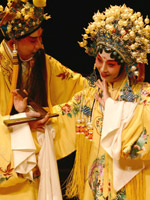 To love, or not to love? This is the question bugging Emperor Xuanzong of the Tang Dynasty (AD 618-907). Making great achievements during his reign, he is also plagued by the conundrum which has perplexed men and women throughout history. To love, or not to love? This is the question bugging Emperor Xuanzong of the Tang Dynasty (AD 618-907). Making great achievements during his reign, he is also plagued by the conundrum which has perplexed men and women throughout history.
Whether it is nobler to elope with his beloved concubine, leaving his people at the hands of fate, or secure his unparalleled fortune and fame, leaving his lover to die in shame? This plays too heavy on his mind, haunting him night and day.
Welcome to Emperor Xuanzong's world, and the story "The Palace of Eternal Youth" (Changsheng Dian), told by the Suzhou Kunqu Opera Theatre and featuring a live band composed of some 30 traditional Chinese instruments such as the bamboo flute, reed pipe and strings.
Following the interest Kunqu Opera aroused by the same theatre's another production "The Peony Pavilion" (Mudan Ting) in Beijing last month, "The Palace of Eternal Youth" will continue to promote the revival of the old performing art genre, and again inspire a wide range of discussions of how to preserve the "Master Piece of Oral and Intangible Cultural Heritage" awarded by the United Nations Educational, Scientific and Cultural Organization.
Revival of tradition
The original version by Hong Sheng (1645-1704) consists of 50 episodes, but only a few are performed today while many have been lost. The version by Suzhou Kunqu Opera Theatre is a three-night show of 27 episodes rearranged by Gu Duhuang, a well-known expert of Kunqu Opera from Suzhou.
Similar to "The Peony Pavilion," "The Palace of Eternal Youth" is a co-production by professionals from Taiwan, Hong Kong, Suzhou and a few other cities.
Gu directed the play starring leading actress Wang Fang and actor Zhao Wenlin as Yang and Emperor Xuanzong. The Academy Award winner Yip Kam-Tim from Hong Kong designed the stage and costume and Chen Chite, a businessman as well as a Kunqu Opera lover from Taiwan, invested and produced the work.
Ten years ago, Chen fell in love with the Kunqu Opera when he first watched "The Peony Pavilion" in Taipei. Being a loyal fan, he continues to donate to Taiwan's Kunqu Opera ensembles and sponsor performances.
"The artists and literati in the Ming (1368-1644) and Qing (1644-1911) dynasties nurtured such a refine theatre genre. I am not sure whether it could live longer in our time. But I would like to do something to preserve the traditional Kunqu Opera," says Chen.
Two years ago, he planned to invest in a production, practising a series of marketing, promotion, workshops and campus seminars.
With the idea of producing a play of very traditional style, he invited Gu to rearrange the scripts. Wishing to attract more young audiences and promoting it to the Western world, he has Yip as the stage and costume designer.
Chen's idea is positively responded by Gu, Yip and other Kunqu Opera experts from Taiwan, Hong Kong, Suzhou and other cities. Some 20 of them and the cast gathered in Suzhou in October 2002 to discuss the issues concerning the future of Kunqu Opera.
All of them agreed that the modern theatrical productions depend much on the special effects by high technology, which destroys the tension of the virtual theatre itself.
In Gu's mind, most of today's productions of traditional Chinese folk opera fail to retain the original essence in terms of culture, losing its authentic charm but packed with meaningless symphonic accompaniment, pop-song-like tunes and gorgeous setting.
Born into a prestigious family of scholars in Suzhou, Gu learned Chinese painting, calligraphy and seal cutting when he was young and later enrolled at the Shanghai Fine Art Junior College to learn Western oil painting.
Influenced by his family, Gu has loved the Kunqu Opera and Peking Opera since boyhood and later learned drama at the Art Department of Suzhou Social Education College.
Since the 1940s, he has devoted all his time to preserving the Kunqu Opera, bringing up hundreds of Kunqu Opera performers and discovering and restoring many scripts which were on the verge of being lost forever.
He also served as deputy director of the Suzhou Cultural Bureau in early 1950s and was in charge of the Suzhou Kunqu Opera Ensemble since it was established in 1956. In 2002, Gu received the Award of Notable Artistic Achievement in Kunqu Opera by China's Ministry of Culture.
Gu holds an extreme view that the Kunqu Opera is not being "murdered, but is committing suicide." He says before the founding of the New China, Kunqu Opera had been bogged in great deal of trouble for a long time. During war time, people struggled for a living while the government ignored folk opera.
However, the trouble facing the genre today is not at all similar.
Both the government and public have realized the importance of preservation and also invest great money and effort: the problem is how to do it.
"It is suicidal to turn the traditional style into a modern way, turn the elegant form into a popular one, turn the Chinese opera into something like the Western theatre," Gu said with great concern.
"The value of the Kunqu Opera is its cultural heritage but not the market value at the box-office. It is wrong to try to create a play with mass appeal. Anyway it is a genre favoured by the intellectual elite. Many of today's works fail to suit the refine taste, neither the popular."
Therefore his direction of "The Palace of Eternal Youth" is to make it as traditional as possible. As the play is famous for its tunes and literary scripts which are said to be better than "The Peony pavilion," Gu tries to retain its original version as much as possible.
Stage appeal
However, Gu did not expect that his idea would be agreed by the Hong Kong-born Yip who received the Western-styled education and works with many Western artists.
The 43-year-old Yip even says that he would make the stage and costume more traditional than tradition itself.
"I always believe that tradition will lead us into the future because the modern world has lost its way. I am confident that in the not too distant future traditional art will once again be celebrated in all its glory, so that we can safely look back, naturally roaming through history and time in search of all that has been lost, cherishing memories and taking in everything, ensuring the future is much more than an empty materialist world," he says.
Yip designed more than 140 costumes, including those for the emperor, empress, various lords, generals, eunuchs, servants and ordinary citizens. They are all brand-new in many colours and styles compared with those usually featured in today's folk opera plays.
Yip is world-known for his design in Ann Lee's movie "Crouching Tiger, Hidden Dragon" which won the Oscar Awards in 2001.
Graduated in Photography Department from the Hong Kong Polytechnic, Yip kicked off his career in 1986 by participating in John Wu's "A Better Tomorrow." Ever since, he has worked in many movies of prominent directors from Hong Kong, Taiwan and Chinese mainland and also impressed the world with his marvelous setting and costume design for drama, dance and Peking Opera since 1993.
He says he does not feel comfortable seeing some of today's "traditional opera," which features elaborate settings, lighting and music.
"I have seen many of these works, copying the Western style or the so-called modern theatre. I don't like it and I tried my best to get rid of the Western influence when I worked for 'The Palace of Eternal Youth,' although I have been involved in it for a dozen years."
He learned from Gu and undertook research. He found an interesting illustrated book featuring 97 Kunqu Opera figures of the court opera performers of Xianfeng and Tongzhi emperors of Qing Dynasty. He was impressed by the costumes and helmets which were far more exquisite than those worn by today's performers.
"Whether in terms of colour, clothing patterns, embroidery or the depiction of facial make up, they all possessed a high quality and remarkably refinement. They are very different from the colours and patterns we see on today's stage," he says.
Inspired by these figures, Yip focused on the rearrangement of the colours when he designed the costumes. The colours used in the traditional costumes include red, yellow, black, white, green, blue, purple, pink and light green/blue. Yip has made them into new hues according to his own design.
"Today's costumes in Chinese folk operas including Kunqu Opera are those from Peking Opera. But I personally don't think it fits Kunqu Opera," says Yip.
"As I understand the music and tunes of Kunqu Opera, for example the shuimodiao, it is gentle, soft and graceful. While Peking Opera, say xipi'erhuang, the tune sounds more bustling and louder. Therefore, in my mind the colour for Kunqu Opera's costumes should be mild and soft."
He also made great efforts in designing the embroidery patterns, discovering old craftsmen in Suzhou, learning from them and designing new patterns on the basis of those they provided.
Throughout the hot summer last year, a number of veteran embroidery handicraftsmen in Suzhou, worked through the day producing work of the highest quality according to Yip's strict requirement.
The result is that the exquisite costumes designed by Yip and hand-made by these old skilled craftsmen highlight the entire image of the performance.
|





