Asia seeks the way ahead
|
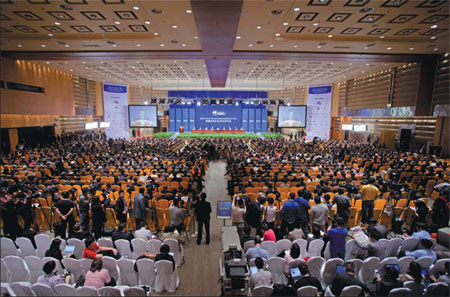
The opening ceremony of the Boao Forum for Asia in April last year. President Xi Jinping will deliver the keynote address at this year's forum, which brings together leading political, business and academic leaders from around the world. "Asia Seeking Development for All" is this year's central theme. AFP |
Is the region innovative enough to meet challenges? Global leaders look to Boao for answers
Aday before the Boao Forum for Asia (BFA) annual conference kicks off on April 6 in the eponymous former fishing village in China's Hainan province, now widely known due to the event, the Nobel Prize winning economist Edmund Phelps puts forward a "provocative" question.
At the curtain-raising panel discussion on April 5 that features questions by leading economists, Phelps asks: What do Asian business leaders believe to be the main obstacles to a boost of indigenous innovation in Asia? Do they lie in the government? Finance? Where?
If the obstacles are not in Asian governments or finance, Phelps, who won the Nobel in 2006 for deepening the "understanding of the relation between short-run and long-run effects of economic policy", wants to know whether they are due to end users' reluctance to try out and adopt new things, or due to entrepreneurs' reluctance to embark on new projects.
"Is the obstacle the risk of failure?" the 79-year-old presses ahead with his query. "A reluctance of Asians to be different, to break away from the group in order to try a different path? Or even a dearth, or paucity, of ideas?"
Phelps says he is asking the question because China, the biggest economy in the region, is heading for a crisis. He perceives China's economic strategy of high domestic investment and technological transfer as running out of opportunities, and domestic investment in residential buildings and high-speed rail facing diminishing returns.
Also, technological transfer has been made more difficult, he tells China Daily Asia Weekly. "Most of the low-hanging fruit has been plucked from the tree and the West is starting to guard the remaining technologies."
The query will trigger a debate on Asia's innovation talent at the conference, now established as an expanding platform for governments, businesses, and academic circles worldwide to discuss opportunities for cooperation and listen to the Asian voice.
There are mixed reactions to it.
"Prof Phelps was being provocative," says Massimo Dominici, chairman, International Society for Cellular Therapy, a Vancouver-headquartered global association aiming to deliver innovative cellular therapies. "It's a relevant opportunity to generate questions and then provide answers."
Dominici, who is speaking at a roundtable on "Life science update" at the three-day conference, feels where cellular therapy is concerned, Asia is one of the most prominent areas in the world.
"There have been dramatic global biotech public offerings from the Asia-Pacific in the last five years. Asia is the place where technology is blooming. Major countries in Asia are investing money in life sciences. In countries like India, China, Malaysia and Indonesia, a lot of companies are involved in the production of stem cell products."
It's not innovation that Asia lacks but regulation.
"We need to harmonize the regulatory framework for the global implementation (of new products). It's a matter of time, not resources."
Laurent Malet, director at Egis, the French engineering group involved in infrastructure, transport systems and environment, echoes Dominici.
"The education in Asia is as good as anywhere in the world," Malet says from his Paris office. "If people want to be creative, they have the educational basis to do so. There are tremendous innovation centers in Asia.
"What differentiates Asia from the West is that in occidental countries people are very pessimistic about the future. In Asia people are very optimistic and that's an innovation booster."
Not lack of innovation but the ability to adapt will be the critical issue for the region, feels Malet, who is speaking on the quality of urbanization at the conference.
In the past 30 years, more and more people in Asia have migrated from rural to city areas. The movement has been much longer and faster than in Europe and America, putting pressure on infrastructure.
"Infrastructure is going to be a critical issue. The adaptability of Asian cities will determine how they face the challenge. It is very important that they adapt very fast - from infrastructure to public transportation and energy," Malet says.
The master planning done, taking into account anticipated changes, is now very likely to be wrong, he cautions. The adaptability of the master plan to change to real development will determine how Asia meets the challenge.
Cities that failed to assess future needs wisely will bear a heavy cost as they will have to start the urbanization process from scratch.
"The process of destroying and rebuilding is long, costs a lot of money and creates a lot of disrupting changes for the population."
However, Malet remains optimistic.
"Whatever we have, we want more. That's a very positive driver for all of us," he adds. "Last year, the world economy grew more than 3 percent. That is sufficient to be optimistic."
Phelps' view is partially endorsed by Zhu Ning, deputy director at Shanghai Advanced Institute of Finance under Shanghai Jiaotong University.
"I tend to largely agree that China is lagging behind in terms of research and innovation (which) are a major driving force for economic growth in developed economies," the professor of finance says from Beijing. "There is a lot for the Chinese government and companies to do to boost Chinese capability (for) innovation."
However, Zhu begs to differ on whether that will lead to a crisis. Lack of innovation may be a bottleneck to growth but not necessarily the main reason for an economic crisis. The crisis would come if China fails to balance quality with economic growth.
Zhu thinks further reform in the financial sector can solve many of the challenges China faces in the attempt to move from an export-driven economic growth model to a domestic-driven one, from an investment-driven one to a consumption-sustained one.
"China should avoid or gradually stay away from the infrastructure-driven, investment-driven growth model to a more sustainable growth model that will guarantee individual satisfaction, environmental sustainability and quality of social welfare."
This is the 10th year Per-Olof Bjork, vice-chairman of the Board of Sweden China Trade Council, is attending the conference, making him uniquely placed to assess the way it has developed since the modest inaugural meet in 2002.
"It has become the most prestigious and most important event in Asia," says Bjork, former vice-president, general affairs, Ericsson China and Northeast Asia. Ericsson is one of the founding members of BFA. "The interaction has increased. There are more sessions, roundtables and discussions. It's become much bigger to cover all the different aspects. More heads of state are coming."
While Chinese President Xi Jinping will deliver the keynote speech, the other world leaders who will speak on common development include personalities as diverse as Brunei's Sultan Hassanal Bolkiah, Myanmar President U Thein Sein, his counterpart in Mexico Enrique Pena Nieto, Zambian President Michael Sata, and Australian Prime Minister Julia Gillard.
This year's event has a strong cultural aspect. Cheek by jowl with heads of states and corporate leaders, the sessions will feature celebrities from the world of arts. James Cameron, director of Hollywood blockbusters like Titanic and Avatar will be talking on his latest film while the young leaders' roundtable includes speakers like pianist Li Yundi and singer Jane Zhang.
In addition, there are sessions on Africa and Latin America, which are big markets and major trade partners of Asia.
Though the Boao meet began as the voice of Asia, with the concept of a global community emerging and the perception that all economies and markets are interdependent and will rise or fall together, it is developing into a forum for the world.
John Hearn, chief executive, the Worldwide Universities Network, has traveled from Sydney to Hainan, expecting to meet leaders from governments, businesses and academia around the world and learn from a range of international opinions. The physiology professor is seeking solutions to global challenges like food security, economic development and knowledge transfer.
"The Boao forum is becoming a forum for Asia and the world and has an Asian perspective for the world," adds Hearn who has worked in China, India and Geneva. "I am excited to see how that is different from the other fora, like the Organisation for Economic Co-operation and Development in Paris and the World Bank Forum in Washington.
"I would like to see what is different in the approaches."
sarkar@chinadailyapac.com