Japan nearly in, China out of trade talks
|
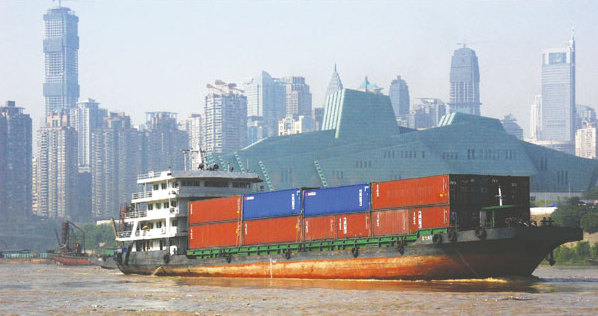
A cargo ship departs the Chinese port of Chongqing. China has not decided to take part in the Trans-Pacific Partnership trade agreement talks led by the United States which now involve 10 countries. Yu Changjiang / For China Daily |
The agreement could reshape the Asia-Pacific region, but the world's second-biggest economy remains absent from negotiations, Joseph Boris reports from Washington.
Amid scorching policy debates in Washington over immigration, government finances and gun legislation, a potentially transformative trade agreement being negotiated for the Asia-Pacific region isn't the stuff of banner headlines or Twitter trends.
But the talks, led by the United States and involving 10 other countries (11 if Japan is allowed in, as expected), to form the Trans-Pacific Partnership have the capability to reshape the region geopolitically, given the scope and commercial value of the proposed free-trade zone.
"The TPP is widely viewed as the most significant negotiation currently underway in the international trading system," the US national security adviser, Tom Donilon, said in November.
The possible ramifications of the TPP, as the planned agreement is known, are on the minds of officials and trade experts in China, which is conspicuous by its absence from the talks. That China hasn't been invited to join the negotiations strikes some observers as a huge gap in the TPP, given that the country is the world's second-biggest economy behind the United States, while others cite that power as the reason Beijing should be excluded.
Indian-American economist Jagdish Bhagwati, a staunch proponent of unfettered trade, has derided the TPP, writing in the Financial Times last year that it has been "conceived in a spirit of confronting China rather than promoting trade".
Other advocates of free trade fear that by focusing on regional agreements like the TPP, the world's biggest economies are hindering the ability of the World Trade Organization to enforce uniform rules among nations - creating what Bhagwati has called a messy "spaghetti bowl" of rules that could conflict with each other. The WTO's most recent negotiations, known as the Doha round, were suspended in 2011 after 10 years of fruitless discussion.
"There are already 354 FTAs [free-trade agreements] in force today, and most of the world's trade is subject to one or more of these arrangements," scholars Scott Kennedy and He Fan write in a new report on US-China interaction in global governance.
"The loss of momentum in the Doha round and the existence of so many FTAs (cause and effect are difficult to disentangle) makes it harder to determine the efficacy of a Trans-Pacific Partnership, the Regional Comprehensive Economic Partnership, and a China-South Korea-Japan FTA. All three are currently being negotiated, and the consequences for trade, investment, and other elements of economic interaction are substantial," write Kennedy and He, who, respectively, are the director of Indiana University's Research Center for Chinese Politics and Business and the deputy director of the Chinese Academy of Social Sciences' Institute of World Economics and Politics.
Chinese officials and policy analysts sometimes use words like "containment" and "encircle" to describe the intention behind moves by the US and its Asia-Pacific allies, particularly in regard to Washington's much-discussed strategic rebalancing, or "Asia pivot". Such rhetoric has begun creeping into discussions involving China and the TPP. While the rebalance mainly involves redeploying military hardware from the wars in Iraq and Afghanistan to US air and naval bases in the Pacific, the trade pact is seen by China as that policy's commercial cousin - a way to curtail China's rise.
That view is given weight when Donilon and other US officials ostensibly tasked with security matters speak of the primacy of TPP and what they insist - in hope of reassuring a wary China - are the nonmilitary aspects of the Asia rebalance. There is no mistaking that the stated US goal of increasing exports to countries in an eventual TPP is intertwined with what Washington says is a defensive redeployment to counter North Korea's nuclear weapon ambitions and ensure that sea lanes remain open for trade.
Potential threat
To China, this duality is a potential threat, both strategically and economically. Besides the United States, the countries negotiating the TPP are Australia, Brunei, Canada, Chile, Malaysia, Mexico, New Zealand, Peru, Singapore and Vietnam - a mix of US allies and trading partners that generally have at least stable relations with China.
Among China's historical rivals in the region, the TPP poses particular challenges. Despite US encouragement to join the talks, South Korea has stayed away, saying it prefers to work out a three-way trade pact with China and Japan. It is Japan, however, that could prove pivotal to the negotiations.
Prime Minister Shinzo Abe announced on April 12 that Japan had reached an agreement with the US to become the 12th party to the TPP talks, all but guaranteeing its participation after the endorsement of other negotiators.
Abe, who recently said he had overcome concerns within his nationalist party about agricultural trade in deciding that Japan's economic and security interests require TPP participation, touted the pact's potential benefits and expressed hope that Tokyo will play a leading role in crafting its rules.
In March, when he announced Japan's request to join the TPP, Abe called the agreement a "last chance" for the world's third-biggest economy to help shape new regional trade rules and reverse decades of economic decline. "For Japan to remain inward-looking means we are giving up on the possibility of growth," the prime minister said at the time.
President Barack Obama's administration responded by welcoming Japan to the talks. The newest entrant would boost the free-trade area's impact to 40 percent of the world's economy.
"Japan's entry into this important initiative for the Asian-Pacific region will help it to deliver significant economic benefits to the United States, Japan and the Asian-Pacific region," Acting US Trade Representative Demetrios Marantis said the same day Abe made his announcement.
Next meeting
A formal invitation to Tokyo could come this weekend when trade ministers from the 11 current TPP countries meet in Indonesia in conjunction with a conference of the Asia-Pacific Economic Cooperation forum. The 11 current TPP members concluded their 16th negotiating round in Singapore in March with the next round scheduled for May 15 in Peru.
Although Japan would be precluded from taking part in the May talks, given the 90-day timetable for Obama's notification to Congress that the administration intends to start trade talks with the country, its entry could come as soon as July. The TPP is supposed to be completed by the end of this year.
For the US, Japan's participation adds complications to the already-intricate talks. Some members of Congress, particularly Democrats from traditional manufacturing states, have criticized the invitation due to long-standing trade barriers to automobiles and other US goods in the Japanese market. Lawmakers will have a chance, during their 90-day notification and consultation period, to try to persuade the White House to alter the terms of the US TPP invitation or to work bilaterally to address their complaints.
In Beijing, a Commerce Ministry spokesman answered a question last month about Japan's pending entry to the TPP by saying China would "improve communications and talks with the related parties and push forward the progress of our own free trade areas".
"We always think every economy in the world has the right to participate in the process of world economic integration and we always take an open and inclusive attitude for all efforts to push for regional and world cooperation," said the spokesman, Shen Danyang. "We also think that any regional or bilateral free trade agreement should be only a complement to the multilateral trade system, not a replacement for it."
With regard to China, US officials have been more circumspect in discussing the TPP. While recent high-level trips to China by Treasury Secretary Jacob Lew and Secretary of State John Kerry touched on the importance of trade generally, the potential agreement wasn't mentioned in public remarks from their meetings with Chinese leaders.
Marantis, the acting trade representative, said at a March 20 briefing in Washington that it's for China to decide whether to seek to join the TPP talks. But he attached a condition to that possibility: China must persuade the 11 - soon to be 12 - existing parties that it could live up to the trade pact's "high standards".
"Whether it's China, whether it's the Philippines, whether it's Thailand, whether it's Taiwan - it's incumbent upon those economies to be able to convince the other TPP partners that they are capable of meeting the high standards that we're negotiating," he said.
US Senator Mark Begich, a Democrat from Alaska, is among those taking a wait-and-see approach to a possible role for China in the proposed trade pact.
"Could China become a party to the talks? I don't know yet - they're such a large player, and we have such strong trade ties to both Japan and China," Begich told China Daily.
"From my end any time we can increase the capacity of trade between Alaska and the Pacific Rim, it's a good thing," he said. "This is a clear opportunity, and we intend to take advantage of it."
China, he pointed out, overtook Japan as his state's top export market in 2012, at nearly $1.5 billion worth of Alaskan seafood, minerals and forestry products. That's more than 10 times the $103 million in goods that America's geographically largest state sold to China in 2000.
As a member of the Senate, which has sole authority in Congress to ratify treaties, Begich will have a chance to vote on whatever TPP terms that the administration negotiates. As of now, he said, the pact is a work in progress.
"The Pacific Rim is a pretty important trading region, but the TPP still has a ways to go before it's ready for a vote," said Begich, adding that senators have been informally debating its terms since meeting with TPP advocate Senator Daniel Inouye of Hawaii three years ago. (Inouye died in December.)
Alaska priority
Begich said he is sympathetic to darker perceptions in China about the TPP, but his priority is commerce for Alaska.
"I think in some ways they may feel threatened, but our role as a country is to ensure that we have open markets and free trade," he said. If the US is to meet Obama's pledge last year to double exports by 2015, regional trade pacts are a way to get there, said the first-term senator, who is a member of the President's Export Council, which advises the administration on promoting US exports.
Begich also has a say on US trade policy as a member of the Senate Commerce Committee, though that post wouldn't give him a role in shaping the TPP before it reaches the full Senate. He said, however, that he is open to the idea of China in the free-trade bloc - with conditions.
"We'll look at it. The goal is that they open their markets to further trade," he said, stressing that a TPP invitation would depend on Beijing's compliance with international trade rules set by the WTO.
"Their conduct could encourage folks to look at it," he said of China's possible involvement.
As for the effect of regional agreements like the TPP on broader trade rules, Begich said commerce that benefits all nations requires coordination. Another of these is the proposed Trans-Atlantic Trade and Investment Partnership the US recently began discussing with the European Union.
"With all of these moving pieces, we have to know, 'What does every country want to do?' It's all happening fast, and we have to be careful everyone isn't leveraging against each other."
He also said US negotiators shouldn't shy away from using trade talks to raise concerns with China in sensitive areas such as cyber security, labor standards and human rights.
"For us to put a kind of blind eye to that would be a mistake," said Begich, who in early April was named to head the Senate's US-China Inter-Parliamentary Group, which works with members of China's National People's Congress to improve bilateral ties through visits to each other's country. He said his top priority in the informal post will be to advance trade between the world's two biggest economies and that NPC members will likely visit Washington later this year.
Obama, addressing an APEC summit in Hawaii in November, said the TPP "has the potential to be a potential model not only for the Asia-Pacific but for future trade agreements" because it "addresses a whole range of issues not covered by past agreements, including market regulations".
Unlike most past trade agreements, the various texts from TPP negotiations haven't been made public, prompting criticism from government-accountability activists in the US. In a letter to Obama, two dozen groups including Public Citizen and the American Library Association demanded greater transparency given the "unprecedented scope" of the TPP's subject matter and the countries potentially involved.
Democrats complain
Several Democrats in the Senate and the House of Representatives have also complained to the administration for leaving them out of the loop and have pushed for greater access to the talks themselves. Like the activists in their letter, the lawmakers have noted the sweeping impact of the pact - on labor, food safety, environmental protection, patents, financial services, health care, energy and telecommunications, all of which are normally regulated by Congress.
The US Trade Representative's Office has said that the TPP parties are engaged in a customary agreement to keep their talks private but that the agency "consults extensively with key congressional committees, interested members of Congress, as well as a wide range of trade advisory committees".
David Dreier, a Republican former congressman from California, believes the US should push for China's accession to the TPP.
"It is in the interests of the US that China be part of this partnership. It is inconceivable that either nation could thrive if the other doesn't," he wrote last week in a Wall Street Journal opinion essay.
"China can ultimately be one of the biggest beneficiaries of the TPP and its high standards on investment, services and intellectual property," wrote Dreier, who served in the House for 32 years until January. US officials, he said, "must find ways to talk to a wide spectrum of stakeholders in China ... on TPP and a shared future as leaders in global trade".