Money moves in Shaolin
People come from all corners of the globe to study kung fu, but has the martial art been subverted by big business?
In the ancient mountain fastness of Shaolin Temple, behind the closed doors of a Buddhist sanctum, Abbot Shi Yongxin holds court from a lacquered wooden chair carved with dragons.
At his left hand, a trio of warrior monks stands attentively, 1,500 years worth of secret skills and kung fu technique trained into their loose limbs.
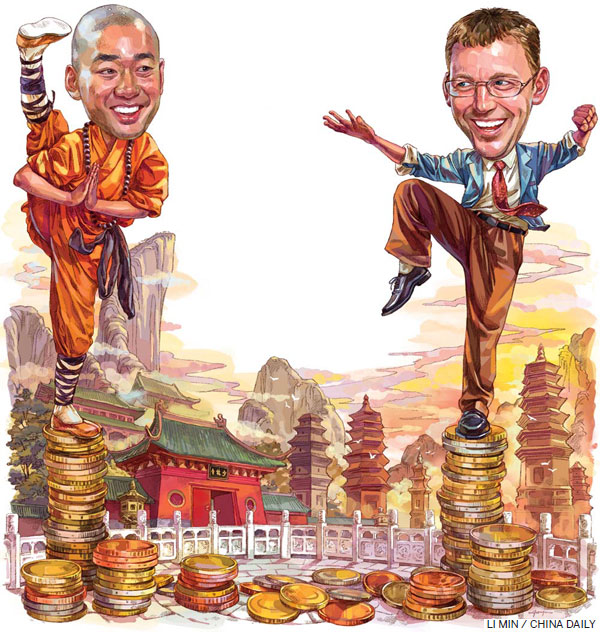
There is something of the snake and tiger in their poise and posture, of the crane and the monkey in the way they move.
Amid the trappings of the past in the ornate receiving room, the abbot and his followers seem like throwbacks to China's age of legend, remnants of a bygone era.
The spell is broken by an electronic jingle.
Shi, the 30th spiritual leader of the ancient order, pulls a smartphone out of his robes. He flips it open briefly to scan the screen, grunts and quickly makes the handset disappear again.
The 21st century has come to the famed temple at the heart of Chinese kung fu, bringing with it a new wave of foreign interest from an unlikely quarter, and a growing debate domestically about what this means for the culturally iconic Chan Buddhist institution.
"We pursue a peaceful and simple life," Shi says. "Our ultimate goal is to achieve the enlightenment of Buddha and to help others achieve enlightenment."
But enlightenment isn't always free at Shaolin Temple, not that this matters to a new breed of acolyte prepared to pay for the kung fu wisdom the order offers.
They are CEOs of multimillion-dollar companies, foreign businesspeople from many fields, and motivated professionals willing to fork out about $800 a month to learn and live at Shaolin.
While this phenomenon is part of a business model that is helping secure Shaolin's future, some believe it is also part of a malaise that jeopardizes its ties to the past.
Every day, thousands of tourists throng the temple grounds, once a quiet retreat for 13 famous warrior monks who, legend has it, took down a despotic warlord and his army during the Tang Dynasty (AD 618-907).
In their time, much of the mystery surrounding Shaolin pertained to the arcane, the closely guarded mental and physical abilities that approach the mystical in the telling.
These days the temple is still cloaked in secrecy, but that relates largely to a veil of corporate confidentiality maintained by a separate business entity.
CTS Songshan Shaolin Culture Tourism Company, which collects an admission fee of 100 yuan ($16) a person to enter the scenic park that people making the pilgrimage to the temple must pass through, declined to provide China Daily with visitor numbers or annual revenue.
Grizzled masters endure the daily invasion with stoic expressions. Shaven-headed novice monks talk loudly on smartphones, or sell incense and trinkets, or access the Wi-Fi now available in the ancient buildings.
Shaolin-brand medical books are sold on Taobao, China's e-commerce equivalent of Amazon, and Buddhist disciples can now avoid the trek up Songshan mountain by paying to study at Shaolin by correspondence on the Internet.
Since 2010, the temple has had an online social media presence on Facebook equivalents such as Sina Weibo, and now boasts more than 150,000 followers. There is also a gaming app being developed to teach users kung fu on their mobile phones.
Shi, one of the first Chinese monks to gain an MBA, says Shaolin's business interests have been set up to support and preserve its 1,500-year-old culture.
"We have entered a commercialized society ... so people tend to evaluate things from the angle of commercialization," Shi says. "But you need to look at what is behind the business practice. Some people do business so they can survive, and some do it to seek fortune. Shaolin Temple just wants to survive, to practice Buddhism."
In March, executives from US tech giants Google and Apple joined the ranks of prominent global businesspeople to have received Shi's wisdom.
Members of the China Entrepreneurs Club, a group that consists of 46 leaders of the country's top private companies, also spoke with the abbot in a closed-door session this year at a conference themed "self cultivation of entrepreneurs".
These kinds of engagements are part of the reason why not everyone is convinced Shaolin's growing commercial interests are entirely altruistic, including outspoken Chinese netizens and some prominent martial arts masters from rival schools.
In a shaded courtyard, kung fu masters flow through fighting forms with a sinuous, otherworldly grace.
A group of students look on as the shaven-headed monks demonstrate the basic stances of wushu, the backbone of Shaolin's fighting style, made famous worldwide by the moviemakers of Hong Kong and Hollywood.
These eager pupils are African, American and European. And while some have made the pilgrimage to Shaolin seeking the fabled martial prowess that will stop an enemy's heart with a single blow, just as many say they have come looking for a professional edge.
As recently as a decade ago, foreign students were uncommon at Shaolin.
But, as Demina Masoula knows first hand, things have changed.
The 43-year-old business and marketing consultant is part of a group from Greece that has come to study at Shaolin for about two weeks.
An insurance company executive and an engineer for a multinational company practice nearby while Masoula takes a breather from the demanding 4:30 am to 9 pm daily training regime.
She believes the principles inherent in the kung fu she is learning can be applied to her professional life. It is a way, she says, of honing business instincts to react like muscle memory.
"In business, you have to be flexible, you have to find new paths and change. You have to see a crisis and avoid it. Kung fu teaches you to be fluid, like water, because everything in kung fu flows and stagnation is bad."
Masoula thinks the temple has successfully struck the right balance commercially and culturally.
"They get people in to make money to maintain the culture and the history here, the martial arts itself."
One of her Greek companions, psychologist Maria Fytrou, 33, disagrees.
"It's a business," she says. "They are selling what they love."
Wang Yumin, dean of Shaolin's Foreign Affairs Office, says that since January last year about 800 foreigners have come to live and train at the temple for periods ranging from a few days to more than 12 months.
Many are funneled in from the more than 40 "Shaolin cultural centers" dotted across Europe, the US and a host of other countries.
In the small city of Dengfeng at the base of Songshan mountain near Shaolin, more than 50,000 people train at 52 kung fu schools annually.
Wang believes foreign students are specifically and increasingly seeking the "legitimacy" that he says Shaolin Temple offers.
But ideas about what constitutes authenticity in Chinese kung fu are varied, and often subjective.
In an open-plan space on the fourth floor of a Beijing skyscraper, a mix of foreigners and locals throw kicks and punches at each other with a brutal efficiency that contrasts with the graceful flow of movement at Shaolin.
This is no accident, says Englishman-turned-Beijing-resident and professional martial artist Jai Harman.
The students are practicing ving tsun, a style renowned for its ruthless practicality. Many in the martial arts scene, such as Harman, believe it holds an authenticity Shaolin wushu is losing.
Harman, 30, who has lived in China for a decade, is a senior instructor at the Beijing Scientific Ving Tsun School. Ving tsun is an offshoot of Shaolin wushu that is now ancient in its own right.
"Wushu is a demonstrational form of kung fu," Harman says. "It has zero practicality for fighting. It's just good for building up the body. Ving tsun doesn't have any pretty poses; it's all about practicality."
Harman came to China on a kung fu pilgrimage to Shaolin, but what he found at the temple was not for him.
He sought out world-renowned ving tsun master Wang Zhipeng, whose lineage boasts ties to martial artist and star of the silver screen Bruce Lee.
"Wang Zhipeng's master's master was Yip Man, who also taught Bruce Lee," he says.
The Beijing Scientific Ving Tsun School has 400 regular students at several locations around the country, and a few thousand casual learners.
Many of them, such as Lebanese business lawyer Rashad Tabet, 31, are foreigners living and working in China.
Harman says preserving, promoting and practicing ving tsun martial arts and culture is still at the heart of what the organization is all about. But he concedes the school is a business.
"We are very open about that," he says. "But making money is a sideline to what we do; it just lets us do what we do."
For all their differences, Harman concedes, there is a common ground between ving tsun and wushu. The basic skills and disciplines of both have practical applications for professionals.
Tabet, the business lawyer, agrees.
"You have to defend your centerline in business, just like you do in ving tsun. You don't know where the attacks will come from. You have to be on your guard 24/7 in the business world. Always be ready to defend. This is something I learned how to do from martial arts."
Harman says avoiding a punch in the face is an excellent, if harsh, motivator for learning transferable professional skills instinctively.
Shaolin Temple and Harman's school are not the only kung fu organizations experiencing a boom in business and popularity.
Sichuan-based Liu Suibin, the head of the Qingcheng faction of Taoism, has more than 468,000 followers on Chinese social media. His instructional tai chi video is available for download in the Apple app store, and is reportedly growing in popularity among office-bound executives and professionals looking for stress release and focus at work.
Liu Haiqin, the executive headmaster of Tagou Educational Group, believes seeking financial sustainability does not change the quality and value of what kung fu masters have to offer. Incidentally, he says, his kung fu-focused schools are manufacturing millionaires.
Located next door to Shaolin, the Tagou campus could be mistaken for part of the temple complex.
Armies of children and teenagers wielding swords and staves flip and cartwheel and duel against each other in flagstone courtyards.
Founded in 1978, Tagou's schools now boast 32,000 students at several locations in China, providing "Shaolin style" wushu as a core syllabus subject for Chinese youths. Since 2007 it has also provided lodging and lessons for about 200 foreign students annually, at a rate of about $10,000 a year.
Liu candidly acknowledges that the company runs a business that focuses on education and specializes in practical kung fu.
"A lot of our graduates go on to be very successful in business," he says. "I think wushu gives them the strength and confidence that they need."
Tagou's effectiveness is being taken seriously by Chinese policymakers, and it is part of the reason why the central government is now considering making kung fu a subject available at State schools nationwide.
Abbot Shi generally shies away from talking about the commercial successes of Shaolin and why he has taken the order down a path that has led to financial sustainability.
But reading between the lines, when he opens up about his own journey to enlightenment, reveals much about the man and his mission.
Born in Anhui province, the son of a train driver, Shi arrived at Shaolin Temple in 1981 when he was 16 years old. He found the place in disrepair. The monks, he says, "didn't have enough to eat".
"At that time, Shaolin didn't have so many visitors. The temple buildings were in poor condition, and more than 30 monks lived off 1.9 hectares of farmland. The conditions were harsh, and life was tough."
Starting in 1987, Shi was able to help steer the future course of the order. In 1999 he became the abbot, and his reform agenda picked up pace.
"For 1,500 years, our belief, our way of practicing Buddhism has not changed," he says. "But our daily work has changed. Historically, monks lived off farming. Now they mainly work by serving tourists. We used to deal with farmlands, but now we deal with people, which is not that easy."
Shi Yanbo, 25, is part of the new generation of novice monks at Shaolin. He believes going back to the old ways makes no sense.
"Tourists are a test of our xiuxing (journey to enlightenment) because we have to make sure that our heart won't be affected by the noisy environment," he says.
"We have to accept it and remain calm and treat visitors with joyful hearts. Shaolin belongs to the world now, and develops with the world. We cannot do farming; otherwise, people would be unable to visit us. All our traditional thoughts and beliefs have been maintained and carried on for generations. Our life may be different, but what we practice is of the heart, and the heart remains unchanged."
On the ancient battleground, or in the modern boardroom, Shi says wushu is about more than physical prowess. It is about mental discipline and the Buddhist drive for constant self-improvement, personal and professional.
As the sun disappears behind the forest-clad Songshan mountain, the tourists empty out of Shaolin Temple. The monks sit quietly and chat beneath swooping squadrons of dragonflies in the gathering twilight, a window into a simpler time before kung fu became commercial.
The abbot says the temple's growing connectivity with the modern world is about survival, and about spreading the benefits of Shaolin wushu to those who are seeking it, globally.
He hints that the kung fu wisdom he shares with executives is not just about people wanting to do better in business, but also about people who have done well in business, wanting something better.
"I tell businesspeople how to behave in a good way, how to do things well," Shi says. "They need to be more confident, improve themselves, keep a normal heart toward things and believe that you reap what you sow."
In the ancient mountain fastness of Shaolin Temple, walking in the footsteps of generations of kung fu acolytes, Masoula says she believes the soul of the ancient order has not been subverted and turned into a business with a focus on profit. Perhaps, she says, it is a case of kung fu in the 21st century giving business a new focus, and the wisdom to recognize that there is profit in having a soul.
Hou Liqiang contributed to this story.