Also: How spending months in space could be bad for your health.
VOICE ONE:
This is SCIENCE IN THE NEWS in VOA Special English. I’m Bob Doughty.
VOICE TWO:
And I’m Barbara Klein. This week, we will tell about an American study of media use and mental health. We will also tell about a new treatment for people who have lost an arm. And we will tell how spending months in space could be bad for your health.
(MUSIC)
VOICE ONE:
A new study suggests that the more young people watch television, the more likely they are to develop depression as young adults. But how much TV may or may not be to blame is a question that the study leaves unanswered.
American researchers used a national long-term survey of adolescent health to investigate the link between media use and depression. They based their findings on more than 4,000 adolescents who were not depressed when the survey began in 1995.
VOICE TWO:
As part of the study, the young men and women were asked how many hours of television or videos they watched daily. They were also asked how often they played computer games and listened to the radio.
On average, each adolescent reported using some kind of media 5.5 hours a day. More than 2 hours of that was spent watching TV.
7 years later, more than 7 percent of the young people had signs of depression. The average age at that time was 21.
VOICE ONE:
The results of the survey were published in the Archives of General Psychiatry. The lead writer was Brian Primack of the University of Pittsburgh medical school. He says every extra hour of television meant an 8 percent increase in the chances of developing signs of depression.
The researchers say they did not find any such link with the use of other media such as movies, radio or video games. But the study did find that young men were more likely than young women to develop depression given the same amount of media use.
VOICE TWO:
Doctor Primack says the study did not explore if watching TV causes depression. But one possibility, he says, is that it may take time away from sports or other activities that could help prevent depression. It might also interfere with sleep, he says, and that could have an influence.
In December, the publication Social Indicators Research reported on a study of activities that help lead to happy lives. Sociologists from the University of Maryland found that people who describe themselves as happy spend less time watching television than unhappy people. The study found that happy people are more likely to be socially active, read, vote and attend religious services.
(MUSIC)
VOICE ONE:
You are listening to the VOA Special English program SCIENCE IN THE NEWS. With Barbara Klein, I’m Bob Doughty in Washington.
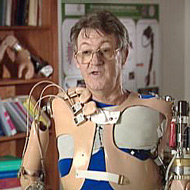
Scientific progress improves the lives of people around the world every day. One of the latest developments is a new kind of surgery. It holds promise to greatly improve the abilities of people who have lost both arms. The operation could help double arm amputees move their manufactured arms with greater ease and control.
Arm amputees commonly use devices joined to their shoulders to operate man-made arms or wrists. These devices use rope-like material to carry movement from the shoulder to the prosthetic arm. Yet, the movement is limited, and requires the person to tighten muscles in the back or arms.
VOICE TWO:
Now, researchers with the Rehabilitation Institute of Chicago are working on another method called TMR, or targeted muscle reinnervation. It uses the remaining nerves of arm amputees that would otherwise be lost because of injuries.
TMR surgically connects the remaining nerves to chest muscles. Electric devices are then placed near those muscles. The idea is to activate the remaining arm nerves to make electrical signals to operate prosthetic devices.
To move an arm, the brain sends a message that causes the chest muscles to tighten. An electrical signal is then sent to the prosthetic arm, telling it to move. The process takes place without any more effort than in a person without prosthetics.
VOICE ONE:
The researchers completed a study involving 5 volunteers who had lost their arms, but had the TMR surgery. They were asked to perform ten different movements, including moving the wrist in a circular motion and moving their elbows.
A group of volunteers who had not lost their arms performed the same test. The times for both groups were similar, but the non-amputees were able to perform the movements faster. For example, the TMR patients completed elbow and wrist movements in an average of 1.29 seconds. The non-amputee volunteers did the movements in 1.08 seconds.
VOICE TWO:
Todd Kuiken of the Rehabilitation Institute of Chicago led the study. His team has found that even more complex movements can be performed by TMR patients with improved kinds of prosthetic devices. The results of the study were reported last month in the Journal of the American Medical Association.
About thirty people have already had the TMR surgery. Doctor Kuiken says the devices used in the study need more work before they will be widely available. However, he says they will make it possible for patients to simply think of the action they wish to perform and do it with prosthetics.
(MUSIC)
VOICE ONE:
Recently, American researchers studied a health risk faced by astronauts traveling on the International Space Station. They found that people who spend months in space lose bone strength at a faster rate than experts had thought. The study found this loss of bone strength increases the risk of broken bones later in life.
The researchers studied 13 astronauts -- 12 men and one woman. Each person had spent 4 to 6 months on the Space Station.
VOICE TWO:
Joyce Keyak led the study. She is a professor of biomedical engineering and orthopedic surgery at the University of California in Irvine.
Her team used a computer program she developed to identify the risk of broken hipbones in people with the bone disease osteoporosis. The team used the same computer program to study images of the hipbones of the 13 astronauts.
The study found their hipbone strength decreased by an average of f 14 percent. Three astronauts showed losses of 20 to 30 percent. These rates are similar to those seen in older women with osteoporosis.
VOICE ONE:
The astronauts’ decrease in bone strength measured from point six percent to five percent for each month spent on the space station.
Professor Keyak says the measurement is much greater than monthly reductions in bone mineral density of 0.4 percent and 1.8 percent. Those measurements were observed in earlier studies on the same individuals.
VOICE TWO:
The study is said to be the first to examine in detail measurements of bone strength instead of bone density. The American space agency provided financial support for the study.
The results were reported in the online version of the publication Bone.
Researchers studying the effects of long-term spaceflight often examine the hipbone or backbone. The hip is believed to have the greatest rate of bone loss in space.
VOICE ONE:
For many years, researchers have studied why the space environment weakens bones. They have found that lack of gravity has a severe effect on bones. Weightlessness does not let bones do their normal work of supporting the body.
Professor Keyak says astronauts need to take preventative measures to keep their bones strong. If not, she says, they may be at increased risk for age-related broken bones years after their visits to space.
(MUSIC)
VOICE TWO:
This SCIENCE IN THE NEWS was written by Brianna Blake, Lawan Davis and Caty Weaver. Brianna Blake also was our producer. I’m Barbara Klein.
VOICE ONE:
And I’m Bob Doughty. We would like to hear from you. Write to us at Special English, Voice of America, Washington, D.C., 20237, U.S.A. Or send your e-mails to special@voanews.com. Join us again next week for more news about science in Special English on the Voice of America.
interfere with:to come into opposition, as one thing with another, esp. with the effect of hampering action or procedure(妨礙,干擾)