U.S. papers search for ways to redesign an industry that helped incite the American Revolution.
VOICE ONE: Welcome to THIS IS AMERICA in VOA Special English. I'm Faith Lapidus.
VOICE TWO:
And I'm Steve Ember. This week on our program, we talk about the newspaper industry in the United States and its history.
(SOUND)
VOICE ONE:
The new movie "State of Play" is a political murder mystery. Ben Affleck plays a congressman whose assistant -- and lover -- is killed. Russell Crowe investigates her murder. Does he play a Washington police officer, a federal agent, a private investigator?
No, a newspaper reporter -- a reminder, in this age of new media and social media, not to forget the importance of the old media.
VOICE TWO:
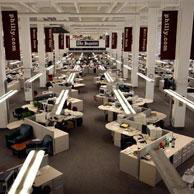
Newsroom of the Philadelphia Inquirer, which continues to publish though its owner sought bankruptcy protection in February American newspapers are reporting what some fear is the slow death of their own industry.
Newspapers in the United States earn most of their money from selling space for advertising. The rates they charge are tied to the number of readers. But the number of people who buy newspapers has been falling for years. And this traditional business model has not worked very well on the Internet, especially not in a bad economy.
VOICE ONE:
Industry profits are shrinking, and many newspaper companies have large debts from buying other papers. Some papers have recently closed or declared bankruptcy or reduced their operations.
Newspapers are looking for new ways to reinvent themselves, new ways to earn money. That includes giving new consideration to an old idea -- charging for at least some of the material that most papers now publish online for free.
Internet access to newspapers means that more people may read the news, which is good for society. But good reporting costs money. The question is how much are people willing to pay for news that they have gotten used to receiving for free?
Another suggestion is for newspapers to become nonprofit organizations. That way they could seek tax-free donations. But the industry has never worked that way.
VOICE TWO:
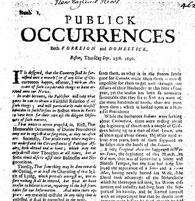
The first newspaper published in Britain's North American colonies appeared in Boston, Massachusetts, in 1690. It was called Publick Occurrences Both Foreign and Domestick. It began with this news:
READER: "The Christianized Indians in some parts of Plimouth, have newly appointed a day of Thanksgiving to God for his Mercy in supplying their extreme and pinching Necessities under their late want of Corn, & for His giving them now a prospect of a very Comfortable Harvest. Their Example may be worth Mentioning."
VOICE ONE:
Publick Occurrences appeared only once. The National Humanities Center in North Carolina explains on its Web site that the newspaper was banned for three reasons.
One was the failure of its editor, Benjamin Harris, to get permission to publish. Another reason was his criticism of the abuse of several French prisoners captured by Indian allies of the English. And the third reason was the publishing of rumors about the moral behavior of the French royal family.
VOICE TWO:
Newspapers that came later reprinted information from papers in Europe so as not to offend colonial officials. Politics and public policy issues were avoided until the New England Courant was published in Boston in 1722. It accused the colonial government, for example, of not doing enough to protect ships from pirates.
The editor, James Franklin, was arrested and barred from publishing the paper. So he appointed a new publisher -- his younger brother Benjamin. And that was how one of America's founding fathers, Benjamin Franklin, came into public life.
(MUSIC)
VOICE ONE:
Freedom of the press is guaranteed by the First Amendment to the Constitution. Historians say a trial in the colony of New York in 1735 went a long way toward establishing this freedom.
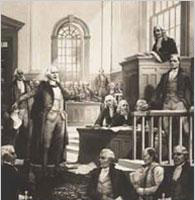
Trial of John Peter Zenger The trial involved, publisher of the New York Weekly Journal. The newspaper had criticized the colonial governor. Zenger was arrested and charged with seditious libel. English law defined seditious libel as criticizing the government in such a way as to reduce public confidence. It made no difference whether the criticism was true or not.
Zenger admitted criticizing the governor. But his defense lawyer asked the jury to decide if citizens have the right to criticize public officials. The jury found Zenger not guilty. Historians say the trial formed the beginning of the legal idea that a statement is not libelous if it can be proven true.
VOICE TWO:
Some newspapers in colonial America supported British rule. But historians say the criticisms of other newspapers helped lead to the American Revolution. After the war, newspapers supported different political parties and felt free to express opposition to the government.
Yet the government of the new nation did not always accept freedom of the press. The Sedition Act of 1798 made it a crime to criticize the government with the aim to damage it in the eyes of the public.
Three years later Thomas Jefferson became president. He permitted the act to end. Jefferson spoke about the importance of a free press. He said "were it left to me to decide whether we should have a government without newspapers, or newspapers without a government, I should not hesitate a moment to prefer the latter."
VOICE ONE:
Newspapers in the early 1800s cost about 6 cents -- too much for many immigrants and working people. Then in the 1830s came the "penny press." These newspapers cost just one cent, a penny. Also, they published a lot of crime and court stories to get more attention than other papers.
The penny press cost so little because businesses paid to advertise in the newspapers. The idea spread.
The Newspaper Association of America says advertising sales today provide about eighty percent of the money for newspapers. Advertising sales dropped 16 percent last year, and the group expects another 10 percent drop this year.
(MUSIC)
VOICE TWO:
In 1846 a group of New York newspapers agreed to share news. That alliance became known as The Associated Press. By that time, the use of the telegraph meant that newspapers could report on recent events.
Publishers often used their papers for political causes. Anti-slavery activist William Lloyd Garrison started a paper in 1831 with the purpose of ending slavery. Historians say the first paper published by blacks in the United States was Freedom's Journal. It appeared in 1827. And immigrant groups created newspapers in their native languages.
VOICE ONE:
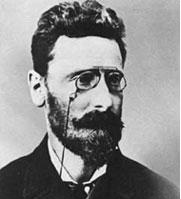
Joseph Pulitzer The hunger for news of the Civil War in the eighteen sixties increased the need for reporters. After the war, the purpose of newspapers slowly changed. They began to consider that their job was mainly to provide information. Still, they helped to influence events.
Joseph Pulitzer bought the New York World in 1883 and used it to improve the lives of workers and the poor. He helped start the practice known as investigative journalism. For example, the reporter Nellie Bly was working for him when she investigated the cruel treatment of patients at a mental hospital.
In 1889, Pulitzer sent Nellie Bly on a trip around the world. He wanted to see if she could do it in under 80 days. She did it in 72 days.
VOICE TWO:
Joseph Pulitzer competed with another powerful newspaper publisher -- William Randolph Hearst. Hearst published the New York Journal. At times, both of them seemed more interested in selling newspapers than in respectable reporting.
VOICE ONE:
No history of journalism is complete without discussing the work of two young reporters from the Washington Post. They wrote a series of stories after a break-in at Democratic Party offices in the Watergate Office Building in 1972. Bob Woodward and Carl Bernstein discovered wrongdoing that led President Richard Nixon to resign.
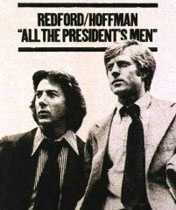
Robert Redford played Bob Woodward and Dustin Hoffman was Carl Bernstein in the movie based on their book "All the President's Men." In this scene, their editors are trying to decide if the paper has enough to support a story that the reporters want to print.
Dustin Hoffman, left, and Robert Redford EDITOR: "We're about to accuse Haldeman -- who only happens to be the second most important man in this country -- of conducting a criminal conspiracy from inside the White House. It would be nice if we were right." OTHER EDITOR: "You double-checked your sources?" EDITOR: "Bernstein, are you sure on this story?" BERNSTEIN: "Absolutely." EDITOR: "Woodward?" WOODWARD: "I'm sure." EDITOR: "I'm not. It still seems thin." OTHER EDITOR: "Get another source."
VOICE TWO:
The look of American newspapers changed after USA Today arrived in 1982. Most of the stories were short. There was heavy use of color and images and things like opinion polls. People who compared it to television did not necessarily mean that as praise. But the new design succeeded and influenced many other papers.
Now newspapers are looking to redesign themselves for an increasingly online world. Millions more people read papers like USA Today and the New York Times for free on the Web than pay for a printed version. Publishers who chose that business plan might regret it now, but they might not have had much choice.
VOICE ONE:
Survival means changing as conditions change. Like any other business, newspapers have to balance their needs with the needs of their customers -- the readers they need to keep.
(MUSIC)
VOICE TWO:
Our program was written by Nancy Steinbach and produced by Caty Weaver. I'm Steve Ember.
VOICE ONE:
And I'm Faith Lapidus. Join us again next week for THIS IS AMERICA in VOA Special English.