And a visit to the studio of ceramic artist William Wilhelmi.
VOICE ONE:
I'm Steve Ember.
VOICE TWO:
And I'm Barbara Klein with EXPLORATIONS in VOA Special English. At the Smithsonian American Art Museum in Washington, D.C. you might see two cowboy boots. They are painted with a design of clouds and stars.

They look like boots that you could wear on your feet. But they are really made out of carefully formed clay material. The artist William Wilhelmi made these ceramic pieces. How did he make these colorful boots? Today, we answer that question as we explore the world of clay art.
(MUSIC)
VOICE ONE:
Clay is one of the most universal materials known to humans. Throughout history and around the world, people have developed the art of forming clay to make ceramic objects, or pottery. Clay is made of water and earth. It is formed into different shapes. Then high levels of heat harden it to produce many kinds of ceramics.
Different kinds of clay contain different minerals such as silicon or iron dioxide. The kinds of minerals in clay affect how soft or hard it is to work with. The mineral content of clay also affects the temperature level at which it hardens.
VOICE TWO:
Earthenware is one of the earliest kinds of clay used by humans. Earthenware hardens at a lower temperature than another clay called stoneware. Porcelain is yet another kind of clay.
It is very fine and smooth. All these clays need to be fired at high temperatures. Early pottery was heated in the sun or by a fire. Later, potters developed heated devices called kilns to control the necessary firing conditions.
VOICE ONE:
The development of ceramics has had an important effect on human history. Ceramic objects permitted early cultures to make containers that could hold water. This means they could cook foods like vegetables and meats. Improving food production methods meant larger populations could survive. Pottery is an art form that grew out of the daily needs of life.
Ceramics are also important for historians and archeologists. Pieces of ceramics found at archeological areas help tell about ancient cultures. These pieces can last for tens of thousands of years. They help answer questions about cultures we know little about.
(MUSIC)
VOICE TWO:
There are many different ways to form clay. The earliest methods involved shaping it by hand. People form containers by pressing a ball of clay into a given shape.
Or, they place long thin rolls of clay on top of each other and then make them smooth. Another method is called slab-construction. A ceramist creates several flat pieces of clay that can be joined together to make the sides of the container.
Later, ceramists developed the method of "throwing" clay on a wheel. A ball of clay is placed on a flat wheel device that turns quickly. The potter holds the clay firmly and guides it while the wheel and clay turn. Using different amounts of upward pressure the potter can build up the sides of a container. This method permits a potter to make similar pieces quickly. But it takes a great deal of skill to become an expert at wheel throwing.
VOICE ONE:
Slip casting is another method. A ceramist pours liquid clay into a hard form or mold. As the clay dries, it takes the shape of the form. This method is useful for making very detailed objects. It is also useful because the mold can be used over and over again to make exact copies of the ceramic form.
There are also many ways to add decoration to ceramics. These methods can be as simple as scratching designs and images into the clay. Or, they can be more complex such as using liquid glazes to change the color or shininess of the clay surface.
(MUSIC)
VOICE TWO:
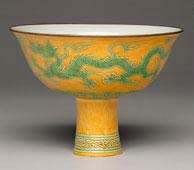
Pottery provides important examples of cultural exchange. For example, native traditions of pottery in Mexico changed greatly in the 15th century. After the arrival of people from Spain, Mexican ceramists stopped making their own religious figures. They started making Christian religious forms instead. Also, the Spanish introduced materials and methods used in Europe, including the potter's wheel.
Trade exchanges spread ceramics all over the world. As early as the tenth century, the Chinese traded their ceramics throughout the Middle East and southeast Asia. Chinese ceramics later had a great influence on Europe. Europeans started to copy the fine traditions of Japanese and Chinese ceramics as early as the 18th century.
VOICE ONE:
Ceramics also demonstrate the depth of human creativity. This art shows the local needs and materials of a group of people. Pottery is often very different from country to country. But it can also be very different within areas of the same country. For example, in Mexico, every area has a different clay tradition. In one part of the state of Oaxaca, potters have been making black clay containers in the same way for centuries.
In another area of this state, pottery for cooking is made with a shiny green coating. Nearby, artists make female figures out of orange clay.
In the Mexican state of Michoacán potters make white clay containers painted with line drawings of fish and other animals. In another part of this state, artists make green painted containers in the shape of the pineapple fruit.
In the state of Mexico, artists make clay candle holders covered with clay animals, plants, and people. They are painted in bright colors. These traditions are just a few of the examples of Mexican ceramics.
Imagine how many different kinds of clay traditions exist in other areas of the world. What kinds of ceramics are made where you live?
(MUSIC)
VOICE TWO:
In the United States, W Studio is on a quiet street in Corpus Christi, Texas. This is where the potter William Wilhelmi makes his art. Let us go back to the ceramic cowboy boots we talked about earlier. Listen as Wilhelmi describes why he made these special boots in porcelain:
WILLIAM WILHELMI: "I'm William Wilhelmi and I made the porcelain cowboy boots at the Smithsonian in Washington DC. That's the only pair of porcelain boots. We use here a low temperature fired clay, which is very easy to work with. The reason the ones at the Smithsonian are porcelain is they were having a show called "American Porcelain". I was asked if I would enter a pair of boots in the show. And they said, are they out of porcelain? And I said 'Why, sure!'"
VOICE ONE:
William Wilhelmi made these boots with the slip cast method. He took two real cowboy boots and made a hard form using their shape. Then, he poured liquid clay into the forms. Once the boot forms dried, he added clay details to the shoes to represent leather shoe material. Later, he painted a Texas night sky on the sides of the boots. And he made the points of the shoes a shiny gold.
Wilhelmi is also known for his clay "monster" creatures. He adds these friendly little creatures to many of his ceramics forms. He says they add humor and a sense of activity. Another design Wilhelmi likes to use is the eucalyptus tree. He paints these trees in black on many of his clay dishes, bowls, and cups.
VOICE TWO:
William Wilhelmi says being a potter can be difficult. You do not always know if a clay object will survive being fired at high temperatures. You can spend a great deal of time making an object only for it to break in the kiln. But he says it is also very pleasant working with clay. And it permits him to use his sense of design, color and shape in many ways.
William Wilhelmi's work can be found in museums all over the United States. Many important people collect his work. For example, the president of Venezuela, Hugo Chavez, owns some of these clay boots. So does Vicente Fox, the former president of Mexico. To see a large collection of the artist's work, you can visit the Wilhelmi/Holland Gallery next to W Studio. Here, people can buy Wilhelmi's work as well as the work of other artists.
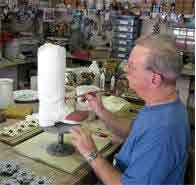
Or, visitors can watch Wilhelmi at work in his studio. This large room is filled with interesting objects like photographs, art and books. There are many worktables covered with tools, color glazes and clay forms. In one area of the room there are three kilns as well as a potter's wheel.
VOICE ONE:
William Wilhelmi finds new artistic ideas by traveling and reading books. He tells about how clay art is both universal and personal.
WILLIAM WILHELMI: "The thing about clay is every culture knows clay, because they use it. That is one of the advantages of working in clay. Everyone can relate to clay. It's been part of our human evolution. And it goes from very basic to extremely baroque things. And also as one lives one's life, you take in all your experiences. And then when I sit down to work, these things come out. It is the experiences of life you reflect in your work."
(MUSIC)
VOICE TWO:
This program was written and produced by Dana Demange. I'm Barbara Klein.
VOICE ONE:
And I'm Steve Ember. You can read this program and download audio on our Web site, voaspecialenglish.com. Join us again next week for Explorations in VOA Special English.
ceramic: of or relating to or made from a ceramic (a hard brittle material made by heating clay to a very high temperature) 陶器的
silicon: a brittle non-metallic element: used in transistors, solar cells, and alloys 硅
kiln: a large oven for burning, drying, or processing pottery, bricks, etc(用來燒或烘干磚等的)窯,爐
glaze: a coating of colored, opaque, or transparent material applied to ceramics before firing 釉;釉料
eucalyptus: any of a mostly Australian genus of trees, widely cultivated for timber and gum, and for the medicinal oil in their leaves 桉(樹)屬植物
Related stories:
Dangerous lead-based paint common around the world
The Newport Folk Festival
Remains of 'oldest kingdom' unearthed
Exploring the history and art of printmaking
(Source: VOA 英語點津編輯)


