VOICE ONE:
I'm Shirley Griffith.
VOICE TWO:
And I'm Steve Ember with EXPLORATIONS in VOA Special English. This week, we tell about the discovery of water on the moon.
We learn where scientists found one of the basic substances necessary for life. And we hear about the newly improved Hubble Space Telescope.

(MUSIC)
VOICE ONE:
The moon appears to be a dry and dead place. Scientists have long believed that Earth's satellite lacks the ability to hold water near its surface because it has no atmosphere. So the announcement by the United States space agency shocked many in the scientific community.
Mapper showing water-holding minerals near a crater on the moon CARLE PIETERS: "Widespread water has been detected on the surface of the moon."
That was Carle Pieters, a professor at Brown University, in Providence, Rhode Island. She is lead investigator for a NASA team studying the lunar findings.
The NASA scientists discovered water molecules mainly in the moon's extreme northern and southern areas. The researchers note, however, that they could also be seeing evidence of another molecule, hydroxyl.
Hydroxyl is the combination of one hydrogen atom and one oxygen atom. Water is made of one oxygen atom and two hydrogen atoms. The NASA team still is not sure how much of what they have found is water and how much is hydroxyl.
VOICE TWO:
Instruments on three separate spacecraft have now shown evidence of lunar water. NASA's Moon Mineralogy Mapper provided the most recent evidence. It was one of eleven scientific devices carried by the Chandrayaan-One spacecraft of the Indian Space Research Organization.
The mapper is a spectrometer, a device that measures reflected light wavelengths. It is able to show scientists what an object is made of from great distances. Similar devices on NASA's Cassini and Epoxi spacecraft also reported the presence of water. But those observations were made years ago and NASA scientists had not trusted the results without clear confirmation. Now, Mizz Pieters calls the new results completely conclusive. The findings were published in the journal Science.
VOICE ONE:
The Moon Mineralogy Mapper can only observe lunar soil to a depth of a few millimeters.
And the amount of water present in that layer is very small. Jim Green is director of NASA's Planetary Science Division. He points out that even the driest deserts on Earth have more water than the surface of the moon near its poles.
Still, the discovery raises some important questions. Was water brought to the moon by space rocks and icy bodies called comets? Or could processes deep within the moon produce water? If that is the case, it may be possible that the moon could hold enough water for future explorations or even colonies.
Indian space officials lost contact with Chandrayaan-One late in August. But another NASA project, the Lunar Crater Observing and Sensing Satellite, or LCROSS, could provide answers to what lies deeper beneath the moon's surface.
That project involves crashing a rocket stage into the moon's south pole. LCROSS will then study the soil thrown up to ten kilometers above the lunar surface before it too crashes into the moon. NASA scientists hope to extend their search for water as deep as five meters beneath the surface of the moon. LCROSS is expected to crash into the moon next month.
(MUSIC)
VOICE TWO:
Scientists have wondered for a long time about where the substances necessary for life came from. Water exists on Earth and the planet Mars. But what about important carbon-based molecules? Astronomers have recently found some surprising evidence that some of those materials may have come from comets.
Scientists at the Goddard Space Flight Center in Greenbelt, Maryland, found the substance glycine in material brought back to Earth from a comet. Glycine is one of the common amino acids. On Earth, organisms use glycine to create proteins. The discovery is exciting because it suggests that the building blocks of life may be more common in the universe than scientists had thought.
VOICE ONE:
The story of how space scientists were able to recover the material and bring it back to Earth is just as exciting. NASA captured the material using the Stardust spacecraft launched in 1999 from Cape Canaveral, Florida. Stardust passed through a cloud of material surrounding comet Wild Two in January of 2004.
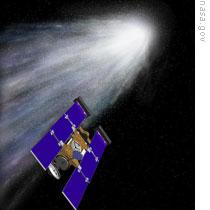
A comet is a huge ball of frozen gas and dust that often releases a long trail of material as it nears the sun. A specially designed collector gathered dust particles from the comet and stored them on the spacecraft. Stardust then returned to Earth and released a special reentry capsule containing the material it had collected.
The recovery of the Stardust capsule was difficult because of its high reentry speed. The capsule was traveling at almost forty-six thousand kilometers an hour. It set a record as the fastest human-made object to ever enter the atmosphere.
The Stardust capsule successfully parachuted onto a dry plain in the state of Utah on January fifteenth, two thousand six. Since then, scientists around the world have been working to identify substances gathered from Comet Wild-Two.
VOICE TWO:
The discovery of glycine was not completely unexpected. But it is the first time an amino acid has been discovered on a comet. Amino acids have already been found in space rocks called meteorites. There is also early evidence suggesting that amino acids may also exist in the space between stars.
Yet, it took some time for the team to confirm that the amino acid glycine came from space. Glycine is very common on Earth. And the team at Goddard Space Flight Center was testing extremely small amounts of material. The researchers found the presence of carbon thirteen, a version of the carbon atom that is usually found in space. The presence of carbon thirteen confirmed that the glycine was from space.
Jamie Elsila led the research team. She said the discovery "supports the theory that some of life's ingredients formed in space and were delivered to Earth long ago by meteorite and comet impacts." The team's findings are to be published in the journal Meteorics and Planetary Science.
(MUSIC)
VOICE ONE:
The Hubble Space Telescope has again captured the imagination of the public by returning extraordinary images of the solar system and beyond. The telescope recently received new equipment and instruments to make it even more powerful. NASA released some new pictures earlier this month. One shows the remains of a dying star four thousand light years away which has thrown off a cloud of glowing hydrogen gas.
The image of the Butterfly nebula shows the intense color and detail that only Hubble can provide with such clearness.
The Hubble Space Telescope was launched into orbit in April of 1990. The project cost one and a half billion dollars. But when the telescope reached orbit, NASA scientists were shocked to discover that the costly mirror of the telescope had not been shaped correctly. Hubble was still able to carry out observations. But it was not until 1993 that the problem was completely solved using corrective mirrors.
VOICE TWO:
Hubble's first-ever image Hubble orbits about six hundred kilometers above the Earth's surface. We think of the telescope as moving slowly in its orbit. But it is really traveling at 28,000 kilometers an hour. It completes an orbit of the Earth in only ninety-seven minutes.
The first image taken by Hubble hardly showed its extraordinary power. It was of a small area of a group of stars. Although it was not a colorful picture, scientists were pleased. They could compare it with images taken by Earth-based telescopes.
VOICE ONE:
There have now been five missions to service and repair Hubble. The repairs carried out in May by the crew of the Space Shuttle Atlantis are expected to be the last. Astronauts added a new wide field camera and a new spectrograph. They repaired an existing infrared wavelength camera and spectrometer. And they fixed Hubble's directional controls and batteries. The work required five separate spacewalks over eleven days. But the mission will keep Hubble alive until at least 2014.
(MUSIC)
VOICE TWO:
This program was written and produced by Mario Ritter. I'm Steve Ember.
VOICE ONE:
And I'm Shirley Griffith. You can see pictures from the Hubble Space Telescope and find transcripts, MP3s and podcasts of our programs at voaspecialenglish.com. Join us again next week for EXPLORATIONS in VOA Special English.
(英語(yǔ)點(diǎn)津姍姍編輯)


