
中國網站品牌欄目(頻道)
SHIRLEY GRIFFITH: I'm Shirley Griffith.
SARA LONG: And I'm Sarah Long with the VOA Special English program, PEOPLE IN AMERICA. Today we tell about the life of award-winning poet Gwendolyn Brooks. She was the first African American to win a Pulitzer Prize for Literature.
(MUSIC)
SHIRLEY GRIFFITH: Gwendolyn Brooks wrote hundreds of poems during her lifetime. She had more than 20 books published. She was known around the world for using poetry to increase understanding about black culture in America.
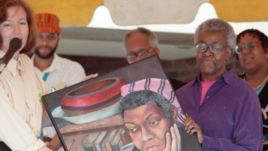
Gwendolyn Brooks wrote many poems about being black during the 1940s and 1950s. Her poems described conditions among the poor, racial inequality and drug use in the black community. She also wrote poems about the struggles of black women.
But her skill was more than her ability to write about struggling black people. She was an expert at the language of poetry. She combined traditional European poetry styles with the African American experience.
SARA LONG: Gwendolyn Brooks once said that she wrote about what she saw and heard in the street. She said she found most of her material looking out of the window of her second-floor apartment house in Chicago, Illinois.
In her early poetry, Gwendolyn Brooks wrote about the South Side of Chicago. The South Side of Chicago is where many black people live. In her poems, the South Side is called Bronzeville. It was "A Street in Bronzeville" that gained the attention of literary experts in 1945. Critics praised her poetic skill and her powerful descriptions about the black experience during the time. The Bronzeville poems were her first published collection.
Here she is reading from her 1945 collection, "A Street in Bronzeville."
GWENDOLYN BROOKS: "My father, it is surely a blue place and straight. Right, regular, where I shall find no need for scholarly nonchalance or looks a little to the left or guards upon the heart."
SHIRLEY GRIFFITH: In 1950, Gwendolyn Brooks became the first African American to win the Pulitzer Prize for Literature. She won the prize for her second book of poems called "Annie Allen." "Annie Allen" is a collection of poetry about the life of a Bronzeville girl as a daughter, a wife and mother. She experiences loneliness, loss, death and being poor.
Ms. Brooks said that winning the prize changed her life.
Her next work was a novel written in 1953 called "Maud Martha." "Maud Martha" received little notice when it first published. But now it is considered an important work by some critics. Its main ideas about the difficult life of many women are popular among female writers today.
SARA LONG: Gwendolyn Brooks wrote poems about the black experience in America. She described the anger many blacks had about racial injustice and the feeling of being different. She used poetry to criticize those who did not show respect for the poor. Yet for all the anger in her writing, Gwendolyn Brooks was considered by many to be a gentle spirit and a very giving person.
By the early 1960s, Ms. Brooks had reached a high point in her writing career. She was considered one of America's leading black writers. She was a popular teacher. She was praised for her use of language and the way people identified with her writing.
(MUSIC)
SHIRLEY GRIFFITH: Gwendolyn Brooks was born in Topeka, Kansas in 1917. But she grew up in Chicago. She began writing when she was 11 years old. She mailed several poems to a community newspaper in Chicago to surprise her family.
In a radio broadcast in 1961, Ms. Brooks said her mother urged her to develop her poetic skills:
GWENDOLYN BROOKS: My mother took me to the library when, I guess, I was about four or five. I enjoyed reading poetry and I tried to write it when I was, I think, about seven, at the time that I first tried to put rhymes together. And I have loved it ever since."
SARA LONG: Gwendolyn Brooks married Henry L. Blakely in 1939. Henry Blakely was a young writer who later published his own poetry. They lived in Chicago for the next 30 years, divorced in 1969, but re-united in 1973. They had two children, Nora Brooks Blakely and Henry Blakely.
Throughout her life, Ms. Brooks supported herself through speaking appearances, poetry readings and part-time teaching in colleges. She also received money from organizations that offered grants designed to support the arts.
(MUSIC)
SHIRLEY GRIFFITH: One of Gwendolyn Brooks's most famous poems is called "We Real Cool". It is a short poem that talks about young people feeling hopeless:
We real cool. We
Left school. We
Lurk late. We
Strike straight. We
Sing sin. We
Thin gin. We
Jazz June. We
Die soon.
SARA LONG: By the end of the 1960s, Gwendolyn Brooks's poetry expanded from the everyday experiences of people in Bronzeville. She wrote about a wider world and dealt with important political issues. She won praise for her sharper, real-life poetic style.
Gwendolyn Brooks was affected by the civil rights struggles and social changes taking place in America. She began to question her relations with whites. She said she felt that black poets should write for black people.
That became evident in her next collection of poetry in 1968 called "In the Mecca." Critics suggested Ms. Brooks had become too political and seemed to be writing only for black people. Her new poems received little notice in the press.
SHIRLEY GRIFFITH: In some of her poems, Gwendolyn Brooks described how what people see in life is affected by who they are. One example is this poem, "Corners on the Curving Sky":
Our earth is round, and, among other things
That means that you and I can hold
completely different
Points of view and both be right.
The difference of our positions will show
Stars in your window. I cannot even imagine.
Your sky may burn with light,
While mine, at the same moment,
Spreads beautiful to darkness.
Still, we must choose how we separately corner
The circling universe of our experience
Once chosen, our cornering will determine
The message of any star and darkness we
encounter.
SARA LONG: Although her poetry did not receive much notice in the press, Gwendolyn Brooks continued to receive honors. She was chosen poet laureate of the state of Illinois in 1968. In 1976, she became the first black woman to be elected to the National Institute of Arts and Letters. She received a lifetime achievement award from the National Endowment for the Arts in 1989. And she was named the 1994 Jefferson Lecturer by the National Endowment for the Humanities. That is the highest honor given by the federal government for work in the humanities.
Ms. Brooks once said that of all the awards she received, there was only one that meant a lot to her. It was given to her at a workshop in an old theater in Chicago. She said: "I was given an award for just being me, and that's what poetry is to me – just being me."
SHIRLEY GRIFFITH: Although she was well known, Gwendolyn Brooks lived a quiet life. She said her greatest interest was being involved with young people. She spent time giving readings at schools, prisons and hospitals. She also attended yearly poetry competitions for Chicago children. She often paid for the awards given to the winners.
In 1962, President John F. Kennedy asked Ms. Brooks to speak at a Library of Congress poetry festival. Soon after, she began teaching creative writing at universities in Chicago, New York, and Wisconsin. She liked working with students. She felt that young people would lead the way in healing the wounds of the United States civil rights movement of the 1960s. To honor her work, Chicago State University formed the Gwendolyn Brooks Center for Creative Writing and Black literature.
SARA LONG: Gwendolyn Brooks influenced many African American writers. Friends say her prize-winning works also helped other black Americans to develop their own sense of identity and culture.
Doctors discovered Ms. Brooks had cancer in November, 2000. She died December 3rd at her home in Chicago. She was 83.
The funeral service was held on the South Side, the same area of the city that had been a window for much of Ms. Brooks's poetry. The service was at times filled with laughter. There were warm remembrances of a woman whose life and words had touched people forever. African drums sounded and dancers leaped.
(MUSIC)
SHIRLEY GRIFFITH: This Special English program was written and produced by Cynthia Kirk. Our studio engineer was Holly Capeheart. I'm Shirley Griffith.
SARA LONG: And I'm Sarah Long. Join us again next week for another PEOPLE IN AMERICA program on the Voice of America.
nonchalance: casual lack of concern 冷漠
Pulitzers for AFP, news websites
Critics'picks for best books and movies of the year
Robert Frost, 1874-1963: most Americans can quote his poems
American history: the 1920's were an active and important period for the American arts
(來源:VOA 編輯:旭燕)
 |
 |
 |
 |
 |
 |


 久久久无码人妻精品无码_6080YYY午夜理论片中无码_性无码专区_无码人妻品一区二区三区精99