OPINION> Newsmaker

|
OPINION> Newsmaker
|
|
A fight to the death
By Chang Ailing (China Daily)
Updated: 2009-11-09 07:42
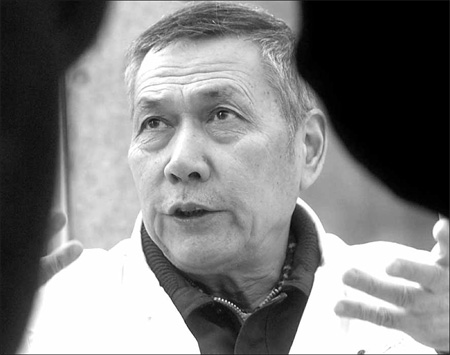
A noisy cab speeds along a dark country road on a muggy Friday night in July. Dr Gui Xi'en, 72, sits on the cramped back seat with a satchel on his shoulder and suitcase on his lap. He is on his way to Shangcai, an AIDS-ravaged county in central China's Henan province. As the cab approaches the county seat, Gui directs it to a small hotel. He plans to stay the night and quietly visit the villages the next day. Ten years after he first exposed their deadly secret in 1999, Gui who blew the whistle on China's "AIDS villages" is still sneaking into rural communities in Shangcai, offering counseling to those dying from the epidemic. "I came secretly before, because they (local officials) were not nice to me. I still come secretly now, because they are too nice to me," says Gui. "If they know I am here, they will come see me and invite me for lunch or dinner. I think that is unnecessary and I don't like it." From being driven out of the villages to being treated as an "important guest", Gui's experiences reflect China's changing official attitude toward the HIV/AIDS plague, believed to be the most serious public health problem confronting new China since 1949. An infectious diseases specialist with Zhongnan Hospital at Wuhan University in neighboring Hubei province, Gui first visited Wenlou, a village of Shangcai in July 1999 as a favor to a fellow doctor there.
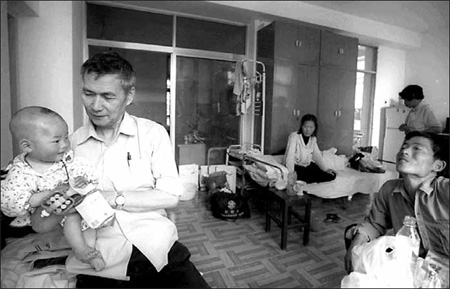
HIV/AIDS was the last thing he expected to find. Some villagers suffered from constant fever and diarrhea. People died every month, with their bodies covered in sores and dark, wine-colored blotches. Panic had seized the village. Gui took 11 blood samples from the villagers, and found 10 to be HIV positive. He immediately informed the local health authorities and urged them to take action. But their response was to refuse him further entry to the villages. Two months later, during a long-weekend holiday when he calculated that officials would let their guard down, he sneaked back into Wenlou with three students. After three days of house calls, Gui returned to Wuhan with 159 blood samples. The result was shocking - 90 of them were HIV positive. Gui realized that he had stumbled on a full-blown AIDS epidemic, something he had only read about in medical journals. The origins of the tragedy went back to an unchecked blood selling and collecting industry that flourished in the early 1990s. Armed with detailed data and analysis, Gui wrote a letter to Beijing. With the central government involved, the local authorities could no longer hide the lethal infection. But they looked on Gui even more unfavorably. On June 8, 2001, Gui went to Wenlou alone. He took medicines for the villagers. The county government sent police to expel him. Gui escaped with the help of villagers, who hid him from the police, and moved him to a safer place by motorcycle in the middle of the night. The mild-mannered doctor then wrote to the county authorities in an uncharacteristically strong tone: "One day the tragedy will be written into history and those responsible will be condemned by history." Today, the health clinics Gui visits in the AIDS villages provide free HIV testing and antiretroviral treatments, and charity homes shelter AIDS orphans and the elderly, whose caretakers have died of AIDS. Nationwide, the government has been providing free antiretroviral treatments to rural HIV/AIDS patients since 2004, and to urban sufferers facing financial difficulties. The government has also provided free HIV screening, free therapy to block mother-to-infant transmission, free infant HIV testing and financial assistance for children who have lost their parents to the epidemic. This summer, Premier Wen Jiabao visited Gui at his home, and thanked him for his efforts in checking the epidemic. In 2007 and again in 2008, Wen invited Gui to join him on visits to HIV/AIDS villages and AIDS orphans. The Chinese media hailed Gui as a medical hero, but Gui is far more comfortable talking about the villagers than about his role in revealing the epidemic. He says, "I just did what a doctor should do." On this Saturday morning, when Gui arrives at bus stop outside Houyang village, Zhao Qiang (not his real name), a farmer with HIV, is already there waiting for him. "Dr Gui is honest, kind and gentle, and is always ready to help. Whenever we call and ask him to come to the village, he comes," says Zhao, whose wife and 6-year-old son are also infected with HIV. After picking him up, Zhao takes Gui by his motor-pedicab directly to his home, where HIV carriers and AIDS patients are waiting.
"I cannot take him to the village clinic. There would be too many people there to see him. He might not be able to leave today." As Gui sees his patients at Zhao's dilapidated house, Cheng Dong (not his real name) waits anxiously at the Shangcai County Hospital. Cheng's cousin with AIDS is in hospital. Cheng calls Gui and asks him to come. He also wants Gui's help in getting his daughter enrolled in a good local high school. Cheng sees nothing inappropriate in his requests. He is sure Gui will help. He was among the first 10 HIV-positive villagers Gui diagnosed 10 yeas ago, and Gui has continued to extend medical and financial help ever since. "He is a marvelous man," Cheng says. "He was unpopular here in the past. Since Premier Wen visited him, everything has changed. But he has not changed. He is still the Dr Gui I know." Despite his age, Gui works full time and spends most weekends and holidays visiting poor farmers, a routine he formed almost 50 years ago. In 1960, the then medical graduate of 23, volunteered to work in the remote hinterlands of Qinghai province on the Qinghai-Tibet Plateau, answering the government's call for young intellectuals to work and settle in the frontier areas. During his 16 years in Qinghai, he focused on curbing infectious diseases and endemics, such as measles, typhoid and plague. But as medical staff were scarce, he was surgeon, laboratory analyst, anesthetist and pharmacist. He once amputated the seriously injured arm of a herdsman. "The man said I saved his life and was grateful to me. But I felt sorry for him, because a proficient surgeon with good facilities might have been able to save his arm." Gui recalls visiting and treating the herders' families. "I didn't need Tibetan translators at that time because I spent so much time with them that I could speak Tibetan fairly well." The bleak and wild plateau also served as a refuge for Gui from the turbulence of the "cultural revolution" (1966-76). Gui was born to well-educated parents, both US-trained scholars. His father graduated from Princeton University with a doctorate in physics. His half-Chinese, half-Dutch mother graduated from Columbia University. They returned to China in the 1920s. During the "cultural revolution", many Chinese with "complicated family backgrounds" or relatives overseas suffered persecution. Despite his "problematic" genealogy, he could still go to villages and the pastoral regions and offer medical help to herdsmen. "I was on good terms with the locals, so I didn't suffer much," he says. The experience taught Gui that doctors had to work in their communities, rather than wait in clinics for patients, a lesson he passes on to his students. "Infectious diseases are not only medical problems, but also social problems. We must reach out to the people in need." The same afternoon, Gui meets Cheng Dong and his cousin in Shangcai County Hospital. He reads the girl's medical records and offers advice to the resident physicians. He also discusses with Cheng his daughter's schooling. As he is about to leave, a girl approaches him. "Dr Gui, could you please have a look at my mother? She doesn't feel well and has not eaten much for a week," she pleads. Without hesitation, Gui follows the girl to her mother's ward. At about 4 pm, Gui has to leave for Zhumadian city to catch a train back to Wuhan. He apologizes to the families of patients who are still waiting to see him and promises to return. On the bus to Zhumadian, he looks drawn. "Once I was able to see about 30 to 40 patients on a day like this," he says. "I am really inefficient now." It is a comment that belies his strong sense of urgency. He describes himself as an "old farm ox", aware that its life is almost at an end but nevertheless plows on diligently. He quietly recalls a colleague, a year his senior, who died suddenly a week ago, while eating at a restaurant. Gui attended the funeral the day before he left for Shangcai. "His family was heartbroken at his sudden death. But I admire him. I think this is a good way to leave, without suffering much and burdening other people," he says. "For people my age, this (death) is a natural thing," he says with a slight smile. "That's why I hope I can still do something. I may not have much time left." (China Daily 11/09/2009 page8) |