New era on the road to 2050
 |
|
ZHAI HAIJUN/CHINA DAILY |
 |
|
Robert Lawrence Kuhn |
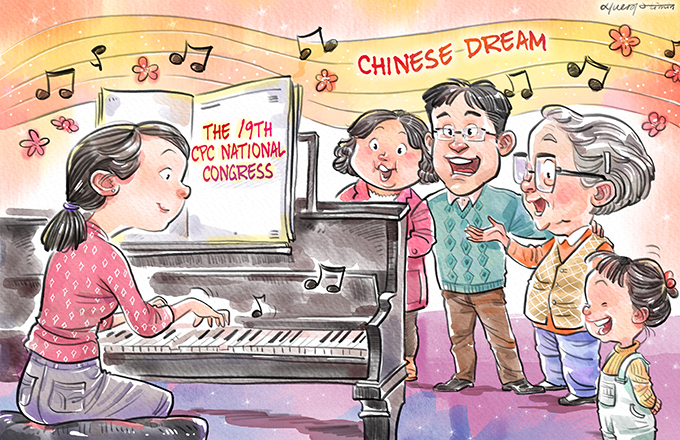
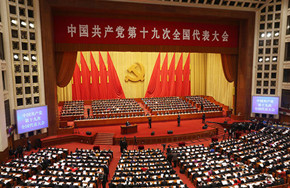
Having departed the Great Hall of the People, I reflected how I, an American, found myself caught up in the welling Chinese patriotism of the 19th CPC National Congress. Certainly, I was experiencing firsthand this inflection point in Chinese history, when China envisions itself becoming a fully modernized country and taking proactive part in international affairs, and regaining its leading seat at the high table of great nations.
What have I just witnessed? Following are some personal observations.
A general consensus describes four primary outcomes of the 19th Party Congress: Xi Jinping Thought on Socialism with Chinese Characteristics for a New Era; a new "contradiction" that defines China's principal social challenge; a China that takes "center stage in the world"; and the Party enhancing its leadership of society, including maintaining, indeed intensifying, its anti-corruption campaign.
To me, however, a highlight was the specificity of Xi's vision of China, not only establishing policies for the next five years, but also framing the agenda and setting the strategies for the next 30 years. This congress, Xi said, is the "confluence" of the "Two Centenary Goals": a moderately prosperous society by 2020 (2021 being the 100th anniversary of the CPC), which will likely be fulfilled within the term of the 19th Party Congress, and a great, modern, socialist country by 2050 (2049 being the 100th anniversary of the People's Republic of China), which is being planned by the 19th Party Congress.
In a multi-meaning refinement, the path to mid-century is now designed in two stages. In the first stage, from 2020 to 2035, the Party states it will build on the foundation of the moderately prosperous society such that, after"15 years of hard work", the country will basically realize "socialist modernization".
In the second stage, from 2035 to 2050, the CPC states it will build on a basically achieved modernization, "work hard for a further 15 years" and "develop China into a great modern socialist country that is prosperous, strong, democratic, culturally advanced, harmonious, and beautiful". China portrays its mid-century self as a global leader in every area of human consequence: economics and trade, science and technology, military and defense, culture and governance.
But Chinese leaders, and officials in general, seem to have a different highlight. While the "Two Centenary Goals" are certainly vital, especially with new stages and specificity, they focus on the amendment to the Party Constitution: "Xi Jinping Thought on Socialism with Chinese Characteristics for a New Era".
"The (Xi's) thought is the biggest highlight of the 19th National Congress of the CPC and a historic contribution to the Party's development," said Zhang Dejiang, the third-ranking member of the Standing Committee of the Political Bureau of the 18th CPC Central Committee. Liu Yunshan, the fifth-ranking member, said the elevation of Xi's thought to the Party's guiding principle is of great political, theoretical and practical significance.
I take a closer look at Xi's thought: first by examining each of its elements, then by considering its unified significance.
"Xi Jinping" is the "core" of the CPC Central Committee and of the whole Party, and he thereby at the top level provides the "centralism" of the Party's cardinal principle of democratic centralism.
The "Thought" is the totality of Xi's fundamental principles. I see four broad categories: people orientation, national rejuvenation, comprehensive development, and Party leadership.
In his report, Xi listed 14 categories: Party leadership over all aspects of society; people-centered policies; deepening reform comprehensively; new concept of development (innovation, coordination, green, open, and sharing); people as masters of the country; adherence to rule of law, comprehensively governing the country by law; socialist value system and cultural confidence; protecting and improving people's livelihoods; harmonious coexistence of man and nature (ecological civilization); national security; the Party's absolute leadership over the military; "one country, two systems" and promoting reunification with Taiwan; international community of a shared future for all humanity; and comprehensive and strict Party governance.
The term "thought" in Chinese has special meaning because before this it had been associated only with Mao Zedong-"Mao Zedong Thought".
"Socialism" is a set of political ideas with a complex history, unified by public or common ownership of the means of production and concern for the masses.
"Chinese characteristics" is the phrase, originating with Deng Xiaoping, that adapts Marxism to China's special conditions-the Sinicization of Marxism in modern China-which includes the market playing a decisive role in the allocation of resources and the encouragement of non-public, for-profit businesses, while at the same time State-owned enterprises still playing a dominant role.
"New Era" is a new idea in the constitutional amendment, and it is designed to profoundly transform the essence of socialism with Chinese characteristics into the vision, concepts and strategies that compose Xi's way of thinking.
The more I reflect, the more I see "New Era" as a conceptual lens with which to view the 19th Party Congress. Semi-official Party analysts say the new era answers five questions.
What "road" to take? Socialism with Chinese characteristics under new historical conditions.
What kind of country to build? First, a moderately prosperous society and then a modernized socialist country.
What development to realize? Better life and common prosperity for all.
What goal to achieve? The great rejuvenation of the Chinese nation.
What contribution to make? Facilitate world peace and prosperity (exemplified by the Belt and Road Initiative of building infrastructure in developing countries).
Thus, Xi Jinping joins only Mao Zedong and Deng Xiaoping in having his name affixed to a political philosophy in the Party Constitution, a blazing sign lost on no one. It then would follow that the "New Era" into which China is now entering is the third era of the CPC and by extension of the People's Republic of China.
A seemingly subtle but significant change is the Party's judgment of what constitutes the fundamental "contradiction" in Chinese society. ("Contradiction" is a Marxist term expressing a particular way of political thinking-dialectical materialism-which identifies "dynamic opposing forces" in society and seeks to resolve the resulting tensions).
The principal contradiction has evolved from one between the ever-growing material and cultural needs of the people and backward social production to that between "unbalanced and inadequate development and the people's ever-growing needs for a better life," Xi said. The needs for the people to live a better life are increasingly broad and have to be met. Not only have their material and cultural needs grown; their demands for democracy, rule of law, fairness and justice, security, and a better environment are increasing.
This "New-Era" contradiction, replacing quantitative GDP growth with qualitative improvement of life, is what will drive China's policy.
The mission of a CPC congress is to review and assess achievements of the previous five years, and to forecast challenges and set targets for the subsequent five years (and beyond). Overall, for the 19th Party Congress, the ambition of the goals and the comprehensiveness of the categories were clear, amplified by the commitment to deepen reform. Here, by category, are what stood out.
The Party and the fight against corruption. Confidence in socialism and the increasing role of the Party in managing all aspects of the country is unequivocal, and the increasingly strict governance of the Party, by reforming and purifying itself, is unambiguous. Moreover, the anti-corruption campaign not only continues but also will be enhanced.
Economy. After more than three decades of rapid growth, China's economy has been transitioning to slower but higher-quality growth. Supply-side structural reform has been written into the Constitution. No GDP growth targets are set. The country focuses on the real economy (as opposed to speculation, such as in the real estate sector). China is not backing away from State-owned enterprises, rather it will support State capital in "becoming stronger, doing better, and growing bigger, thereby turning Chinese enterprises into world-class, globally competitive firms".
Consumption is fundamental in driving economic growth. The framework of regulations must be improved, prudent macroeconomic and monetary policy maintained, and interest and exchange rates made more market-based. For economic development, innovation leads, especially in science and technology.
Poverty alleviation. Xi has made the elimination of extreme poverty in China by 2020 a cornerstone of his domestic policy. After all, how could China claim to have achieved a moderately prosperous society by 2020 if millions of its citizens would be still living in extreme poverty?
Opening-up. China reasserts its commitment to become more open, including easing market access and protecting the rights and interests of foreign investors. China's economists see foreign competition as upgrading the quality and cost efficiency of Chinese companies, thus better serving Chinese consumers.
Rule of Law. Strengthening and institutionalizing the rule of law, and weakening arbitrary rule of officials, is a priority. Reflecting Xi's commitment, the Party is setting up a central leading group for advancing law-based governance in all areas, coordinating the activities of judicial organs. The goal is to complete the transformation of China's legal system by 2035 with theoretical foundations and practical enforcement.
Ecology. Beautiful China is one of the country's main descriptions for its second centenary goal by the middle of the century. This modernization is characterized by harmonious coexistence between humanity and nature (such as nature parks) and it requires substantial bolstering of regulatory agencies and their enforcement powers.
Armed forces. China's goal is to transform the People's Liberation Army into a world-class military by mid-century, basically completing military reform and modernization by 2035, with information technology/cyber applications and strategic capabilities prioritized.
Especially significant for Xi's mission are the two "anti's"-anti-corruption and antipoverty-the former to support the Party's continuing leadership, the latter as a prime example of what the Party has delivered.
Xi does not downplay a realistic appraisal of problems, including social imbalances, industrial overcapacities, financial system risks, endemic pollution. "Achieving national rejuvenation will be no walk in the park," Xi said, an example of his plainspoken candor. "It will take more than drum-beating and gong-clanging to get there."
The speculations of China watchers, and the focus of the international media, have been on the new Standing Committee of the Political Bureau of the CPC Central Committee. Because everything in China reports to a standing committee member, composition and balance determine the vision, strategies and policies that will shape China.
This remains true today, but less true today. It is hard to overstate the significance of Xi Jinping's name written into the Party Constitution. Xi is now, officially, the originating designator and overarching arbiter of "Thought" as it relates to "Socialism with Chinese Characteristics for a New Era", which is the guiding political theory of China and encompasses, essentially, everything in China. For Xi to be named in the CPC Constitution is the ultimate in authority, surpassing even "core" (which already had superseded all other leaders), thus setting into perpetuity Xi's predominant status and assuring his preeminence in the country's political life.
That said, to know China is to know the members of the Standing Committee. They are a highly competent, highly experienced group: six of the seven have run provinces or province-level municipalities, many of which, in terms of population and GDP, are the equivalent of major nations.
Traditional norms of balance and age are respected. It's a diverse group-by geography, education and political career. They have worked together, in various combinations, for years. With much now being written about each member, I'll just offer some personal reflections.
First, of course, is Xi Jinping, general secretary of the CPC Central Committee, whose prior experience included governor of Fujian province and Party secretary of Zhejiang province and Shanghai.
In 2005, I was advised to study the "Zhejiang model", which promotes entrepreneurship to generate economic development. I met Xi, who was then Zhejiang provincial Party secretary, and he recommended that I study China both "horizontally" across diverse regions and "vertically" through the history of its development.
"To understand our dedication to revitalize the country, one has to appreciate the pride that Chinese people take in our glorious ancient civilization," Xi said. "This is the historical driving force inspiring people today to build the nation. The Chinese people made great contributions to world civilization and enjoyed long-term prosperity," he said. "Then we suffered over a century of national weakness, oppression and humiliation. So, we have a deep self-motivation to build our country. Our commitment and determination is rooted in our patriotism and pride."
But he cautioned that pride in China's recent achievements should not engender complacency.
Second, premier of the State Council, is Li Keqiang, who was Party secretary of Henan and Liaoning provinces. When I visited Li in Liaoning, he explained the complex challenges of revitalizing State-owned enterprises while creating a fertile environment for private businesses. Li shared the same experience of Xi as educated youths in the countryside in the 1970s. The experience gave them the chance to know better rural China and the lives of rural people and thus fostered their people-orientation.
The following members are new:
Li Zhanshu, who was governor of Heilongjiang province and Party secretary of Guizhou province, has been director of the general office of the CPC Central Committee since 2012.
Wang Yang, vice-premier, is former Party secretary of Chongqing municipality and Guangdong province. At the height of the global financial crisis in early 2009, he argued it was imperative to restructure Guangdong's economy, so that it can move up the ladder of industrialization and promote more knowledge-based, high-tech, low-polluting businesses.
Wang Huning, secretariat, is director of the Policy Research Office of the CPC Central Committee. Wang is well known for providing intellectual vision and sophistication in support of practical strategies and policies, ranging from political philosophy to international relations.
Zhao Leji, new chairman of the Central Commission for Discipline Inspection, has served as head of the CPC Organization Department, and before that, as Party secretary of Qinghai and Shaanxi provinces. In addition to his responsibilities for Party and government officials, Zhao provided strong support for the poverty-alleviation mission.
Han Zheng is Party secretary of Shanghai. Under his leadership, Shanghai has become a recognized leader in trade, logistics and finance.
What is the impact of all this on China's international relations?
There is no need to speculate. Xi himself, in his report, openly and boldly tells all who will listen. China, he says, "has become a great power in the world". China's global engagement is proactive, confident and growing. Economics and trade drive China's power, exemplified by the much-needed Belt and Road Initiative, but diplomacy, the soft power of culture and media, and the hard power of a blue-water navy projecting power, are developing rapidly.
As Xi said, the new era sees "China moving closer to center stage and making greater contributions to mankind". The country is now offering "Chinese wisdom" and "Chinese solutions" to the international community-the experiences and lessons of China's remarkable development, especially to developing countries.
Regarding Taiwan, which exemplifies Chinese sovereignty, Xi painted a bright red line. "We will resolutely uphold national sovereignty and territorial integrity and will never tolerate a repeat of the historical tragedy of a divided country," Xi emphasized. "We have firm will, full confidence, and sufficient capability to defeat any form of Taiwan independence secession plot."
China has asserted again that it is no threat to any country. No matter how powerful China becomes, China's leaders say it will never seek hegemony or pursue expansionism. Nonetheless, some foreigners remain suspicious, wary of China's long-term ambitions. Who knows future circumstances, they worry? Who knows how China may change? Although I fear self-fulfilling prophecy, I am encouraged that China appreciates such sensitivities and works to build confidence.
The 19th Party Congress, especially Xi's report, is an epic narrative of what China has accomplished, what China has yet to achieve, and what China envisages as necessary to be a great nation. Xi, now, carries the authority; he also bears the burden.
Setting that new target date of 2035 for China to achieve basic modernization, Xi sees China as standing at a new historic starting point and socialism with Chinese characteristics as exploring new horizons. China has entered a new era and the road ahead leads, apparently, to great nation status by 2050.
The author is a public intellectual, international corporate strategist, and China expert/commentator. He is co-creator (with Adam Zhu) and the host of China Global Television Network's Closer to China with R.L.Kuhn.