

(The author of this article is the deputy director of Tianjin City Land Resources and Housing Administration and director of the Specialist Consultative Committee Of Tianjin City Historic and Stylistic Constructions Protective Committee)
1. General Description
According to the "Protective Regulations on the Tianjin City Historic and Stylistic Architecture (Protective Regulations)", historic and stylistic architecture is a terminology referring to any constructions and buildings that have been built for more than 50 years, bearing some architectural features or scientific values in terms of their styles, structures, technical skills, or engineering technologies; or any historic
 |
|
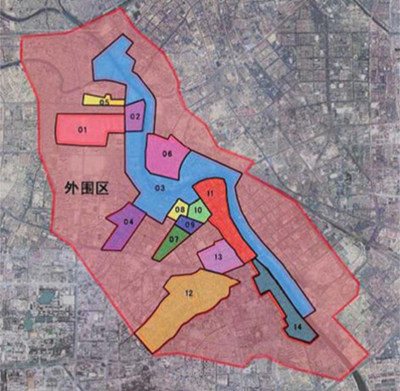
Fig.1 14 protective areas of historical and cultural heritages.01.Seat of the Old City area02. Ancient Cultural Street area03. Haihe River area04. Anshan Avenue area05. Gu Yi Street area06. One-Palace Garden area07. Chifeng Avenue area08. Quanyechang Mall area09. Central Garden area10. Chengde Avenue area11. North Jiefang Road area12. The Fifth |
The Protective Regulations came into force on the first of September 2005. According to it, and after the authentication of the Specialist Consultative Committee of the Tianjin City Historic Architecture Protective Committee, the city government confirmed 746 historic constructions in five groups, totaling an area of 1,140,000 sq. m. during the period from 2005 to 2009. Of them, 60 buildings are classified as special important ones to be protected, 204 as key ones and 482 as general ones, all distributed across the 15 districts and counties of the city. Of the 746 buildings, 12 have been designated as the national key units to be protected, and 81 as the city's relic units to be protected and 79 as the relic units protected by the districts or counties.
In March 2006, the State Council approved the city's overall program including the famous historic and cultural city program, wherein 14 historic and cultural landscape protective areas were confirmed (Fig. 1), of which six areas are confirmed as historic and stylistic construction quarters.
The existing historic constructions include either those quadrangle compounds, guildhalls and temples, all of traditional Chinese styles, or Western styled classic and modern architecture. Together with those historical and cultural landscape areas, they have formed a unique architectural culture and city spectacle, thus making up the important part of Tianjin City, a national famous historic and cultural city in China.
 |
|
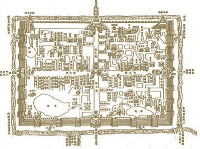
Fig.2 The seat of the Old City of Tianjin |
2. Historical Background
The historic and stylistic constructions and such quarters witnessed the development of the city itself and the society. The earliest relics of human existence left over by our forefathers in the Tianjin area date back to 10,000 years ago during the Old Stone Age. During the Sui and Tang, or Song and Liao dynasties, larger groups of constructions appeared in this area. So far, the earliest construction in ancient times we found is the Dule Temple, which was reconstructed in the second year of the Tonghe period of the regime of Emperor Shengzong of Liao Dynasty or A.D., 984. In the second year of the Yongle period of the regime of the Ming Emperor Chengzu, (December 23, 1404), a guard was established, called "Tianjin", a name given by Emperor Chengzu (Zhu Di) himself to mark his expedition to the south to seize the state power. Tianjin means the ferry, specially for the emperor. Since then, the history of the city has begun.
Through the Ming and Qing dynasties, Tianjin took the seat of the old town as its base for
 |
|
Fig.3 The Drum-Tower of Ming Dynasty |
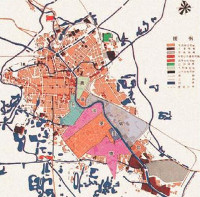
After the Second Opium War in 1860, Tianjin was forced to lend its port to foreign powers. In 1900, the Eight-Power Allied Forces encroached on Tianjin. The old city was destroyed by the forces on November 26 of the same year. Four sections of the city walls were demolished and turned to be four avenues. Since 1860, nine imperialist countries including Britain, France, the United States, Germany, Japan, Russia, Italy, Belgium, and Austria-Hungary acquired the right to supposedly lease a tract of land as concessions in the city one after another, (Fig. 5). The concessions were formed through three stages.
 |
|
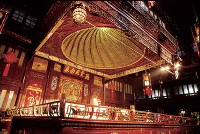
Fig.4 The Guangdong Provincial Guildhall |
First stage: The city ceded tracts of land for concessions to Britain, France and the United States. In 1860, the British-French Allied Forces waged the Second Opium War Against China and forced the Qing Government to sign the Sino-British Treaty and the Sino-French Treaty (Convention of Beijing) respectively. Tianjin was lent to them to be a port for trade. On December 7 that year, a part of the area on the west bank of the Haihe River including the Purple Bamboo Grove and Xia Yuan Garden was ceded to Britain as its concession in the city. In June, the following year, France and the United States had their concessions on the south and north sides of the area of the British concessions respectively.
Second stage: Germany and Japan seized their concessions and the British concession was expanded.
First, Germany acquired its concessions on the west bank of the Haihe River in 1895. Then in 1896, Japan had its concession on the west of the French concession. In 1897, Britain arbitrarily expanded the area of its former concession to the north side of the Nanjing Road.
 |
|
Fig.5 A sketch map of the former concessions |
Third stage: The formation of the concessions of the nine countries. In 1900, when the Eight-Power Allied Forces encroached on China, Russia got its concession on the east bank of the Haihe River in 1900, on the south side of which, Belgium seized the area as its concession in 1902. In the same year, Italy had its concession on the north side of the Russia's concession. On the north side of the Italy's concession, a part of the area was seized by Austria-Hungary as its concession. At the same time, Britain, France, Japan and Germany seized the opportunity to expand the area of their concessions. Eventually, all the concessions were concentrated on the both sides of the Haihe River, covering 23,350.5 mu of land, (about 1,566.7 hectares). At the time, the seat of the old city only occupied 2,940 mu of land, (about 196 hectares), one-eighths of the total area of the concessions.
British concessions had been maintained for 85 years—the longest period of all. The Austria-Hungary's concession lasted only 17 years—the shortest. This phenomenon in the history of world's cities has never seen before. Accordingly, Tianjin has suffered the galling shame and humiliation in the modern history of China. Meanwhile, the historic and stylistic constructions together with their multi-culture derived from therein, have become important historic context and valuable cultural resources that cannot be neglected in the city construction. The mushrooming of constructions in the area of concessions brought Western architectural culture and technologies into Tianjin as torrents. Architecture
 |
|
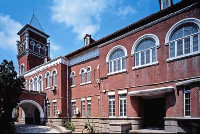
Fig.6 A separated mansion-Zhangyuan Garden |
In the history of Chinese cities, a city that has a long history of 600 years is still regarded as a city not too old. As a national famous historic city, Tianjin, though neither having the prominent position in history of such antique capitals as Beijing, Xi'an and Nanjing, nor the brilliant culture developed by the cities of Yangzhou, Suzhou, and Kaifeng, boasts its own value in terms of cultural interchanges between itself and the Western countries over the past hundred years. After the Opium War, some of the vestiges of almost all the historical significant events in China can be found in the city. So, in the Chinese historical circles, a prevalent saying goes: "Xi'an is a witness of the past five thousand years, and Beijing, a witness of the past 1,000 years, while Tianjin, a witness of the modern China."
3. Types of Constructions
 |
|
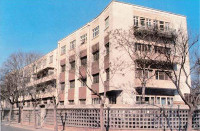
Fig.7 An apartment building — the Minyuan Building A separated mansion-Zhangyuan Garden |
The numerous historic constructions in Tianjin have lasted for more than 1,000 years, including dwelling houses, public constructions and warehouse. For convenient management and study, they can be classified into three categories.
1) Constructions Built in Chronological Order
After the Second Opium War in 1860, Tianjin was forced to lend its port to foreign countries and gradually to cede its tracts of land to nine imperialist countries as concessions, and the construction in the city developed itself from the traditional Chinese style to a combination of the Chinese and Western styles, marking a great change of times and the ideas with a distinctive symbol. Therefore, taking the year 1860 as the watershed, we can classify the historic constructions as the ancient ones (before 1860) and the modern ones (1860-1950).
The ancient constructions mainly include traditional Chinese-style architecture. So far, only about 50 such constructions have been left over, most of which are distributed in Jixian County, and the seat of the old city, such as the Dule Temple of the Liao Dynasty, (built in 984), the Tian-hou-gong Taoist Temple of the Yuan Dynasty (built in 1326) and the Yu-huang-ge Taoist Temple of Ming Dynasty (built in 1427).
 |
|
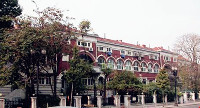
Fig.8 A suite of flats with separated entrance in a block — Village of Comfort |
The modern constructions are treasures of the city with the largest quantity and the most distinctive characteristics, mainly distributed on the both sides of the Haihe River in the downtown of the city.
2) Constructions Classified in 10 Categories By Functions
Dwelling houses—they are the most in quantity, with most distinctive characteristics. Of these houses, some can be further classified as separated courtyard or compound mansions (Fig.6), flat or apartment (Fig.7) and apartment in a block (Fig.8). Other types include school constructions, banking constructions, business and trading headquarters, office buildings, factories and warehouses, churches, entertainment and sports facilities, hospitals, communication facilities.
3) Constructions Classified Into Five Categories By Exterior Features
Traditional Chinese bureaucratic constructions: They were built strictly in accordance with the traditional type and system of the officialdom, mainly including temples, government offices, such as the Tian-hou-gong Taoist Temple, Yu-huang-ge Taoist Temple and Compound of Great Mercy.
 |
|
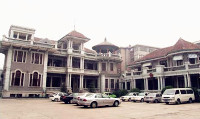
Fig.9 The former residence of Bao Guiqing |
European classic renaissance styled constructions: Most such constructions modeled after the constructions of ancient Greece and Rome and those built during the period of Renaissance, such as the office building of Kailuan Mining Administration.
Eclectic styled constructions: These are combinations of buildings modeling on typical European classic styles and the eclectic patterns together with both the Chinese and Western styles. Most constructions in the city can be grouped into this category, such as the former residences of Bao Guiqing (Fig. 9) and Sun Dianying.
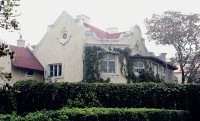
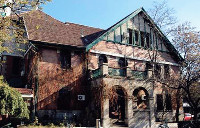
Dwelling houses of common people: They include traditional Chinese styled common houses and the local courtyard-styled compounds such as the Shi's Family compound, and Xu's Family compound. Many other living houses modeled after the typical European-styled houses such as the Spanish-styled (Fig.10), British-styled (Fig.11), German-styled and Italian-styles houses.
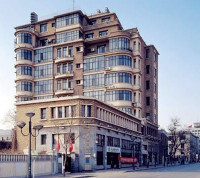
Modern houses: These constructions were built with new materials and in new structure, such as the Lihua Building (Fig.12) and the Bohai Building.
 |
|
Fig.10 A villa in Spanish style — the Davinci villa |
4. Basic Characteristics
1)Constructions being built in a comparatively concentrated period of time. About 60 percent of all the historic constructions were built during the period from 1900 to 1937, in less than a period of 40 years.
2)Constructions of each type being built in a concentrated area, making up a quarter of buildings. Traditional Chinese style constructions were concentrated on the seat of the old city and in the Ancient Culture Street. Banking buildings were mainly densely built in the North Jiefang Road, known as "Financial Avenue". Business and trading buildings were concentrated in the Heping Road and the Gu Yi (Secondhand Clothes Shopping) Street and the Ancient Culture Street. Common dwelling houses were on the seat of the old city, the "One Palace" Garden of the Hebei?District, Dayingmen of the Hexi District, the Fifth Avenue of the Heping District and near the Central Garden. Warehouses were mostly built along the banks of the Haihe River.
 |
|
Fig.11 The Xu's Family residence in British style |
3)The modern designs and techniques of historic constructions followed the patterns of constructions in Western countries, such as the followings.
—Advanced ideas of design. During the 1920s, when the new idea of building a "gardening city" was prevalent in Britain, constructions being built in the new district of the British concession (now the Fifth Avenue district) at that time were mostly following the practice of this idea. The scope of the residential quarter was moderate, and the quarter was equipped with such facilities as schools, churches and playgrounds, providing a pleasant and comfortable living environment. New model of apartments and flats in a block was also introduced from their origin to Tianjin.
—Complete public support facilities and interior room equipment: All the concessions paid attention to the leveling of ground and construction of roads and perfection of municipal engineering and facilities, such as road lamps, treeplanting, and providing utilities, and flush toilets, so as to improve the living environment and hygienic conditions.
 |
|
Fig.12 Leopold Building |
—Advanced idea of development of real estate and properties industry: All the concessions introduced the Western idea and patterns in the development of real estate and properties, for instance, the British and French concessions divided a tract of land into squares, encircled on four sides by roads, to lend them out at different times.
—Modern way of life and the different city activities: The Western way of life in modern times was introduced into the concessions when they were being built. For instance, the family way of life centered on a living room, a dining room or a ballroom; the public way of life took parks, churches, and the town council as its center of activities; and the people's walking on foot was replaced usually by such modern traffic means of trams or automobiles. This modern way of life was quite different from the conservative way of life long time maintained by Chinese people and it also brought in diversified activities in the city.
4) A diversity of construction styles and arts: Influenced by both the traditional Chinese and Western architectural trends of thought, a co-existence situation had been created of the traditional Chinese style, classic renaissance style, eclectic style and modern style.
 |
|
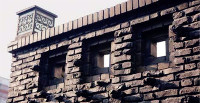
Fig.13 Detail of bricks with coarse and lump surface |
5) Outstanding features of construction materials and techniques: The unique construction materials and techniques
must owe to the city's unique geographical environment and its water and soil. These materials and techniques were brought into full play in the constructions. For instance, the chamottoe bricks (or known as bricks with coarse gravels on the surface) (Fig.13) were widely used in the common houses in the Fifth Avenue, becoming a special mark of Tianjin's constructions with their solid quality and grave colors.
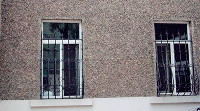
Other materials like fair-faced bricks, coarse-surfaced slabs, imitation water dressing stones, stucco plastered bricks walls and pea pebbles wall (Fig.14) were also used. The constructions
 |
| Fig.14 Pea pebble wall |
For example, the chicken coop-shaped dougong, a traditional Chinese construction technique, was used in the theater stage of Guangdong Guildhall and the self-built underground tunnel conditioner in the Shi's Family Compound were all newly created.
6) Affluent humanity resources: Because Tianjin is close to Beijing, and was opened earlier to the outside world, a number of celebrities of society swarmed into the city, where they had opportunities to develop their capabilities and talents. The historical drama staged in modern China has left over precious legacy to the city. According to textual research, about 200 dignified
 |
| Fig.15 Nankai High School |
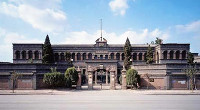
The revolutionary pioneers like Dr. Sun Yat-sen, Zhou Enlai, (Fig. 15), Deng Ying-chao and Zhang Tai-lei had led the revolutionary activities in the city; Patriotic generals like Zhang Xueliang, Ji Hongchang, Zhang Zizhong, had regarded Tianjin as the important stage of their lives; scientists and scholars like Liang Qichao, Li Shutong, Yan Fu, Zhang Boling, and Hou Debang, had devoted themselves to the introduction of modern schools, publicity of a new culture, and the practice of salvation of the country by science and technology; Pu Yi, the last emperor of the Qing Dynasty, and Dai Zhen, the imperial prince Qing, had had their daydreams of restoration of a dethroned monarch; The five presidents of the Northern Warlord Government (Bei Yang Government) Yuan Shikai, Xu Shichang, Li yuanhong, Feng Guozhang, and Cao Kun and its premiers and ministers of different tenure of office had staged a political farce in the city.
 |
| Fig.16 The Beiyang University |
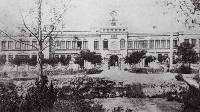
Along with all these historical figures, a number of events of pioneering significance had occurred in these constructions in the modern history of China. According to statistics made by a scholar, about 130 items of inventions originated in the city, including the first postage stamp, the first newspaper, and the first university (Fig. 16). They have constituted a part of the city's humanity and tourism resources.
These tangible constructions and such quarters, together with their intangible humanity resources, as an historical heritage, are the city's valuable wealth, and the cultural support to its further development. Protection of these constructions embodies the carrying out the policy of developing and building up a flourishing city in a scientific way and it is incumbent on us to do a much better work in the protection and use of the constructions in the future.


