

 Comments
  Print
Print  Mail
Mail  Large Medium Small
 |
|
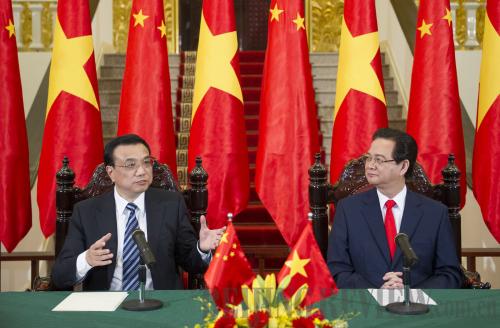
BROTHERHOOD: Chinese Premier Li Keqiang (left) holds a joint press conference with his Vietnamese counterpart, Nguyen Tan Dung, on October 13 in Hanoi during the last leg of his Southeast Asia visit [HUANG JINGWEN] |
The autumn of 2013 is a busy season for China's diplomacy. The successive visits of President Xi Jinping and Premier Li Keqiang to Central Asian countries and Southeast Asian nations as well as their presence at the Shanghai Cooperation Organization (SCO), APEC and East Asian summits have demonstrated the top priority that the new generation of Chinese leadership has given to Asia.
It is believed that the new Chinese Government has slightly readjusted its foreign policy. While continuing to attach great importance to relations with major powers, China will further balance its diplomatic strategy by enhancing relations with neighboring countries.
SCO countries—the countries of Central Asia and Russia—and ASEAN members, like the two wings of a dragon, are twin priorities for China's neighboring diplomacy. During their visits, President Xi proposed that China and Central Asian countries join hands to build a Silk Road economic belt to boost cooperation, while Premier Li proposed a new Maritime Silk Road of the 21st century with ASEAN countries.
During their forays overseas, both leaders have repeatedly stressed China's principles of non-interference in the internal affairs of countries and attempted to reduce misgivings of neighboring countries toward China's rapid development, as well as desalinate geopolitical competitive factors between China and other major powers.
An unavoidable problem for China when conducting its neighboring diplomacy is how to deal with interests in the Asia-Pacific region regarding the United States, the world's sole super power, and how to turn competition into cooperation. Some Chinese and overseas scholars say that the Chinese Government is responding positively to the "Going West" strategy put forward in academia. That strategy states that if China puts excessive diplomatic resources into East Asia, China is bound to engage in conflict with the United States. Therefore, China should pay more attention to its western neighbors in Central Asia for a more balanced diplomacy.
Although Beijing has repeatedly reiterated that its active neighboring diplomacy is not intended to squeeze the United States out of Asia, and Washington has repeatedly stressed that it welcomes China to play a bigger role in the world and has no intention to contain its in Asia, international public opinion prefers a "zero-sum" game between the two, a kind of geostrategic competition.
The competition between China and the United States in Asia has been exaggerated. Both need the peace, stability and prosperity in Asia. Top leaders of the two countries have reached consensus on building a new type of relationship between major powers, and the Asia-Pacific region was made the prime arena for the two to practice this. Neither China nor the United States is willing to fall victim to a rat race between an emerging power and an established power. And both have recognized that a peaceful coexistence in Asia is a prerequisite for the two sides to achieve diplomatic goals.
The Obama administration has been ambitious in its "returning to Asia" strategy during his first term, trying to safeguard the United States while rebalancing the rising influence of China in the region. However, Obama has to accept the reality that China will play a more direct and critical role in Asian issues than the United States in the days ahead.
Forging ahead
As both a land and sea power, China has incomparable advantages in Asia due to its unique geopolitical and cultural influence as well as its growing direct investment in the region. The only card that Washington could play to counter Beijing would be its traditional military presence, using it to interfere with the territorial and maritime disputes between China and some neighboring countries to slow the pace of regional countries' drawing nearer to China.
As the rise of China in Asia has become a reality, China has gradually become the focus of the US Asia-Pacific strategy. Washington's push to contain Beijing is becoming an impossible mission, and it increasingly needs the cooperation of Beijing when dealing with various Asian issues. The Obama administration realized the radical "pivot to Asia" strategy goes against its fundamental requirement of a generally stable Sino-US relationship. The rebalancing strategy cannot pay off.
While two of China's top leaders visited Southeast Asia consecutively, Obama had to cancel his trip there to deal with the budget and debt crisis at home, missing out on a series of important summits. Additionally, the Trans-Pacific Strategic Economic Partnership (TPP) summit, which was to be chaired by Obama himself, had to be cancelled.
First initiated by Brunei, Chile, New Zealand, and Singapore, TPP was later dominated by the United States after it joined the organization in 2008. It quickly became a tool for Washington to promote its values and practice new free trade rules in the Asia-Pacific region. TPP is widely known as a major project of the United States to contend with China's strong economic diplomacy in Asia. During the 2012 US election campaign, Obama said that TPP does not include China, and that it could pressure China to follow basic international standards.
US public opinion criticized Obama's cancellation of the trip to Asia sent a signal that the United States is unable even to fend for itself, let alone Asia. They claimed that Obama's absence has helped China get an upper hand in contending for dominance of regional cooperation in East Asia.
Obama admitted that cancelling the trip was not in line with the interests of the United States. He said in a recent media press meeting, "I should have been there. In the short term, I would characterize it as missed opportunity."
Unsustainable pivot
Some Asian observers noted that, due to the uncertainty of the US domestic political and economic situation, the US pivot to Asia strategy is not sustainable. Even if Obama hopes to focus on Asia, he would be constrained by the complicated domestic situation. They suggested that it is necessary for Asian countries to readjust their strategy gradually.
But for Chinese diplomats and analysts, the real problem of Washington's Asia strategy is not the lack of policy coherence caused by political instability, but reversing the regional agenda by force and bucking the trend to strengthen military alliances as well as imposing its values, institutional models and trade standards in the region.
During the consultation on Asian affairs between China and the United States, Beijing has frequently stated that Washington needs to respect the universal aspiration of Asian countries for sustainable economic development and focus its strategy on helping the development of regional countries and promoting open collaboration while not purposely highlighting security issues and sowing discord.
Asia is undergoing historic changes. While increasing input in Asia in their respective ways, Beijing and Washington should give full consideration to one another, steering their competitive factors to the track of cooperation while refusing to expand one's own influence in Asia by damaging or constraining the other. This also might be the message Chinese leaders want to send to Obama during the APEC and East Aisa meetings held in Southeast Asia.


Copyright 1995 - . All rights reserved. The content (including but not limited to text, photo, multimedia information, etc) published in this site belongs to China Daily Information Co (CDIC). Without written authorization from CDIC, such content shall not be republished or used in any form. Note: Browsers with 1024*768 or higher resolution are suggested for this site.
License for publishing multimedia online 0108263 Registration Number: 20100000002731