
 |
 |

CHRISTOPHER CRUISE: This is SCIENCE IN THE NEWS in VOA Special English. I'm Christopher Cruise.
JUNE SIMMS: And I'm June Simms. Today, we tell about the creation of what are being called the world's first genetically engineered monkeys. We also hear from American physicists. They are working to find the subatomic particle known as the Higgs boson. And we tell how rising levels of carbon dioxide are changing the chemistry of the oceans.
(MUSIC)
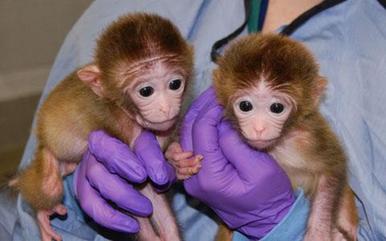
CHRISTOPHER CRUISE: Scientists have created monkeys from cells taken from differentembryos. Experts at the Oregon National Primate Research Center believe the animals are the world's first genetically engineered monkeys. The center is part of the Oregon Health and Science University.
The scientists combined up to six rhesus monkey embryos to produce three animals. The embryos were placed into female rhesus monkeys.
A single monkey and twins were born last year. Their tissues and organs contain cells that come from each of the embryos used in the "mix." The animals are now about nine months old. An official at Oregon National Primate Research Center has said they are in good health and growing normally.
JUNE SIMMS: Shoukhrat Mitalipov was the lead writer of a report about the event. The report appeared last month in the journal Cell.
The new monkeys are called chimeric monkeys or chimeras. In ancient Greece, a chimera was said to be a frightening-looking creature. Its body contained parts from more than one animal. But the chimera monkeys born last year look like other monkeys.
Professor Mitalipov says the monkey-producing experiment tested the possibilities of creating stem cells from embryos in laboratories. Stem cells have already been used to treat some conditions in human beings.
CHRISTOPHER CRUISE: Researchers produced the first chimeric animals in the 1960s. At that time, work with mouse embryos showed the embryos could be joined to form one normal-sized mouse. Using these mice, scientists have been able to study conditions like heart disease, diabetes and Parkinson's disease. Since then, researchers have made chimeric rats, rabbits, sheep and cattle.
Efforts to make more complex mammals had failed until recent times. The Mitalipov team succeeded with the rhesus monkey embryos because of embryonic cells called totipotent cells. They can divide and produce all the different cells in the body of the organism. They also can produce the cells in the placenta, the tissue that connects the embryo to the mother.
JUNE SIMMS: Totipotent cells were responsible for creation of the whole animal, not just other living tissues. In the process, stem cells were injected into an embryo when it was still in early development. The embryo grew into a chimeric animal. This showed that the stem cells became part of the animal's tissues and organs.
Shoukhrat Mitalipov said stem cells hold great promise for replacing damaged nerve cells. He noted the possibilities for helping patients who have lost ability to move and breathe from spinal cord injuries.
Creating chimera monkeys required a lot of work. But South American monkeys called marmosets are naturally chimeric. Marmoset mothers almost always produce twins – two babies developed from separate eggs.
(MUSIC)
CHRISTOPHER CRUISE: Late last year, scientists reported they are one step closer to finding the sub-atomic particle called Higgs boson. The announcement came from scientists at the CERN laboratory in Switzerland. They announced results of experiments with the Large Hadron Collider. It is the world's most powerful particle accelerator.
High-energy physicists hope the collider will give them an idea of what happened at the beginning of the universe. This is how the machine works. Using a lot of electricity, scientists spin atoms around a huge underground tunnel at close to the speed of light. Then, the atoms hit each other with great force. This causes the atoms to break into even smaller pieces. These pieces are what physicists want to study.
JUNE SIMMS: CERN's Large Hadron Collider is just a few years old. But information gathered from the experiments has excited scientists in the United States.
University of Florida professor Jacobo Konigsberg has been active in CERN's hunt for Higgs boson, also called the "God particle." He says finding it would uncover one of the biggest mysteries of physics.
Professor Konigsberg has been studying the results of experiments at the Fermi National Laboratory near Chicago, Illinois. He says the recent announcement identified an area where the Higgs boson is likely to exist, if it exists at all.
CHRISTOPHER CRUISE: Another scientist at Fermilab, Robert Roser, welcomed the announcement, but still had many questions. Mr Roser visited the CERN laboratories in the days leading up to the announcement.
Still, the development demonstrates the power of the Large Hadron Collider. It is more famous than Fermilab's Tevatron Accelerator, which suspended operations last September.
For 30 years, American scientists used the Tevatron to search for the sub-atomic particle. However, there is a still a chance the device could produce the results scientists are looking for. Robert Roser and his team are still studying information from earlier tests. They expect to release their findings in March.
(MUSIC)
JUNE SIMMS: Many scientists say carbon emissions are a major reason for rising temperatures in Earth's atmosphere. Carbon emissions can come from automobiles, buildings and factories. Most of these gases go into the atmosphere. But about 30 percent end up in the oceans. This makes seawater more acidic.
New research suggests that too much carbon dioxide in the oceans is creating a serious threat to sea life. Ocean acidity levels differ naturally from place to place and from one year to the next. This makes it difficult for scientists to show how much human activities are responsible for carbon emissions.
In a recent study, scientists looked back at 21,000 years of climate history for information. Their findings were reported in the journal Nature Climate Change.
CHRISTOPHER CRUISE: Tobias Friedrich is a post-doctoral fellow at the University of Hawaii International Pacific Research Center.
TOBIAS FRIEDRICH: "The idea was that atmospheric carbon dioxide concentration increased from the Last Glacial Maximum to preindustrial times. This, of course, also had an effect on acidity levels in the ocean, and just to compare this naturally occurring increase in atmospheric carbon dioxide concentrations with man-made emissions over the last, let's say 200 years."
The scientists used computer models with information from ice and the ocean floor to recreate ocean conditions. Earth's temperatures started to rise about 17,000 years ago, at the end of the last ice age. When that happened, carbon dioxide levels in the atmosphere began to rise. Over the next 6,000 years, it grew from 190 parts per million to 280 parts per million. Sea creatures and their environment had time to react to the changing conditions.
JUNE SIMMS: Axel Timmerman also works at the University of Hawaii International Pacific Research Center. He says the record over the past 200 years tells a different story.
AXEL TIMMERMAN: "Starting with the pre-industrial revolution, of course, the anthropogenic [human] emissions increased so much that the oceans suddenly started to take up huge amounts of carbon."
Carbon dioxide levels in the atmosphere now stand at 392 parts per million. Mr Timmerman says that has resulted in dangerously high levels of ocean acidification in some areas. And he says this is happening at a much faster rate.
AXEL TIMMERMAN: "Compared to the last glacial period, the rate of change is about two orders of magnitude faster than what occurred during the last major reorganization of the carbon cycle, about 20 to 15,000 years ago."
CHRISTOPHER CRUISE: Ocean acidification could have been discovered much earlier. But scientists only began to measure it about 30 years ago. Combined with pollution and warming temperatures, it is a serious threat to ocean life. Acidification reduces the availability of carbonate. That is the mineral many shellfish and corals use to form their shells and skeletons. Axel Timmerman says the study gives decision-makers another tool for measuring the threat and finding ways to fight it.
(MUSIC)
JUNE SIMMS: This SCIENCE IN THE NEWS was written by Brianna Blake and Jerilyn Watson. I'm June Simms.
CHRISTOPHER CRUISE: And I'm Christopher Cruise. Listen again next week for more news about science, in Special English, on the Voice of America.
subatomic: 亞原子的
embryos: 胚胎;晶胚
rhesus: 恒河猴
chimera: 嵌合體
placenta: 胎盤;胎座
spinal: 脊髓的;脊柱的
Will physicists have to rewrite the special theory of relativity?
Fermilab scientists testing Faster-Than-Light Neutrino Claims
(來源:VOA 編輯:Rosy)

添加Chinadaily_Mobile
你想看的我們這兒都有!

中國首份雙語手機報
學英語看資訊一個都不能少!
關注和訂閱



電話:8610-84883645
傳真:8610-84883500
Email: languagetips@chinadaily.com.cn