Policy injects life to private hospitals
Updated: 2012-02-27 07:40
By Todd Balazovic (China Daily)
|
|||||||||


Foreign companies now allowed to invest in China's healthcare sector
BEIJING - The Ministry of Commerce is breathing new life into the country's private medical sector as doors are opened for foreign companies to invest more freely in the once heavily regulated field.
In response to increasing pressures on the overwhelmed public healthcare system and a desire by the emerging middle class to seek private care, curbs on the funding foreigners are allowed to inject into medical institutions have been lifted.
|
 |
|
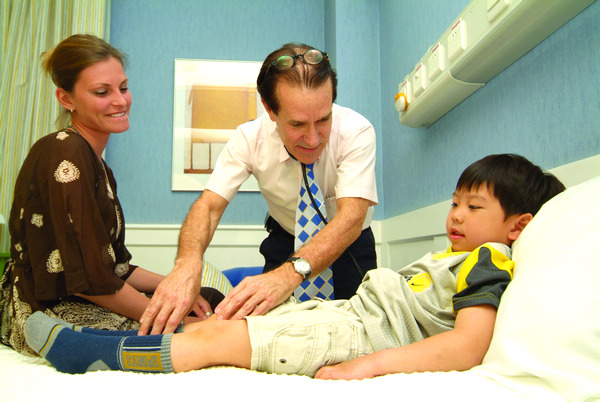
A boy has a health exam at Beijing United Family Healthcare, the first private hospital in China, in this file photo. The nation's emerging middle class is seeking better care in private medical institutions. [Provided to China Daily] |
In the past, overseas companies had to form a joint venture with a local Chinese company and the amount of foreign funding was limited to 70 percent.
Non-Chinese companies can now fully fund private healthcare services.
In the Foreign Direct Investment Industry Guidelines published last year, medical institutes with several other industries, including advanced manufacturing and renewable energy, were moved from the category of restricted to permitted.
|
|

"With sound guidance and management, the private hospital, which is indispensable to China's medical sector, will play a more important role in satisfying people's medical needs," Zhang Mao, vice-minister of health, told China Daily when the reform was launched.
In the 12th Five-Year Plan (2011-15), healthcare is listed as one of the top 10 priorities.
Over the past six years spending on healthcare in China has grown considerably, reaching a compound annual growth rate of almost 19 percent, according to the Beijing office of the business consulting firm Frost and Sullivan.
Between 2006 and 2009, total annual healthcare spending more than doubled from $123.4 billion to $251.8 billion. By 2015, it is estimated that the figure will exceed $705 billion.
In the past, most foreign investment was in medical equipment and drugs, and easing restrictions on foreign investment shows that private healthcare as an option for those who can afford it is now another area that is given serious consideration.
For years China's public healthcare sector has experienced severe growing pains. Often the sick in less urbanized areas have to travel to larger towns or cities to get medical attention in public institutions because of a dearth of specialized and quality medical resources in rural areas.
This has put a strain on city health facilities, and often hospitals in big cities are overrun with patients, some of whom have to wait for days just to see a doctor.
As a result, increasing numbers of the burgeoning middle class have been seeking healthcare outside the public health system, sending the country's demand for private healthcare institutions soaring.
For Roberta Lipson, CEO of Chindex International Inc, which was responsible for opening China's first private hospital, Beijing United Family Healthcare (UFH), in 1997, this is good news.
Lipson, who founded Chindex in 1981 with her partner Elyse Beth Silverberg as part of an effort to bring advanced medical technology to China, was one of the first to see potential in China's private health market more than 30 years ago.
Chindex is now one of the leading premium healthcare providers in the country, with income of about $114 million last year and a 23 percent compound annual growth rate over the past six years.
UFH was originally aimed at the medical needs of Beijing's expatriates - in the late 1990s.
"Now, more than ever, we are seeing Chinese people calling for extensive, quality healthcare," Lipson said.
The policy change on foreign investment shows not only the vast potential of the private health market, but also the government's recognition of the sector's role in the rapidly changing way Chinese people are choosing to live their lives.
"Chinese people, certain segments of the market, have made choices in all aspects of their lives, including where they live, what they wear, what they eat," Lipson said.
"The government has recognized the desire for people to also have choice in healthcare, but those kinds of special needs they recognize shouldn't be provided by the government and that it's the private sector's role."
And, with an increasing number of affluent Chinese seeking their healthcare in private institutions, there is plenty of room in the market for new blood.
About 30 joint-venture private medical providers now operate in the country, but most, like UFH, are confined to the big cities.
"I think we're far from the point where there's oversupply," Lipson said.
"Having more than one player in the market (means) private premium services (are) considered more often," she said. "It will make access more available to people who want it, and I think that's a fine thing."
The waiting rooms of many of Beijing's public hospitals are crowded, but at UFH in the Shunyi district of Beijing, which has a heavy concentration of Western residents, the sterile white hallways are all but deserted.
That may well have something to do with another distinguishing factor between premium private health services in China and the State-run public healthcare system: cost.
For consultation fees alone, private facilities like UHF or Parkway Health, another noted foreign operated medical facility in Beijing, it costs between 1,000 yuan ($160) and 1,200 yuan just to see a doctor, compared with the average price at a public hospital of 50-200 yuan, which is often reimbursed to the patient by the government.
The cost of an essential procedure such as giving birth in premium private hospitals can run as high as 50,000 yuan, nearly 10 times the amount charged in a State-owned public hospital.
And because places like UHF and Parkway are listed as private, the government's health programs and Chinese company insurance policies rarely reimburse costs, meaning that for most patients the cost is entirely out of pocket.
For patients this means shorter waiting times, ostensibly better doctors, modern technology and international standards, all of which an increasing number of Chinese patients are willing to cough up for.
In 2010, The ChinaCare Group, one of China's leading international healthcare consultancy firms, published a two-year survey that explored the views of more than 1,000 people classified as middle class from three big cities.
It found that more than a quarter of the patients were dissatisfied with the public health system. The three reasons most commonly cited were long waiting time, poor physical conditions and the poor attitudes of staff members.
The level of dissatisfaction has grown, said David Wood, president and senior partner of The ChinaCare Group.
Wood, who has more than 12 years' experience in China's healthcare sector and 30 years globally, once served as the country's only foreign head of a Chinese hospital while working as president and CEO of New Century Children's Hospital in Beijing. While there is a growing demand for private healthcare, the new measures barely scrape the surface of what needs to be done, he said.
"There have been a number of efforts over the last two years by the government to encourage foreign investment in healthcare."
He said that while interest from foreign backers has been readily available for years, opening a hospital in China poses a much bigger challenge than just having the money.
"The old rules weren't the problem. The barrier was, and continues to be, the local authorities and getting the local permits and permissions. The money is not the issue."
When UHF opened in 1997, about 180 different licenses and permissions were needed to operate. But because it was the first hospital of its kind local authorities were keener to see the project succeed, going as far as easing the now eliminated 70 percent foreign investment cap to allow 90 percent overseas backing.
In the 15 years since, things have become more difficult.
"Having greater access to foreign investment is meaningless if you don't have licenses, and getting a license is definitely problematic, in the big cities particularly," Wood said.
Several of The ChinaCare Group's clients, including prestigious medical companies such as American Cancer Centers and German Medical Supply Ltd, have had projects fully funded and ready to go only to be denied crucial licenses at the last minute.
In addition to obtaining a license, finding internationally qualified doctors is another issue many foreign health companies have when setting up an operation in China.
"There's lots of day-to-day nuts and bolts issues that are far more problematic than easing the restrictions on bringing in the money," Wood said.
For that reason, many companies prefer to do exactly what the new regulations allow them to do: form joint ventures with Chinese businesses. By throwing their chips in with Chinese companies foreign businesses can utilize their Chinese counterpart's knowledge of the Middle Kingdom's complex health market.
At least that is how Arvind Subramanian, president and CEO of Wolters Kluwer Health Clinical Solutions, sees it.
Subramanian recently visited Beijing to help jump start Wolters Kluwer Health's drug information and clinical decision support branch after the company entered into a joint venture with Medicom, one of China's leading drug information providers.
"My view, and it may not be everybody's view, is that we could not have done this on our own," he said.
Through Wolters Kluwer Health's cooperation with Medicom, the health information service and publishing company from the Netherlands has been working closely with China's Ministry of Health in an effort to help modernize doctor access to on-site information in hospitals.
Subramanian said the biggest challenge when figuring out how to set up his company's IT division was understanding the differences between operating in China and the US, where the company has more than 60 years' experience.
Through the joint venture, Subramanian said, the company has managed not only to better understand operating a business in China, but has also gained access to Medicom's large list of clients, while providing financial backing for Medicom and allowing it to expand its services.
"I think we would have stumbled quite a bit, we wouldn't have had the same positive reception we got and we certainly wouldn't have had the years of administrative health contracts that our friends in Medicom have built. I'm a big believer in this type of partnership."
While many companies have had success by joining forces with Chinese businesses already on the ground, most foreign operations moving to China prefer sole operations to avoid conflicting management styles with potential partners.
Related Stories
China to issue medical information card 2012-02-03 13:54
China to raise health insurance subsidies 2012-02-23 07:19
Consumers seek accident, health insurance 2012-02-20 19:30
China's maternal mortality drops 2012-02-24 13:02
Guangzhou to revive pre-marital check-ups 2012-02-23 21:06





Hot Topics
Wu Ying, iPad, Jeremy Lin, Valentine's Day, Real Name, Whitney Houston, Syria,Iranian issue, Sanyan tourism, Giving birth in Hong Kong, Cadmium spill, housing policy
Editor's Picks

|
|

|

|

|

|